Politics & Diplomacy
Dahlan says Kushner confirmed Israel will halt Gaza attacks from Sunday
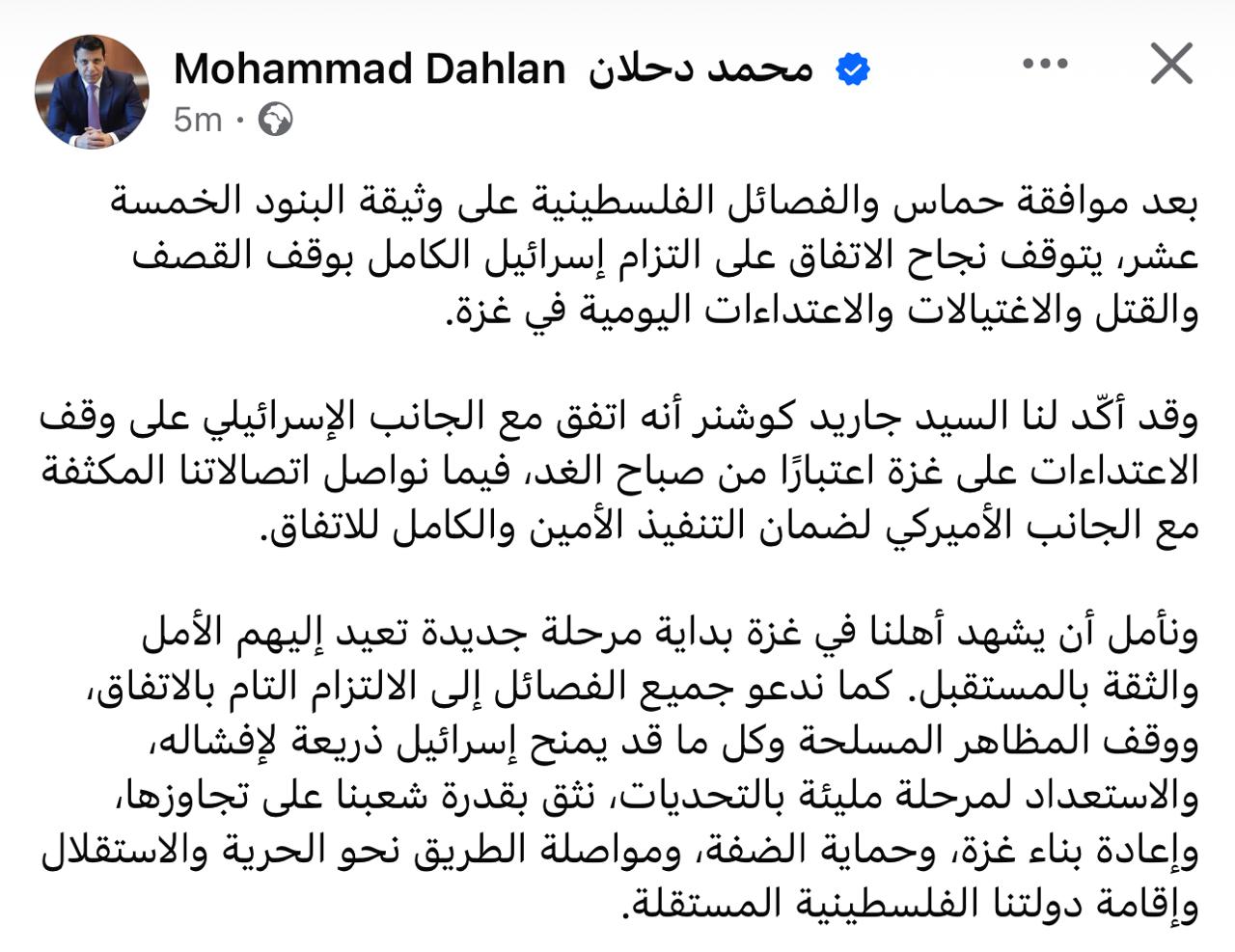
Photo: Mohammad Dahlan's verified Facebook page (screenshot)
Original Reporting
Mohammad Dahlan, the exiled Fatah leader whose back channel to Washington helped unlock the latest Gaza breakthrough, said on Saturday that US envoy Jared Kushner has confirmed to him that Israel agreed to halt its attacks on Gaza from Sunday morning, now that Hamas and the Palestinian factions have approved the fifteen-clause implementation document.
"After Hamas and the Palestinian factions approved the fifteen-clause document, the success of the agreement depends on Israel's full commitment to halting the bombing, the killing, the assassinations and the daily attacks in Gaza," Dahlan wrote on his verified Facebook page minutes after the factions' approval was announced. "Mr. Jared Kushner confirmed to us that he has agreed with the Israeli side to halt the attacks on Gaza as of tomorrow morning, while we continue our intensive contacts with the American side to guarantee full and secure implementation of the agreement."
The document Dahlan referenced is the fifteen-clause framework drafted with President Trump's Board of Peace for the next phases of the Gaza ceasefire — the plan carried by the Board's Gaza envoy Nickolay Mladenov, built on the "one authority, one law, one weapon" governing principle and anchored in UN Security Council Resolution 2803. Regional reporting in recent days recorded the factions negotiating final amendments to clauses five and eight before consenting to the full text. The Times of Israel reported this week that direct contacts between Kushner and Dahlan were credited with the breakthrough in the disarmament talks — the same channel through which, by his account on Saturday, the promise of a halt was relayed.
Dahlan coupled the announcement with a demand aimed at his own side of the ledger. He called on all factions to commit fully to the agreement, to end armed displays, and to avoid "anything that could hand Israel a pretext to make it fail" — and to prepare, he wrote, "for a phase full of challenges." He closed with the hope that "our people in Gaza witness the beginning of a new phase that restores their hope and confidence in the future," and with confidence in Palestinians' capacity "to overcome, to rebuild Gaza, to protect the West Bank, and to continue the road toward freedom, independence and the establishment of our independent Palestinian state."
There was no immediate public statement from Kushner, the White House or the Israeli government confirming the timing Dahlan described; the promise of a Sunday-morning halt rests, for now, on his account of the exchange. What is already on the record is the sequence that produced it: the factions' approval of the fifteen clauses closes the Palestinian side of the framework, and shifts the weight of the agreement's success — as Dahlan's own first sentence framed it — onto Israeli compliance, under American guarantee.
For Gaza's residents, the difference between the two readings is not academic. Every previous phase of the ceasefire has been measured on the ground in the frequency of strikes, the reach of aid convoys and the daily count of casualties. If the halt Dahlan described takes hold on Sunday morning, it will be the first test of the fifteen-clause document's central bargain: a single Palestinian authority in Gaza, in exchange for the guns finally falling silent.