Economy & Aid
East Asian partners list 47 Palestine development projects
Graphic: Times of Palestine
Original Reporting
East Asian governments have put 47 Palestine development projects into a single public inventory, turning a regional pledge of solidarity into a list that readers can begin to track.
The project list published by Japan’s Foreign Ministry spans health, water, education, agriculture, public administration, technology, business and youth development. Nine partner countries registered bilateral and triangular initiatives carried out since October 2023, as well as work planned for the years ahead.
The list is useful precisely because the 47 entries are not all at the same stage. Some record completed courses or scholarships already in progress. Others describe multi-year programmes running as late as 2032. Several future courses are marked “TBD,” meaning that their dates, participants or implementation still need to be confirmed.
That distinction does not diminish the cooperation. It shows where delivery is visible and where the next practical step lies. The inventory gives East Asian partners and Palestinian institutions a foundation on which to publish budgets, milestones, beneficiary numbers and updated results.
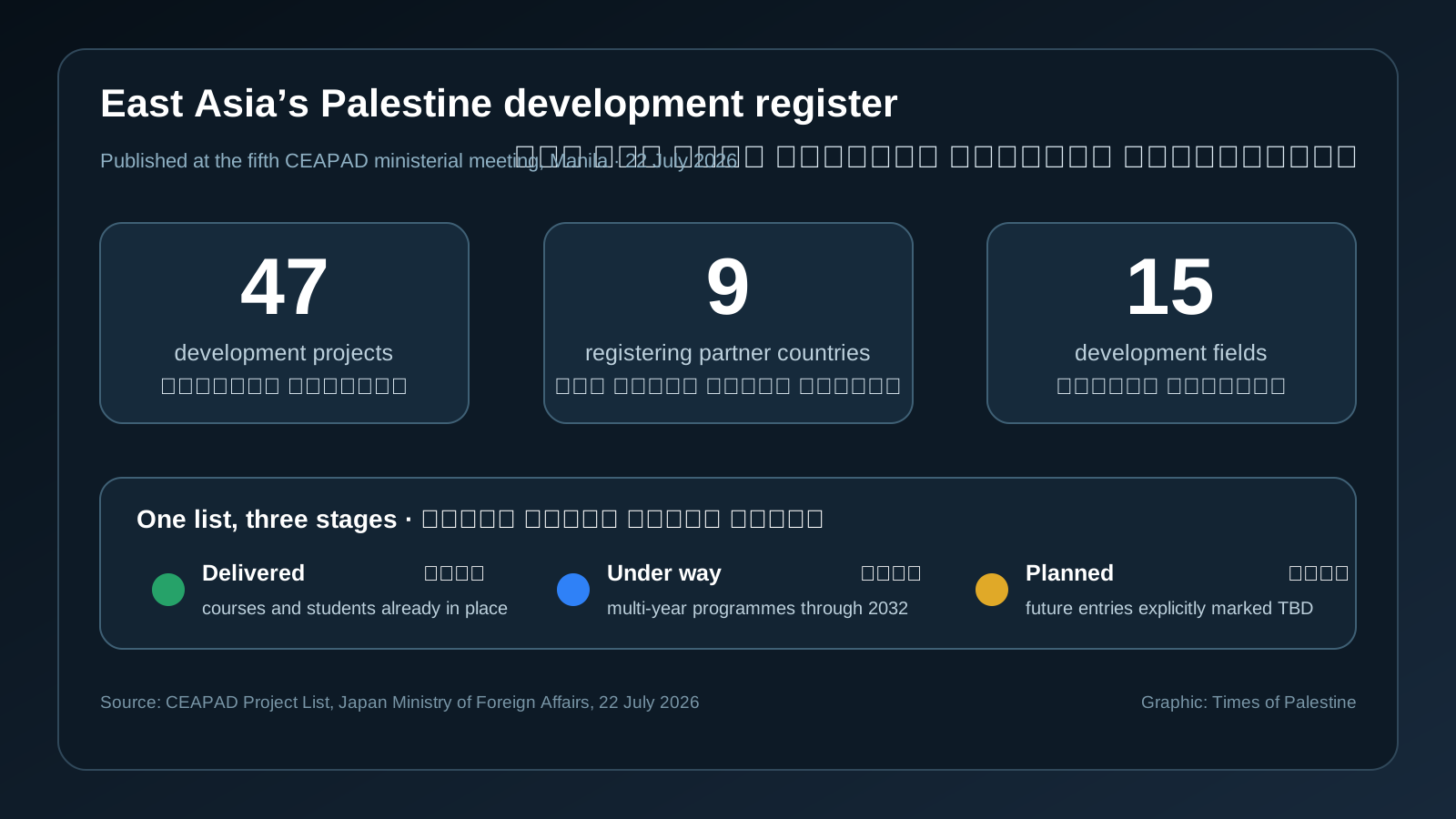
The CEAPAD inventory covers 47 projects registered by nine partner countries across 15 fields. It includes delivered work, active multi-year programmes and future entries marked TBD. Graphic: Times of Palestine.
From a regional meeting to a public project list#
Japan, the Philippines and Palestine co-chaired the fifth ministerial meeting of the Conference on Cooperation among East Asian Countries for Palestinian Development, known as CEAPAD, in Manila on 22 July.
According to the Japanese Foreign Ministry’s meeting record, representatives from 13 countries and regions joined the meeting alongside the United Nations agency for Palestinian refugees, UNRWA. The participants included Brunei, Cambodia, Indonesia, Japan, Laos, Malaysia, Palestine, the Philippines, Singapore, South Korea, Thailand, Timor-Leste and Vietnam.
CEAPAD began in 2013 as a forum through which East Asian countries could contribute their own development experience to Palestinian state-building. The Philippines joined in August 2025 and hosted this year’s meeting. The Philippine government’s account says Manila is preparing cooperation on aquaculture, technical and vocational education, and migration governance.
The 2026 inventory is broader than a communiqué. It names programmes, partners, purposes and expected periods across 15 fields. It also identifies whether work is bilateral or brings together a Palestinian institution, an East Asian host and another technical partner.
Health and education show early results#
Several entries already connect Palestinians with classrooms, hospitals and professional networks.
Indonesia’s SHEMIND scholarship provides clinical education for Palestinian medical students whose training was interrupted in Gaza. The CEAPAD list records the programme through March 2028. An Indonesian-language update from Universitas Gadjah Mada confirms that eight students from Al-Azhar University in Gaza—five women and three men—were welcomed by the medical faculty on 7 July.
The university’s programme page says the Indonesian government scholarship covers academic and living costs and is designed to help students complete clinical rotations. This is a concrete result: the students are not merely listed as prospective applicants; they have arrived at the institution that will train them.
Malaysia’s work with Palestinian healthcare providers in Lebanon offers another delivered example. The project inventory says 308 Palestinians benefited from specialist training during 2025 and that the initiative would continue in 2026. A 24 June report from Malaysia’s embassy in Beirut says the latest programme concluded after training more than 100 healthcare providers and frontline responders in trauma care, childhood illness, geriatric care and mental-health support.
Longer programmes address the systems around individual training. Japan lists digital science, technology and mathematics content for pupils in grades five through nine in the West Bank and Gaza, scheduled through June 2028. A separate school-construction programme runs through December 2026, while an e-learning equipment project in West Bank schools runs through January 2027.
Scholarships also reach beyond one host country. Japan and Egypt list places at the Egypt-Japan University of Science and Technology through 2029. Japan and Malaysia list scholarships at the Malaysia-Japan International Institute of Technology through 2032. Malaysia reports that three Palestinian postgraduate students are currently enrolled at public universities through its technical cooperation scholarship.
What the 47 entries include#
The public inventory mixes completed activities, active programmes and future plans. Representative entries include:
| Area | Partners | Published period | What the record shows |
|---|---|---|---|
| Medical education | Indonesia and Palestine | October 2025–March 2028 | Eight Gaza medical students are now at UGM |
| Trauma response | Malaysia, Palestinian providers in Lebanon | July 2025–June 2026 | 308 beneficiaries reported in 2025; a 2026 course has concluded |
| Digital school content | Japan and Palestine | July 2025–June 2028 | Maths, science and technology material for grades 5–9 |
| Local economy and heritage | South Korea and Sebastia | August 2025–December 2029 | Tourism, income generation and support for vulnerable groups |
| Startup development | South Korea and Bethlehem | May 2026–December 2032 | A startup hub, networks and Korea–Palestine exchanges |
| Aquaculture training | Philippines and Japan | January 2027–December 2028 | Proposed training; the inventory marks it TBD |
The range matters. Water infrastructure in Jenin is listed through 2029. Japan’s programme for community-led livelihoods in West Bank refugee camps runs through 2029, and a wider camp-improvement programme extends to 2031. South Korea lists disaster-response training with Jenin, Jericho and Jordan through 2030, as well as an artificial-intelligence research institute scheduled through 2031.
Agriculture and local business receive sustained attention too. Japanese programmes cover veterinary services and agricultural extension. Malaysian and Indonesian institutions have hosted Palestinian officials for crop-management training. South Korea’s Sebastia project links cultural heritage with tourism and income generation, including opportunities for women and children.
Malaysia’s trade and economic cooperation memorandum with Palestine, signed in September 2025, covers industrial zones, small and medium-sized enterprises, halal industries, tourism, energy and the digital economy. The inventory says Malaysia agreed in principle to exempt some Palestinian agricultural and food imports from customs duties. “In principle” is important: the list records the policy direction, while the products, legal instrument and start date would need separate publication before traders can rely on the exemption.
How triangular cooperation works#
CEAPAD’s distinctive method is to combine expertise from several countries rather than treat development as a one-way transfer.
Japan’s development agency frequently works with an East Asian host. Palestinian officials may study crop management in Malaysia, tourism systems in Thailand, diplomatic practice in Vietnam or industrial zones in Cambodia. Other projects connect Indonesia with Australia, or South Korea with Jordanian disaster-management institutions.
This model can widen the pool of relevant experience. Southeast Asian countries have built public-health systems, agricultural value chains, vocational training programmes and small-business networks under conditions that may offer practical lessons for Palestinian institutions.
The model also creates a clear responsibility: every partner in a triangular project should identify what it contributes, who is participating and what happens after the course. Training becomes more valuable when graduates can use the new skills inside a functioning institution with equipment, authority and continued support.
A list is not a pooled fund#
The 47 projects should not be read as 47 new grants announced in Manila. Nor does the inventory provide a total value for the package.
Some programmes began before the latest meeting. Some are already complete. Some are continuing commitments, and several planned entries remain marked TBD. The document usually gives a purpose and a period, but it does not consistently state the budget, disbursement, number of places, Palestinian implementing body or latest completion percentage for each project.
Separate records show that substantial financing exists behind parts of the cooperation. Japan’s representative office in Ramallah announced $12 million through the World Bank in May for fiscal stability and health services, and Japan said in July that it had announced another $1 million for emergency water and sanitation support in the West Bank at the end of June. These amounts should not be added to every CEAPAD entry: they demonstrate Japan’s wider support, not a price tag for the 47-project list.
The same care applies to beneficiary figures. Eight students at one Indonesian university and more than 100 people in a Malaysian-supported health course are verified results for those programmes. They are not a count of everyone reached by CEAPAD.
The next useful step is a living public register#
Publishing the inventory is a constructive advance. It lets Palestinian institutions, participating governments and the public see how regional commitments are taking shape.
Its value would grow further if CEAPAD partners turned the PDF into a regularly updated register. Each project could show the responsible institutions, approved budget, money disbursed, number and location of beneficiaries, milestones completed, delays, changes and a contact point. Planned work could move visibly from “TBD” to funded, scheduled, active and complete.
That reporting would also help partners learn from one another. If a medical scholarship successfully brings students into clinical training, the register could show how many finish and where they practise. If a startup hub opens in Bethlehem, it could report the businesses supported and jobs created. If agricultural tariff relief takes effect, exporters could see which products qualify and under what rules.
Palestinian Social Development Minister Samah Hamad used the Manila meeting to emphasize humanitarian needs, Gaza’s reconstruction, conditions in the West Bank and the Palestinian Authority’s fiscal crisis. Those needs are larger than any one training programme or regional forum.
CEAPAD’s contribution is to make cooperation practical and cumulative. Its new list shows that East Asian engagement already reaches medical wards, classrooms, municipal services, refugee camps, farms, heritage sites and emerging technology.
The 47 entries are therefore both a record of work and a starting point. Completed programmes deserve recognition. Active projects need continuity. Future plans need dates and resources. A living register can show, project by project, how regional solidarity becomes durable Palestinian capacity.