Politics & Diplomacy
After Abbas: Who Gets Power First—and Who Gets to Keep It?
Graphic: Times of Palestine
Original Reporting
Palestinian rules point to Hussein al-Sheikh as temporary president if the office becomes vacant today. But permanent power is supposed to come from voters—and three promised ballots collide with competing laws, new appointments, occupation, fragmentation and deep public distrust.
Four names dominate talk about the day after Mahmoud Abbas: Hussein al-Sheikh, Marwan Barghouti, Yasser Abbas and Abbas himself.
But succession is not one race.
It is a collision between the person who could take office temporarily, the people who carry weight inside Fatah, and the voters who are supposed to choose a permanent president.
Why this matters#
The next transition could decide more than who occupies the presidential office. It could shape the first national elections since 2006, the balance among the Palestinian Authority, PLO and Fatah, and whether Palestinians in Gaza, the West Bank, Jerusalem and the diaspora receive a meaningful vote.
At a glance#
- Hussein al-Sheikh has the clearest written caretaker route. A 2025 constitutional declaration assigns the temporary presidency to the PLO Executive Committee’s vice-chair—the office he holds.
- That does not make al-Sheikh the permanent president. The declaration allows a caretaker term of up to 90 days, with one possible extension if an election cannot be held.
- The Basic Law points somewhere else. Article 37 says the speaker of the Palestinian Legislative Council should become temporary president for 60 days.
- Yasser Abbas and Marwan Barghouti have political weight, not an automatic constitutional claim. Yasser Abbas entered Fatah’s Central Committee in May; Barghouti received the committee contest’s highest vote total.
- Three votes have been announced. The PNC is scheduled for 1 November 2026, the PLC for 28 November, and a presidential election for the first quarter of 2027. Only the PLC vote has a detailed public calendar.
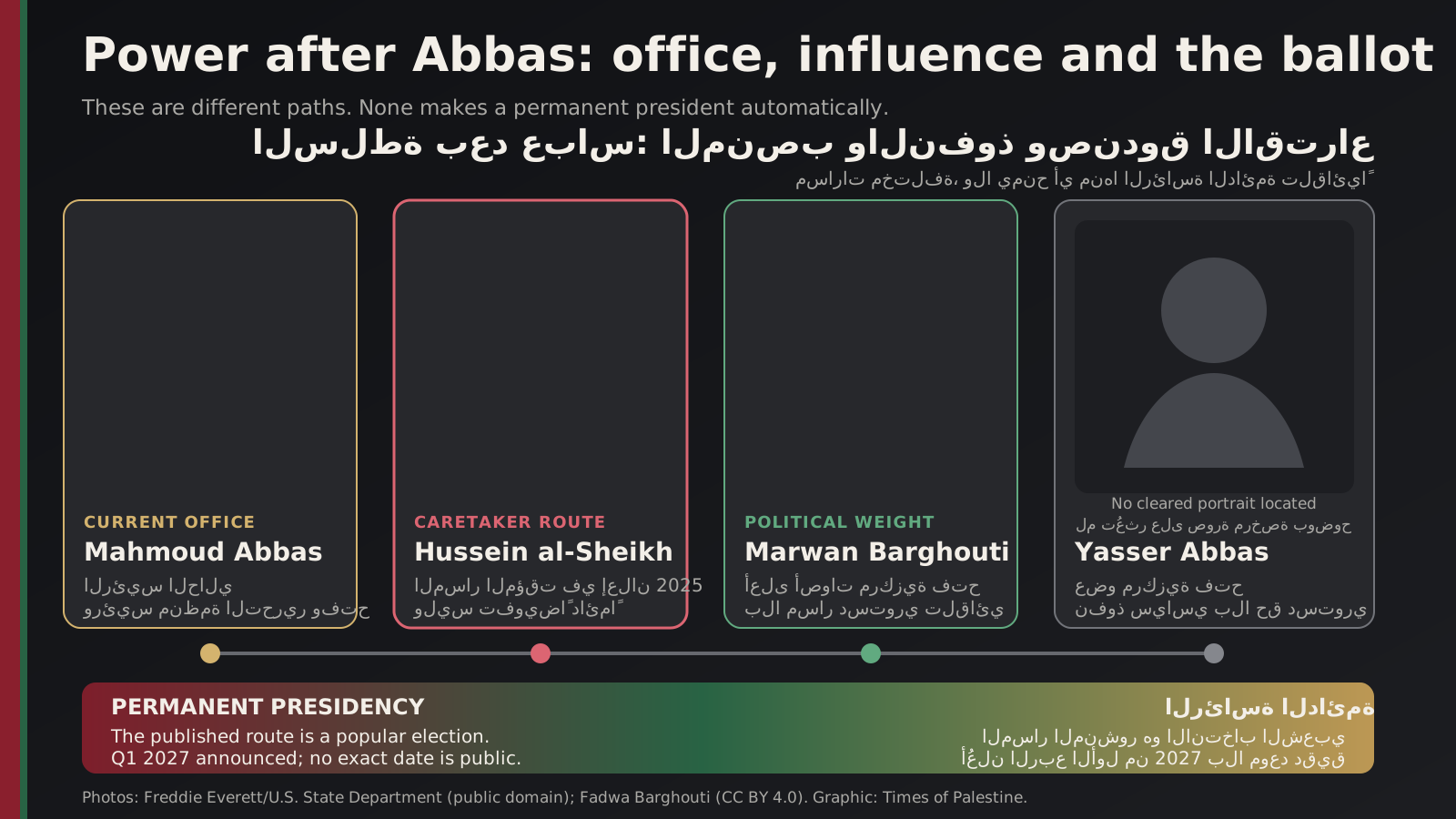
Four names carry four different kinds of power. Only al-Sheikh has a published caretaker route; none has an automatic claim to the permanent presidency. Graphic: Times of Palestine.
The legal fault line: one vacancy, two rules#
The 2003 Amended Basic Law is direct. If the presidency becomes vacant through death, accepted resignation or loss of legal capacity, the PLC speaker temporarily assumes the presidency for no more than 60 days while a direct election is held.
The problem is that the PLC elected in 2006 stopped functioning after the Fatah–Hamas split and was declared dissolved by the Supreme Constitutional Court in 2018. There is no sitting speaker ready to perform Article 37’s role.
Abbas responded on 26 October 2025 with a constitutional declaration. It says that, while no legislature exists, the PLO Executive Committee’s vice-chair and vice-president of the State of Palestine becomes temporary PA president for up to 90 days. If “force majeure” prevents an election, the Palestinian Central Council may approve one additional period.
That office belongs to al-Sheikh, whose appointment was approved in April 2025.
What is clear
- If a vacancy occurred under the institutions that exist today, the 2025 declaration points to al-Sheikh.
- The declaration describes a temporary handover, not a permanent presidency.
- A presidential election remains the stated route to a full mandate.
What is disputed
The Basic Law says amendments require a two-thirds vote of the legislature. The 2025 mechanism was created by presidential declaration after the legislature had disappeared.
Constitutional scholar Nathan J. Brown argues that the declaration sits outside the Basic Law’s normal amendment process and leaves unresolved the relationship among the PA, the State of Palestine and the PLO. The presidency presents it as a continuity measure required by institutional paralysis.
Both facts matter: the declaration establishes a practical caretaker route, and its constitutional authority remains contested.
| Question | 2003 Amended Basic Law | 2025 constitutional declaration |
|---|---|---|
| Temporary officeholder | PLC speaker | PLO Executive Committee vice-chair |
| Initial period | Up to 60 days | Up to 90 days |
| Extension | Not specified in Article 37 | One additional period for “force majeure” |
| Current practical obstacle | No functioning PLC or sitting speaker | Authority of the declaration is contested |
Four names, four different kinds of power#
Mahmoud Abbas: the offices still converge in one person
Abbas remains president of the Palestinian Authority and State of Palestine, chair of the PLO Executive Committee and chair of Fatah. That concentration is one reason succession is so difficult: replacing him is not necessarily one institutional act.
Hussein al-Sheikh: the caretaker route
Al-Sheikh holds the office named in the 2025 declaration. Fatah’s new Central Committee also elected him deputy chairman on 3 June.
That gives him the strongest formal route into an immediate vacancy and a powerful position inside the dominant movement. It does not guarantee that he would win a presidential election, lead every institution permanently or face no internal challenge.
Marwan Barghouti: electoral weight inside Fatah
Official preliminary results from Fatah’s May conference gave imprisoned leader Marwan Barghouti 1,893 votes—the highest total in the Central Committee contest.
His result is evidence of influence inside Fatah. It is not a constitutional succession mechanism, and the report does not establish whether he will be able or willing to contest a future presidential vote.
Yasser Abbas: new influence, no constitutional claim
Yasser Abbas, the president’s son, won a Central Committee seat with 1,301 votes. The position gives him a formal place in Fatah’s most important executive body.
It does not place him in the constitutional line of succession. He is not the PLO vice-president named in the 2025 declaration, and he has not received a national electoral mandate.
His election has prompted public speculation about a family succession. The institutional record supports a narrower conclusion: he has acquired influence inside Fatah, but no published rule gives him an automatic route to the presidency.
By the numbers: Fatah’s leadership vote#
- 2,595 conference members were eligible to participate.
- 94.64% turnout was reported across Ramallah, Gaza, Lebanon and Cairo.
- 59 candidates competed for 18 Central Committee seats.
- 1,893 votes went to Marwan Barghouti.
- 1,884 went to intelligence chief Majed Faraj.
- 1,586 went to Hussein al-Sheikh.
- 1,301 went to Yasser Abbas.
The conference also returned Mahmoud Abbas as Fatah chairman without a challenger.
Three ballots—but not one election#
The announced road map contains three votes for three different institutions.
1 November 2026: Palestinian National Council
The PNC is the PLO parliament and is intended to represent Palestinians inside Palestine and across the diaspora.
The new system sets 350 seats: 200 for the Palestinian territory constituency and 150 for diaspora constituencies. It promises proportional representation by list. Where direct voting abroad cannot be organized, however, members may be chosen through an electoral assembly, community consensus or appointment.
That preserves diaspora representation on paper. It does not guarantee that every seat will carry a direct electoral mandate.
28 November 2026: Palestinian Legislative Council
The Central Elections Commission says the new PLC will have 200 seats.
The published calendar schedules:
- West Bank voter-registration centers: 15–19 August
- Candidate nominations: 26 September–7 October
- Campaign: 6–27 November
- Security-force voting: 26 November
- Public voting: 28 November
The law uses proportional representation, lowers the candidacy age to 23 and expands women’s representation.
First quarter of 2027: presidency
The presidency has announced a presidential vote for the first quarter of 2027.
No exact polling date or detailed legal calendar has been published.
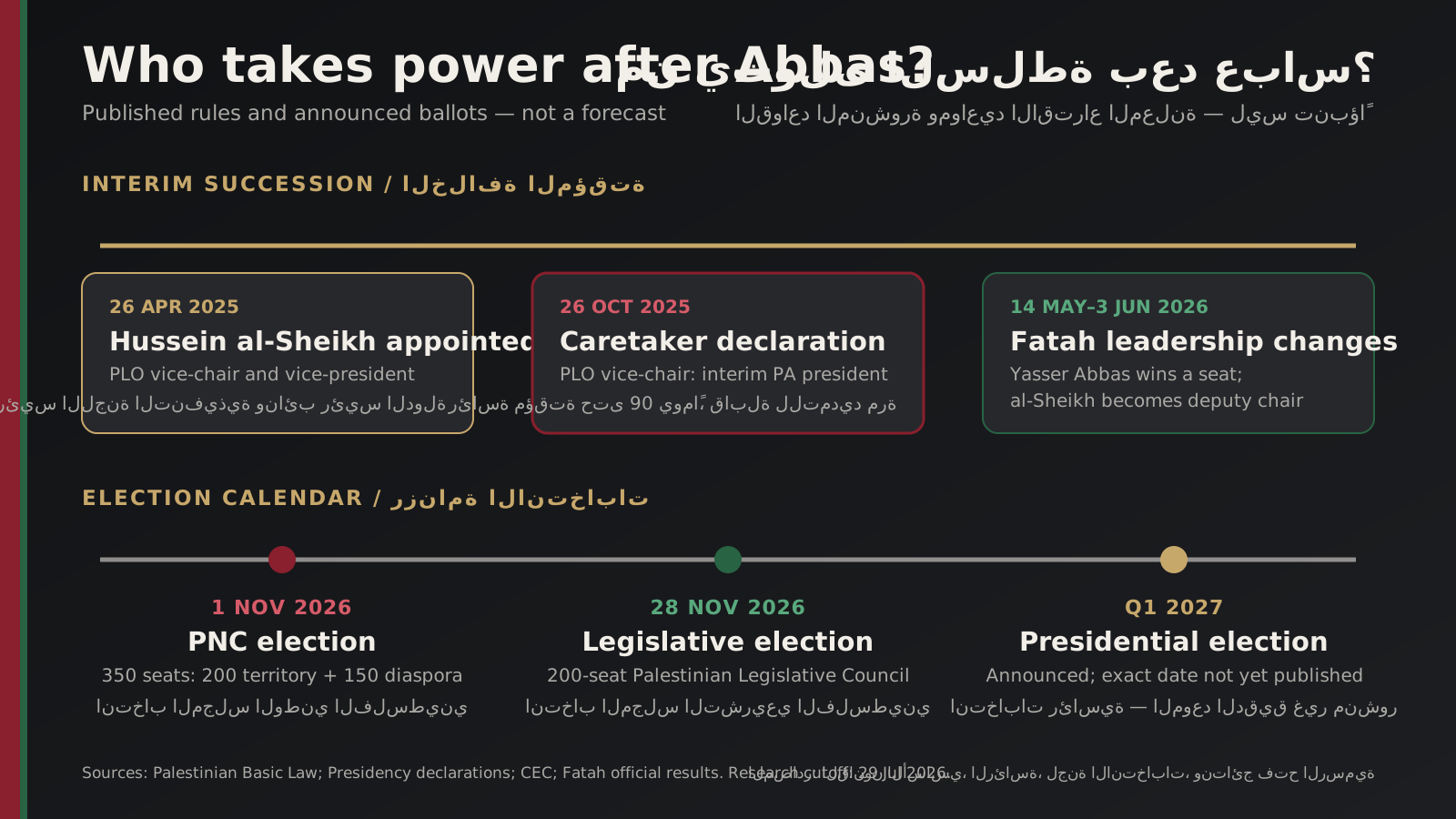
Published succession measures and announced ballots from 2025 through early 2027. The dates are official announcements, not a prediction that each vote will occur as scheduled. Graphic: Times of Palestine.
The calendar contains a collision#
The PNC vote is scheduled 27 days before the PLC vote.
That matters because elected PLC members are also supposed to become PNC members and count within the 200 PNC seats assigned to the Palestinian territory.
Authorities have not yet published a sufficiently clear operational explanation of:
- how the territory’s PNC seats will be handled during the 27-day gap;
- how later PLC results will replace or integrate with the earlier PNC formation;
- which body will adjudicate disputes.
This is not a technical footnote. It goes to the composition and legitimacy of the PLO’s parliament.
Who gets to run may matter more than the date#
Decree-Law No. 10 of 2026 requires every PLC candidate to recognize the PLO as the sole legitimate representative of the Palestinian people and support its political and national program and relevant international-legitimacy resolutions.
Supporters can call that a constitutional baseline for candidates seeking office inside a PLO-led order.
Critics call it a political loyalty test that could exclude major factions before voters can judge them.
The Palestinian civil-society organization ICSPR welcomed lower thresholds and broader representation for women and young people. It also warned that the amendments were produced without comprehensive national dialogue and could reproduce appointments and quotas instead of renewing legitimacy.
Public skepticism was already deep before the 2026 decrees.
In a face-to-face PCPSR survey of 1,200 adults in the West Bank and Gaza in October 2025:
- 60% did not expect national elections within a year;
- 80% wanted Abbas to resign;
- 63% opposed requiring candidates to accept PLO obligations.
The poll is a baseline of distrust, not a prediction of the November result.
Reality check: April proved capacity—and exposed the limits#
The strongest available test is the local election held on 25 April 2026.
The Carter Center found that the CEC retained substantial operational capacity and public confidence despite financial and logistical pressure. Voting in Deir al-Balah was Gaza’s first in two decades.
But the same assessment recorded a much harder reality:
- Voting occurred in 183 of 420 planned local authorities.
- More than half of constituencies were noncompetitive.
- Fatah was the only party to compete officially, although faction-affiliated individuals ran as independents.
- Turnout in Deir al-Balah was 22.8%, compared with 56% in the West Bank.
- East Jerusalem was excluded.
- Israeli checkpoints, closures, military operations and movement restrictions constrained campaigning and access.
- The CEC still faced a reported $1.8 million funding gap in June.
The report also documented allegations of intimidation and security-service interference. Those allegations require investigation; they are not adjudicated facts.
Seven tests for a credible vote#
Before the first national ballot, Palestinian institutions have yet to publish answers on seven points. It is not settled which succession rule governs, or whether the 2025 declaration displaces Article 37 only while no legislative council exists. No published plan explains how the PNC and PLC votes connect across the 27-day gap between them, or where people will actually vote — there is no legally reviewable arrangement for Gaza, East Jerusalem or the diaspora constituencies.
Nor has any body said what evidence would allow direct diaspora voting to be replaced by an electoral assembly, a consensus process or appointment; whether candidacy rules will exclude major political constituencies; or whether funding, campaign finance, station-level results, complaints and court decisions will be published. The presidential election itself still has no exact date, no legal calendar, and no stated guarantee that the result will be implemented.
What to watch#
- 15 August: scheduled opening of West Bank registration centers.
- 26 September: scheduled start of PLC nominations.
- 1 November: announced PNC vote.
- 28 November: announced PLC vote.
- First quarter of 2027: announced presidential-election window.
If the presidency became vacant under today’s institutions, the 2025 declaration points to Hussein al-Sheikh as the temporary officeholder.
That is the clearest answer the documents provide.
The permanent answer is supposed to come from voters. Yasser Abbas’s new Fatah role and Marwan Barghouti’s internal vote total may shape that contest, but neither decides it.
The larger question is whether Palestinians will be offered meaningful choices—and whether every institution with power will honor the result.