Economy & Aid
Palestine's flagship companies post a recovery from the war's worst year
Graphic: Times of Palestine
Original Reporting
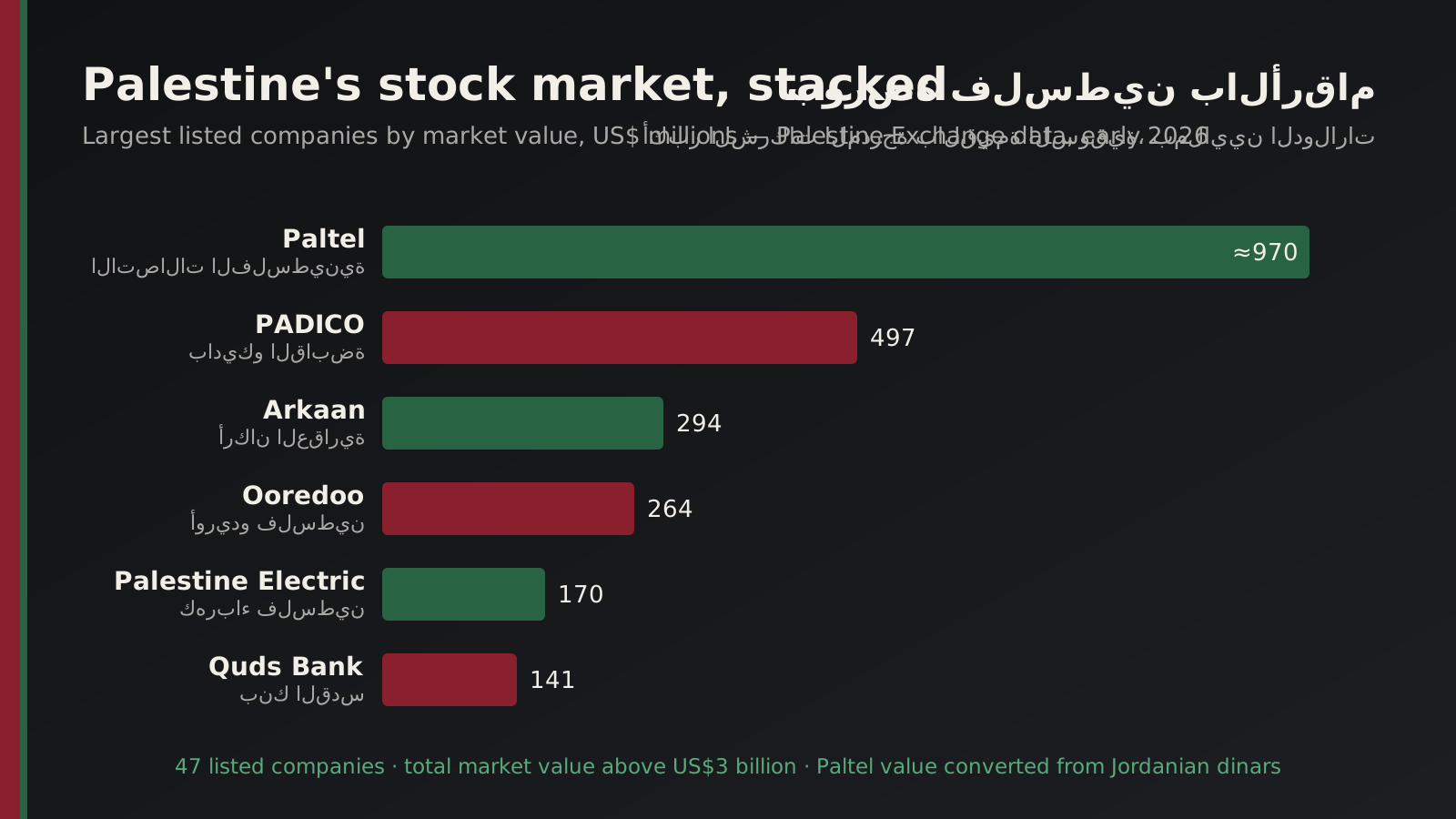
The numbers that describe corporate Palestine in 2026 should not, by any textbook, coexist. The World Bank recorded an 83 per cent collapse in Gaza's economy in 2024 and a slow, partial West Bank rebound in 2025; unemployment reached 69 per cent in Gaza and 29 per cent in the West Bank. Yet 47 companies still trade on the Palestine Exchange with a combined market value above 3 billion dollars, the banking sector earned 46 million dollars in the first half of 2025 — an almost fivefold jump from the same period a year earlier, the Sada news agency reported from exchange disclosures — and the largest Palestinian firms closed their books, paid their people and kept their networks running through the most destructive period in their history. This is a balance-sheet tour of the companies that carry the Palestinian economy.
Paltel Group, the market's anchor#
Palestine Telecommunications Company is the heaviest stone in the arch: a World Economic Forum profile puts it at roughly 31 per cent of the exchange's entire capitalisation, and its market value of 688 million Jordanian dinars is close to a billion US dollars. The group reported 2024 revenue of 241 million dinars, down from 280 million a year earlier, with net profit of 41.8 million dinars — a decline of under 4 per cent in a year when its Gaza network was being physically destroyed. The company told the market it kept more than two million people in Gaza connected while giving away hundreds of millions of minutes, messages and gigabytes. Its Jawwal and Ooredoo Palestine duopoly still competes, both companies report, against Israeli operators broadcasting from settlements without Palestinian licences.
Bank of Palestine, the balance sheet of a nation#
With group assets approaching 8 billion dollars, Bank of Palestine is the largest financial institution in the country and among its largest private employers. The war priced itself directly onto its ledger: a 27.9 million dollar net loss for 2024, driven by provisions for Gaza that included banknotes physically lost in destroyed branches — a line item few banks anywhere have ever booked. The group returned to profit in 2025 with the rest of the sector. Founded in Gaza in 1960 to finance citrus growers, it now runs the country's largest branch network and has led the push, with the monetary authority, to digitise payments in an economy drowning in unbankable cash.
PADICO Holding, the index in one share#
Palestine Development and Investment Company is the closest instrument to buying the Palestinian economy whole: stakes across telecoms, real estate, tourism, agriculture and industry, and a market value near 500 million dollars that makes it the largest listed company after Paltel — itself a PADICO affiliate. The holding reported a return to profit in 2024 — 0.7 million dollars attributable to shareholders against an 11.6 million dollar loss in 2023 — even after booking its 12.4 million dollar share of provisions for subsidiaries' damaged Gaza assets. Consolidated assets stood at 723 million dollars. Founded by Munib al-Masri in 1993 as Oslo's economic wager, PADICO remains the test of whether diversified Palestinian capital can compound through crisis.
APIC, the billion-dollar supply line#
Arab Palestinian Investment Company is the biggest Palestinian company most consumers never notice, because its business is the shelf itself: exclusive distribution of global consumer and pharmaceutical brands, plus manufacturing through the Jerusalem-born meats brand Siniora. Chairman Tarek Aggad reported 2024 revenues of 1.12 billion dollars, down 6 per cent, with EBITDA of 68 million dollars and net profit attributable to shareholders of 9 million dollars — squeezed, the company said, by logistics costs and financing rates in a war economy. Its trucks reaching supermarkets are, in practice, a daily referendum on whether commerce still functions.
Ooredoo Palestine, the challenger network#
The second mobile operator, launched in the West Bank at the end of 2009 after years of spectrum delays, carries a market value of about 264 million dollars and the Gulf backing of the Ooredoo group. Its competition with Jawwal gave Palestinians falling prices and, from 2027 on current plans, a 4G rollout the sector has awaited for a decade — while Gaza's network remains to be rebuilt from rubble.
Palestine Islamic Bank, faith-based finance at scale#
The largest Sharia-compliant lender illustrates both the war's cost and the sector's resilience: returns dipped negative in 2024 under Gaza provisions, then assets grew more than 11 per cent in 2025 as deposits returned. A trailing-year revenue of some 64 million dollars and a cost-to-income ratio the bank cut from 41 to 31 per cent through digitisation make it the quiet efficiency story of Palestinian finance, in a market where Islamic banking keeps taking share.
Birzeit Pharmaceuticals, the medicine cabinet#
Palestine's leading drugmaker produces around 270 medicines across 16 production lines on four sites, exports to Eastern Europe, and anchors a pharmaceutical sector that kept West Bank pharmacies stocked through closures that halted almost everything else. Its chairman, Talal Nasereddin, has run it since 1974; its listed peers Jerusalem Pharmaceuticals and Beit Jala Pharma round out an industry Palestinians rank among their proudest.
National Beverage Company, the franchise that stayed#
Privately held, Zahi Khouri's Coca-Cola franchisee runs four bottling plants and four distribution centres, including the 20-million-dollar Gaza plant opened in 2016 — an asset whose fate encapsulates the cost of the war on private industry in the Strip. Forbes has described NBC as among the largest private Palestinian employers and investors, and the company has pledged publicly to be part of Gaza's reconstruction economy.
Consolidated Contractors Company, the giant abroad#
The largest Palestinian company does not trade in Ramallah and does not operate mainly in Palestine: Athens-headquartered CCC, founded by Palestinian refugees in 1952, reported revenue of 2.3 billion dollars in 2023, ranks among the world's top international contractors and employs a workforce drawn heavily from the diaspora it helped create. Its founding Sabbagh and Khoury families have channelled decades of construction profits into Palestinian hospitals, universities and institutions.
Palestine Investment Fund, the state's portfolio#
The sovereign wealth fund holds close to a billion dollars in assets — 960.7 million at its last detailed accounting — with 90 per cent invested domestically through arms covering real estate, energy, agriculture and technology, according to the International Forum of Sovereign Wealth Funds. It is the intended engine of reconstruction finance, and the discipline of its governance, which the transparency coalition AMAN continues to press on conflict-of-interest rules, will decide how far public capital can crowd private money into rebuilding.
The recovery these balance sheets describe is real and radically incomplete. It runs on the West Bank's rebound while Gaza — 17 per cent of the Palestinian economy before the war, under 3 per cent of it now, by World Bank measure — waits for reconstruction to begin. What the 2024 and 2025 accounts prove is narrower but not small: the corporate infrastructure of a Palestinian state — its banks, its networks, its factories, its fund — took the worst year on record and closed its books still solvent, still listed and still hiring.