The Diaspora
St. Louis dabke troupe funds West Bank autism therapy
Graphic: Times of Palestine
Original Reporting
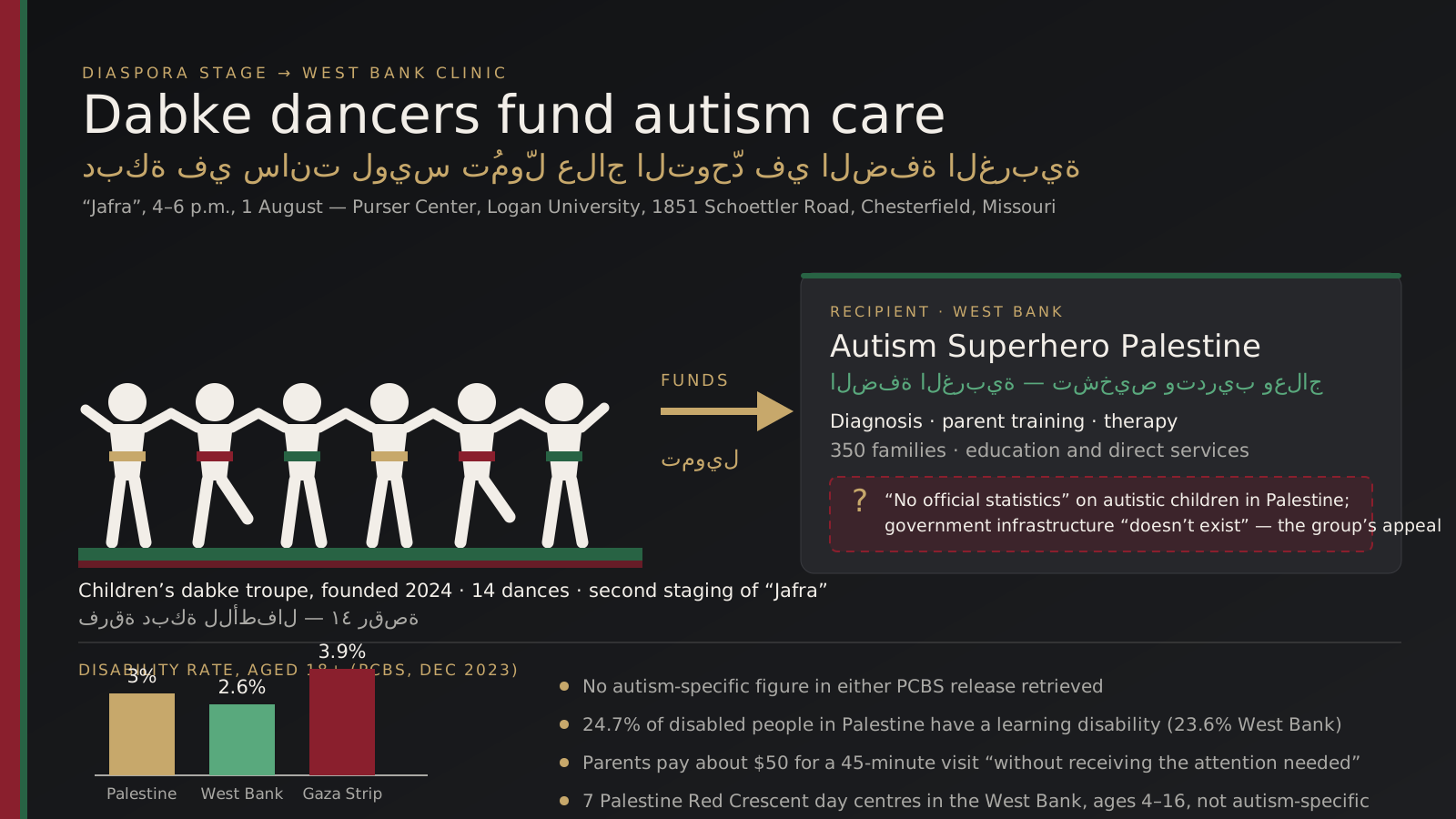
A children's dance troupe in suburban St. Louis staged a two-hour Palestinian folk-dance production on Saturday to pay for autism diagnosis, parent training and therapy in the West Bank — services the organisation receiving the money says the Palestinian government does not supply at all.
The show, "Jafra," ran from 4 to 6 p.m. on 1 August at the Purser Center at Logan University, 1851 Schoettler Road, Chesterfield, Missouri, according to St. Louis Public Radio, which reported that the performance would support autistic children and their families in the West Bank through the nonprofit Autism Superhero Palestine. The broadcaster described the production as an exploration of regional dabke styles, a UNESCO-recognised Levantine tradition that St. Louis Public Radio traced to a yearly roof-packing practice in which villagers stomped mud in unison to seal their homes before winter.
The claim the fundraiser rests on is a gap in the public record itself. On its GoFundMe charity page, Autism Superhero Palestine states that there are no official statistics in Palestine on the number of children diagnosed with autism, and that the government infrastructure to provide resources and services "doesn't exist," leaving a shortage of comprehensive autism centres and of specialists including diagnosticians and therapists.
Published Palestinian statistics are consistent with the absence of a count. The Palestinian Central Bureau of Statistics, marking the International Day of Persons with Disabilities in December 2023, reported a disability rate of 3 per cent among adults aged 18 and over — 2.6 per cent in the West Bank and 3.9 per cent in the Gaza Strip. A separate PCBS release reports prevalence by category rather than diagnosis: mobility disability affects 48.4 per cent of disabled people in Palestine, and learning disability 24.7 per cent, 23.6 per cent in the West Bank. Neither release retrieved reports an autism-specific figure.
The bureau has also documented what happens after diagnosis. In a PCBS publication, more than one-third of persons with disabilities aged three and over had never enrolled in education, and only 9 per cent of working-age disabled women in Palestine are economically active, with almost half of those unemployed.
Where services exist, they are largely charitable and not autism-specific. The Palestine Red Crescent Society says it runs seven day centres in the West Bank — in Jenin, Tubas, Nablus, Anabta, Jericho, Hebron and Tarqumiya — for children with intellectual disabilities aged four to sixteen, alongside centres in Khan Younis, Rafah and Jabalia in Gaza, with a pre-vocational rehabilitation programme after the age of sixteen. The health organisation Juzoor, describing a capacity-building project, says it assessed 11 West Bank associations working on speech and hearing disability for administrative, technical and infrastructure needs before narrowing to five partners.
Tadamon, which has supported autism work in Palestine, states that children with autism in the West Bank face limited access to affordable therapy and rehabilitation from either government or nonprofit providers. The Danish organisation Human Act, describing its support for Autism Superhero, says parents struggle to find specialists able to give an accurate diagnosis and are directed to centres claiming to have them, paying around $50 for a 45-minute visit without receiving the attention needed.
Autism Superhero Palestine, a 501(c)(3) organisation that describes its work as support, education, advocacy and community-based programmes across Palestine, sets out the access problem in physical terms. On its website it says that although professional autism services are available in Jerusalem, many West Bank families cannot reach them because Israeli movement restrictions often prevent them from obtaining permits or travelling to the city, and that families are also reluctant to travel long distances inside the West Bank because of settler violence along certain roads. It says therapy centres in the West Bank commonly require advance payment for expensive services of limited quality, and that many families can afford only one session a week, which it describes as rarely enough to meet a child's developmental needs. No Israeli government response to those specific assertions appears in the material retrieved.
Accounts of the organisation's own founding differ. Its LaunchGood page says three mothers created a Facebook page on 3 January 2019 to speak about the reality of autistic children in Palestine, and describes the group as Missouri-based; Human Act says it was founded by four mothers of children with autism; the GoFundMe charity page is written in the voice of a founder who says she began the organisation three years ago and that it now serves 350 families across two programme categories, education and direct services. St. Louis Public Radio identifies the nonprofit as belonging to the troupe's coach, Hanan Hamed.
Hamed told the station that the group had previously worked in Gaza but had lost most of the families it served there, and that she understands what West Bank families face because they are unable to obtain therapy services.
The troupe itself is two years old. St. Louis Public Radio reported that Hamed established it in 2024 with the help of Lea Koesterer, co-founder of the cultural exchange organisation St. Louis Friends of Bethlehem, and that the first staging of "Jafra," on 10 January, was the first dabke theatre show of its kind in the city. Saturday's performance was the second staging of that programme, built around 14 dances that Hamed described as a living curriculum in Palestinian history and folklore.
Finding a stage has been part of the story. Hamed told St. Louis Public Radio that venues were hard to secure, quoting hosts as saying they did not want anything controversial or press coverage or problems, which she characterised as erasing a group of people because their culture is read as political. In 2024, the St. Louis Art Fair in Clayton said the troupe would not perform at its annual event in part because organisers feared the dancers would make a political statement, while troupe members said they were excluded because organisers viewed the expression of Palestinian culture as controversial.
The fundraising model is not confined to one city. HEAL Palestine has published an account of an earlier Canaan Wellspring dabke performance in St. Louis staged in support of its work, and the Athenaeum Center for Thought & Culture in Chicago has listed "Jafra" among its 2026 events.
What the shows have produced financially is not on the public record: no figure for proceeds from the January or August stagings appears in the troupe's or the nonprofit's published material, and the ticketing page for the Chesterfield event states only that all proceeds go to Canaan Wellspring.
Nor is the underlying number known. Al-Quds University has announced a third peer-reviewed paper from doctoral research on the quality of life of mothers of autistic children in the West Bank, published in the Journal of Autism and Developmental Disorders with policy recommendations, work the university says is intended to supply evidence for developing services for this group. Until such evidence produces a state count, the size of the population these fundraisers serve remains an estimate made by the families raising the money.