Research & Investigations
Ten Palestinian business leaders keep a wartime economy standing
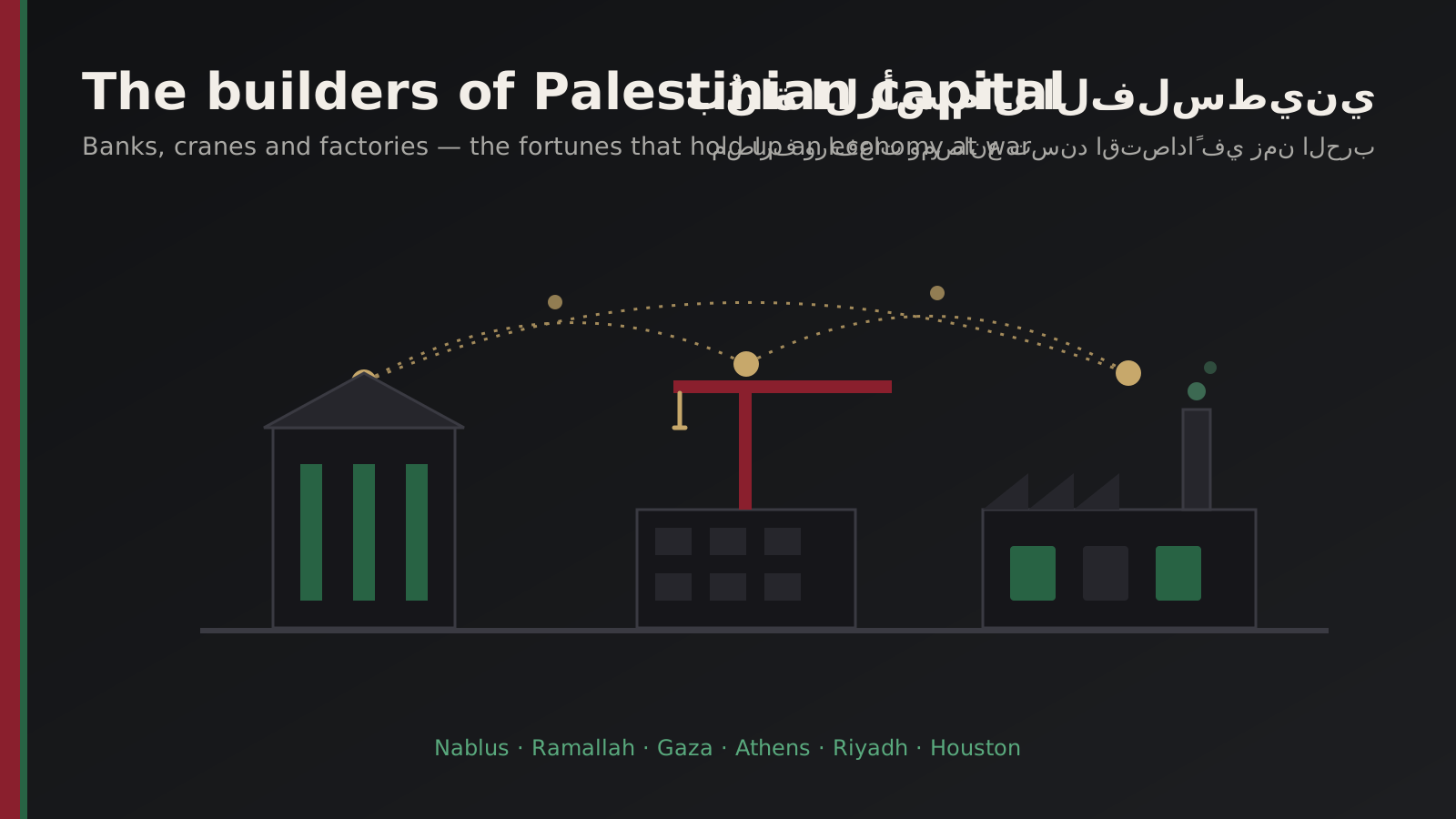
Graphic: Times of Palestine
Original Reporting
No wealth registry counts Palestinian fortunes, and the men who hold the largest of them mostly refuse to count in public. What can be counted is what their money built: the banks that kept paying out through a war, the telecom towers that kept Gaza reachable, the factories, planned cities and trading houses that still employ tens of thousands while the World Bank records the deepest economic contraction in Palestinian history. This list ranks no one by net worth — no audited number exists for most of these men, and several dispute the labels attached to them. It profiles, instead, the ten figures whose enterprises carry the most weight in Palestinian economic life in 2026, at home and across a diaspora that stretches from Riyadh to Houston.
Munib al-Masri, the patriarch of Nablus#
Munib al-Masri, born in Nablus in 1934 and trained as a geologist at the University of Texas, made his first fortune through Edgo, the London-based energy-services group he founded and ran across the Middle East. In 1993, betting on Oslo, he founded PADICO Holding, the investment company that today holds stakes in dozens of firms spanning telecommunications, real estate, tourism and industry; PADICO states that the market value of the group and its listed companies is about 40 per cent of the value of the Palestine Exchange, which it also helped establish. Arabian Business has ranked al-Masri among the world's wealthiest Arabs, and global business media routinely describe his fortune in ten digits — a description he has repeatedly waved away, saying he himself does not know what he is worth. Now in his nineties, he remains PADICO's chairman and the closest thing Palestinian capitalism has to a founding father.
Sabih al-Masri, the banker of two capitals#
A cousin by clan and a partner by temperament, Sabih al-Masri built his base outside Palestine: the Astra Group he founded in Saudi Arabia grew from agro-industry into construction, manufacturing and telecommunications across the Gulf and Jordan. He chairs Arab Bank, one of the Arab world's largest financial institutions, and chairs Paltel Group, the largest company on the Palestine Exchange, according to both companies' records. His brief detention in Riyadh in December 2017, and the regional alarm it caused before his release days later, measured how much of Jordanian and Palestinian finance rests on one Nablus-born chemical engineer, another University of Texas graduate.
The Sabbagh and Khoury families, builders on three continents#
Consolidated Contractors Company, founded in 1952 by Hasib Sabbagh, Said Khoury and Kamel Abdul-Rahman, grew into the largest construction company in the Middle East, with company records showing revenue of 2.3 billion dollars in 2023, offices in more than 40 countries and a place among the world's top international contractors. Its founders — refugees of 1948 from Safad and Haifa — kept the group Palestinian in identity even as its headquarters settled in Athens, and their heirs, among them Samer Khoury, run it today. CCC built airports, pipelines and towers across the Gulf; its founding families also endowed hospitals, scholarships and institutions across Palestine and the diaspora.
Bashar Masri, the man who built a city#
Bashar Masri, born in Nablus in 1961, founded Massar International in 1995 and grew it to more than 30 subsidiaries in finance, real estate, agribusiness, media and technology. His signature work is Rawabi, the first Palestinian planned city, rising north of Ramallah with thousands of homes, a tech hub and an amphitheatre — the largest private-sector project in Palestinian history. In 2025 a lawsuit filed in a United States court alleged that projects connected to his companies in Gaza had benefited Hamas; Masri rejected the allegations as baseless and resigned from Harvard Kennedy School's Dean's Council while contesting the case. He continues to sit on the Development Accountability Council of the US International Development Finance Corporation, and Rawabi continues to sell homes.
Tarek Aggad, the quiet billion-dollar operator#
Arab Palestinian Investment Company, which Tarek Aggad chairs and runs, posted revenues of 1.12 billion dollars in 2024 — a 6 per cent decline in a war year, the company reported, with net profit attributable to shareholders of 9 million dollars and total assets of 842 million dollars. APIC's subsidiaries distribute consumer goods and medicines across Palestine and the region and manufacture food through Siniora, the Jerusalem-rooted meats brand. Aggad inherited a tradition rather than a company: his father Omar Aggad, who died in 2018, built one of the great Palestinian industrial fortunes in Saudi Arabia and helped finance half the institutions of Palestinian economic life.
Hashim Shawa, the banker who stayed#
Bank of Palestine was founded in Gaza in 1960 by Hashim Atta Shawa to lend to citrus farmers; his grandson and namesake has chaired it since 2007 and built it into the country's largest financial institution, with group assets approaching 8 billion dollars. The war put that franchise through fire: the bank reported a net loss of 27.9 million dollars for 2024 after taking provisions for Gaza, including cash physically lost in destroyed branches, and returned to profit in 2025 as the sector recovered — Palestinian banks earned 46 million dollars in the first half of 2025, the Sada news agency reported from exchange disclosures. Shawa's bet, made publicly and repeatedly, is that there is no Palestinian future without a Palestinian bank willing to price its risk.
Zahi Khouri, the man who bottled optimism#
Born in Jaffa in 1938 and exiled with his family in 1948, Zahi Khouri built an international career before returning after Oslo to found the Palestinian National Beverage Company, the Coca-Cola franchisee, in 1995. The company grew to four bottling plants and four distribution centres — including a 20-million-dollar Gaza plant opened in 2016 — and Forbes has described it as among the largest private Palestinian employers and investors. Khouri became American business's most persistent advocate for Palestinian economic normality, arguing in boardrooms and op-eds that occupation, not incapacity, is what constrains Palestinian enterprise.
Talal Nasereddin, the industrialist of medicine#
Talal Nasereddin joined Birzeit Pharmaceutical Company in 1974, fresh from university, and never left; as chairman and chief executive he built it into Palestine's leading drugmaker, producing some 270 medicines across 16 production lines and exporting to Eastern Europe. His chairmanships radiate across the economy — the National Bank, Al-Takaful Insurance, the lubricants maker Petropal he founded — making him the rare Palestinian industrialist whose empire was built entirely inside the occupied territories, factory by factory.
Mazen Sinokrot, the food magnate who served#
Mazen Sinokrot founded his group in Ramallah in 1982 with a single sweets factory; Sinokrot Global Group now describes itself as the largest family-owned business group in Palestine, spanning food and agro-industry, bottled water, dates, chocolate, tourism and technology, and exporting to more than 30 countries. He served as the Palestinian Authority's minister of national economy and founded much of the private sector's institutional architecture, including the food industries union and the Palestine Trade Center. The Sinokrot brands on West Bank shelves are, for many Palestinians, the most tangible daily proof that a national industry exists.
Farouk Shami, the 71-dollar immigrant#
Farouk Shami left Beit Ur al-Tahta, near Ramallah, in 1965 with 71 dollars; the Houston company he founded, Farouk Systems, earns roughly a billion dollars a year from the CHI and BioSilk hair-care brands, Forbes has reported, and employs more than 2,000 people. A hairdresser who developed an allergy to ammonia, he invented the first ammonia-free hair colour and built his empire on it. He has funnelled his success home conspicuously — including a science high school for girls in his native village — and in 2025 became the first Arab American to light Bethlehem's Christmas tree.
The wider bench#
Behind the ten stand others who shape Palestinian wealth from farther away: Mohamed Hadid, the Nazareth-born developer of Bel Air and Beverly Hills trophy mansions who once bought the Ritz-Carlton hotels of New York and Washington; the five Palestinian families that Arabian Business has estimated hold assets above a billion dollars each; and a generation coming up behind them that looks different — Manal Zraiq, a partner in Massar and one of the leading women in the Rawabi project, or Majd Mashharawi, the Gaza engineer whose SunBox solar kits kept lights on through the blackouts. The fortunes on this list were built through wars, closures and exiles, which is precisely why their holders keep investing: every one of them has already seen worse than the market's worst year.