Health & Healing
Israeli import controls keep prosthetic limbs from Gaza's amputees
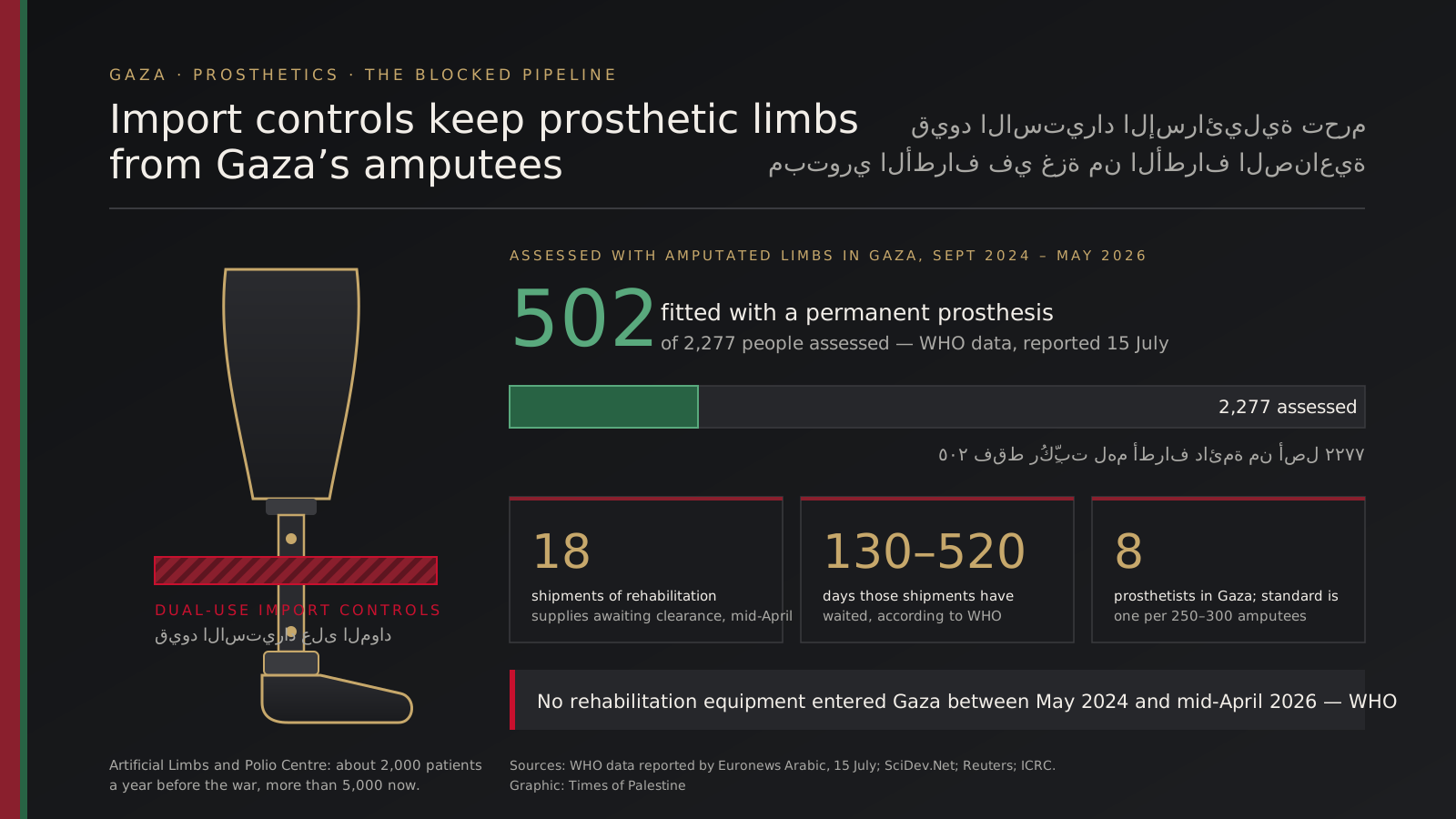
Graphic: Times of Palestine
Original Reporting
Of 2,277 people with amputated limbs assessed in Gaza between September 2024 and May 2026, 502 have been fitted with a permanent prosthesis, according to World Health Organization data reported by Euronews Arabic on 15 July.
SciDev.Net reported in June, citing WHO, that fewer than a quarter of roughly 2,300 amputees assessed over the same period had received permanent limbs, attributing the shortfall to a severe shortage of prosthetic materials and components.
The assessed caseload is a fraction of the total. OCHA's humanitarian update of 9 October 2025 reported, citing WHO, that nearly 42,000 Palestinians in Gaza had sustained life-changing injuries over two years of war, one in four of them children, including more than 5,000 amputations.
The counts diverge by source. B'Tselem reported in July 2025 that data supplied by the health ministry in Gaza to Physicians for Human Rights–Israel recorded more than 4,700 limb amputations, including over 940 children and about 370 women, while a WHO report that May put limb injuries above 15,000. UNICEF said in January 2025 that Gaza has the highest number of child amputees per capita in the world; figures attributed to the agency and cited by Al Jazeera put the number of children with one or more amputations at 3,000 to 4,000 — a far higher child total than the ministry's. Reuters reported in April that Gaza has nearly 5,000 war amputees, a quarter of them children.
Ninety-eight per cent of the pipeline problem, by the account of the agencies that run it, is materials. The ICRC, which supports the Artificial Limbs and Polio Centre in Gaza — the territory's main prosthetics facility, run by Gaza municipality — told Reuters in April that imports of plaster of Paris had been almost entirely restricted for more than four months, leaving stocks sufficient only to June or July.
WHO recorded 18 shipments of rehabilitation supplies awaiting clearance as of mid-April, with waiting times of 130 to 520 days, SciDev.Net reported. The Journal reported in May, citing the agency, that no rehabilitation equipment entered Gaza between May 2024 and mid-April 2026.
Israel's COGAT, the military body controlling access to Gaza, told Reuters it facilitates the regular entry of medical equipment but will not permit materials usable by Hamas for a "terrorist build-up", and said on prostheses that it is in dialogue with the UN and aid groups on enabling an adequate medical response. Reuters reported that plaster of Paris and plastic prosthetic components do not appear on Israel's published dual-use lists, though "construction products" do.
Gisha, the Israeli legal centre, states that the dual-use regime derives from Israel's 2007 Defence Export Control Law and that since October 2023 Israel has classified further items, including non-electric wheelchairs, as restricted. The ICRC and UNICEF told Reuters restrictions on items such as wheelchairs have eased since the ceasefire.
Three facilities carry most of the fitting. The Artificial Limbs and Polio Centre served about 2,000 patients a year before the war and now receives more than 5,000, its manufacturing supervisor told Xinhua in November, adding that the centre recycles old components. A centre spokesman told Xinhua in July 2025 that it had fitted prostheses for around 100 people since the war began and had more than 300 patients in physiotherapy.
The Hamad Hospital for Rehabilitation and Prosthetics in northern Gaza, funded by the Qatar Fund for Development, resumed operations at its main site in December after suspending during Israeli military operations in September 2025, and opened a southern branch. Gulf Times reported that about 100 patients had received prosthetic services since March 2025, alongside nearly 9,000 receiving rehabilitation and audiology care. The head of its prosthetics department told Drop Site News in November that the numbers exceed what the hospital can serve.
Humanity & Inclusion has fitted 118 temporary prostheses in Gaza since early 2025 and told Reuters it can now offer only maintenance, its last shipment having arrived in December 2024.
WHO counts eight prosthetists in Gaza, according to Drop Site News; SciDev.Net reported nine prosthetics and orthotics specialists in June. An ICRC spokesman in Jerusalem told SciDev.Net that international standards indicate one prosthetist for every 250 to 300 amputees and one physiotherapist for every 100 to 150 patients in rehabilitation.
The route out is narrowing. WHO-oPt data cited in the Journal of the Egyptian Public Health Association record 7,841 patients evacuated between October 2023 and 29 September 2025, with Egypt receiving 51 per cent. UNRIC reported that evacuations halved in 2025, with 2,266 people moved between the January 2025 ceasefire and 10 September, against 4,947 before May 2024. Al Jazeera reported on 18 June that more than 18,500 patients now require evacuation, and that Israel closed Rafah again on 28 February, suspending evacuations; WAFA reported an evacuation of 35 patients and 62 companions through Rafah on 16 June, a discrepancy the published record does not resolve. WHO's director-general cited health ministry figures of 1,092 patients who died awaiting evacuation between July 2024 and 28 November 2025, saying the figure is probably under-reported.
Regional programmes fit limbs outside Gaza. Jordan's armed forces report 703 prostheses fitted under their Restoring Hope initiative and 1,849 people evacuated, including 498 patients. Emarat Al Youm reported on 29 July that the Emirati floating hospital at Arish has fitted 51 Palestinian amputees under its Step of Hope programme.
The cheapest scaling option on the record is digital. UNICEF Aotearoa announced in 2025 a pilot to 3D-print prosthetics for Gaza's children, funded with more than a quarter of a million dollars from the Federation of Islamic Associations of New Zealand, with a production facility planned in Jordan; it said printed limbs cost about a sixth of conventional ones and can be made from measurements taken on a smartphone. 3DP4ME's Step by Step programme is training a prosthetist and a 3D technician in Jordan to produce custom sockets.
Growth is the recurring cost nobody has costed publicly. WHO recorded nearly 14,000 patients registering for limb reconstruction between July 2025 and May 2026, almost half of those assessed needing further surgery, SciDev.Net reported, and its May report found 32 per cent of assessed amputations were above the knee — the cases requiring the most advanced limbs and longest training.
Whether plaster of Paris shipments cleared before the ICRC's stocks ran out in June or July has not been reported, and no date has been announced for Rafah's reopening.