The Diaspora
Chile's Palestinian friendship day is stuck in an unfinished bill
Graphic: Times of Palestine
Original Reporting
Chile’s Senate has approved a national day of friendship and solidarity with the Palestinian people, but the proposal has not yet become law.
The distinction matters. On 20 May, senators approved an amended version of the bill without a dissenting vote and returned it to the Chamber of Deputies. As of 30 July, the Chamber’s official tracker for Bulletin 16.577-24 still listed the measure in its third constitutional stage. That means the lower house must consider the Senate’s changes before the legislation can advance.
The proposed date, 7 January, commemorates Chile’s recognition of the State of Palestine in 2011. The bill would allow public institutions to hold commemorative activities linked to friendship, solidarity and human rights. It would not, on its face, create a paid holiday, a spending programme or a new legal right.
Its unfinished journey nevertheless documents something larger: how a migration that began under the Ottoman Empire built durable Chilean institutions, and how Palestinian identity moved from immigrant newspapers, clubs and mutual-aid networks into the language of the national legislature.
Key findings#
- The measure is still a bill. The Senate returned its amended text to the Chamber on 20 May, and the public legislative record showed no later completed stage by 30 July.
- The Senate narrowed the government’s obligation. The final Senate text says institutions may hold activities. Earlier wording that the government “shall promote” them raised a constitutional objection because foreign relations are a presidential power.
- The date carries diplomatic meaning. Chile formally recognised the State of Palestine on 7 January 2011 and later elevated the Palestinian representation in Santiago to an embassy.
- Palestinian institutional life in Chile predates the bill by a century. Community organisations, publications and Club Deportivo Palestino made identity visible long before the current proposal.
- The often-cited community size is an estimate, not a census finding. Senate speakers used a figure of about 500,000 people of Palestinian origin, while Chile’s Foreign Ministry describes the community as the largest outside the Middle East without publishing a definitive count on its Palestine page.
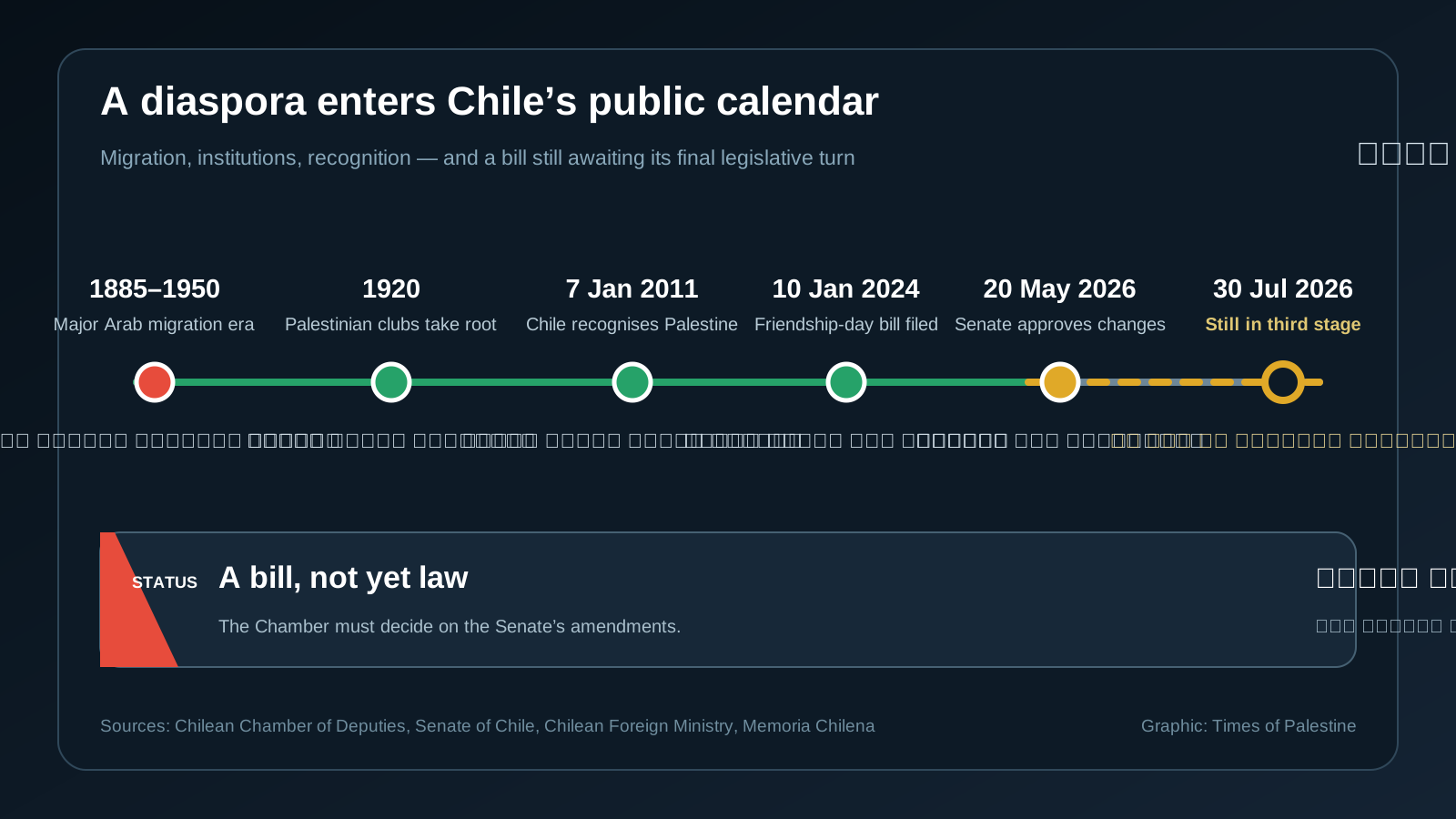
The bill connects a century of Palestinian-Chilean institution-building to the anniversary of Chile’s 2011 recognition of Palestine. Its present status remains “bill, not yet law.” Graphic: Times of Palestine.
What the bill would do#
The operative text is short. It would declare 7 January the “Day of Friendship and Solidarity between Chile and the Palestinian People.” Public institutions could conduct educational, cultural or commemorative activities, including work connected to United Nations principles and the human rights of the Palestinian people.
That is a symbolic law, not a material support package. The published text does not create an immigration route, finance humanitarian assistance, alter Chilean foreign policy or impose a mandatory national curriculum. It also does not make the day a statutory public holiday.
The symbolism is still specific. According to the Chilean Foreign Ministry’s account of bilateral relations, Chile recognised the State of Palestine on 7 January 2011. The Palestinian diplomatic mission in Santiago was subsequently upgraded to an embassy. Chile had already opened a representative office to the Palestinian National Authority in Ramallah in April 1998.
Choosing the recognition anniversary ties the proposed observance to a state decision, rather than to a religious festival, a military event or a date defined by one community organisation. It presents Palestinian friendship as part of Chile’s public diplomacy.
Why the Senate changed the language#
The bill’s most consequential debate concerned a single verb.
The version that reached the Senate said the government “shall promote” commemorative activities. During committee consideration, the executive warned that this could intrude on the president’s constitutional authority to conduct foreign relations.
The official Senate debate record shows how lawmakers resolved the problem. They changed the command into permission: public institutions “may” organise activities. The Senate also retained language about United Nations commitments and Palestinian human rights, framing it as a reaffirmation of obligations Chile had already accepted rather than a new direction imposed on the executive.
This edit makes the bill easier to enact but weaker as an instruction. An institution would be authorised to mark the day, not required to do so. Whether the date becomes a living civic occasion would therefore depend on ministries, municipalities, schools, universities, cultural organisations and community groups choosing to use it.
The vote was broad. On 5 May, the Senate approved the idea of legislating by 30 votes to none, with four abstentions, according to the Senate’s official account. On 20 May, it approved the amended articles without a vote against and sent them back to the Chamber, the Senate reported two days later.
The legislative journey#
| Date | Recorded action | Why it matters |
|---|---|---|
| 10 January 2024 | Deputies filed the motion | The bill formally entered Congress |
| 15 January 2025 | Chamber approved and sent it to the Senate | The first constitutional stage ended |
| 5 May 2026 | Senate approved the bill in general | Senators accepted the idea of legislating |
| 20 May 2026 | Senate approved amendments and returned the text | The Chamber must now consider the changes |
| 30 July 2026 | Chamber tracker still showed the third stage | The proposal had not completed Congress |
Chile’s Chamber guide to the lawmaking process explains that the chamber of origin reviews changes made by the revising chamber during the third stage. If deputies accept the Senate’s text, the measure can proceed toward the final constitutional and presidential steps. If they reject the changes, a mixed commission may be required to seek agreement.
The tracker’s lack of a later entry does not prove that the bill has been abandoned. It establishes only what the public record can support: the measure remains pending and its next decisive act belongs to the Chamber.
A community built through trade, print and association#
The parliamentary debate repeatedly described Chile’s Palestinian population as part of the country’s social fabric. That claim has a long institutional record behind it.
The Chilean National Library’s Memoria Chilena archive places the principal period of Arab immigration between 1885 and 1950. It estimates that 8,000 to 10,000 Arab migrants settled in Chile during that era, roughly half of them Palestinian, with Syrians and Lebanese making up most of the remainder.
Many arrived with Ottoman documents from towns in Palestine and neighbouring provinces. They travelled through Mediterranean ports, often crossed Argentina and entered Chile over land. Early migrants frequently worked as travelling merchants before establishing shops and textile businesses.
Commerce was only one part of settlement. Migrants and their descendants created mutual-aid bodies, newspapers, clubs and political organisations. Memoria Chilena records the founding of Club Palestino in 1920, the Committee for the Defence of Arab Rights in Palestine in 1936 and a Central Arab Committee in 1947. Arabic- and Spanish-language publications helped a dispersed community argue about identity, homeland and its place in Chile.
Those institutions complicate any simple story of assimilation. Palestinian-Chileans became participants in national business, politics, professional life, sport and culture while maintaining organisations that named Palestine directly. The proposed day draws on both identities: it is framed not as an observance imported from abroad, but as a Chilean recognition of a relationship already embedded at home.
Football as a public archive#
Club Deportivo Palestino is the most visible example. The club’s official history traces its founding to members of the Palestinian community in 1920 and describes its sporting identity as inseparable from that origin.
A football club does more than preserve a name. Its crest, colours, supporters and weekly fixtures put Palestinian identity in an ordinary national setting. The community is not visible only during war, diplomatic votes or commemorations. It is present in league tables, family memory and neighbourhood conversation.
That helps explain why senators referred to Palestinian institutions while debating a calendar law. The bill does not invent friendship between Chile and Palestine. It attempts to give official form to a relationship that civic organisations have carried for generations.
How many Palestinian-Chileans are there?#
The number most often repeated is about 500,000. Senators used that estimate in debate, and Chile’s Foreign Ministry says the country has the largest Palestinian community outside the Middle East.
Those two statements should not be collapsed into a precise demographic fact. “Palestinian origin” can include recent migrants, descendants across several generations and people with different forms of self-identification. Chile’s national census does not provide, on the official pages reviewed for this report, a single current count that resolves those categories.
The historical immigration estimate is not an answer either. A founding population of several thousand over many decades can grow substantially through descendants, but that does not by itself verify a contemporary total.
The most accurate formulation is therefore institutional: Chilean officials and legislators commonly estimate the community at around half a million and describe it as the largest Palestinian diaspora outside the Middle East. The exact figure remains dependent on definition and method.
What a commemorative day can and cannot change#
A date on the civic calendar can create recurring space for schools, museums, municipalities and public bodies to tell a history that is otherwise remembered unevenly. It can also recognise Palestinian-Chileans as authors of Chilean life, not simply as objects of distant foreign policy.
But symbolic recognition has limits. The bill would not decide how Chile votes internationally, how it responds to events in Gaza or the West Bank, how Palestinians access visas and consular services, or how public institutions address discrimination. It contains no enforcement mechanism and, after the Senate amendment, no requirement that any institution hold an event.
That tension is the bill’s central truth. Its supporters want the state to recognise a relationship built over more than a century. Its final Senate language leaves the practical meaning of that recognition to voluntary action.
What to watch#
The next step is not a ceremony. It is a legislative decision by the Chamber of Deputies on the Senate’s amendments.
If the Chamber agrees, the proposal can move toward completion and eventual promulgation. If it disagrees, lawmakers may need a mixed commission. Until the official record shows those steps and the law is promulgated, 7 January remains a proposed national observance rather than an established one.
The first real test would come after enactment: which institutions choose to participate, what histories they present and whether Palestinian-Chileans shape the programmes carried out in their name.
For now, the bill is both recognition and unfinished business. It says that Palestinian history belongs in Chile’s national story. Its pending status says that even a widely supported symbol still has to complete the work of becoming law.