Research & Investigations
Times of Palestine names the 100 most influential Palestinians of 2026
Graphic: Times of Palestine
Original Reporting
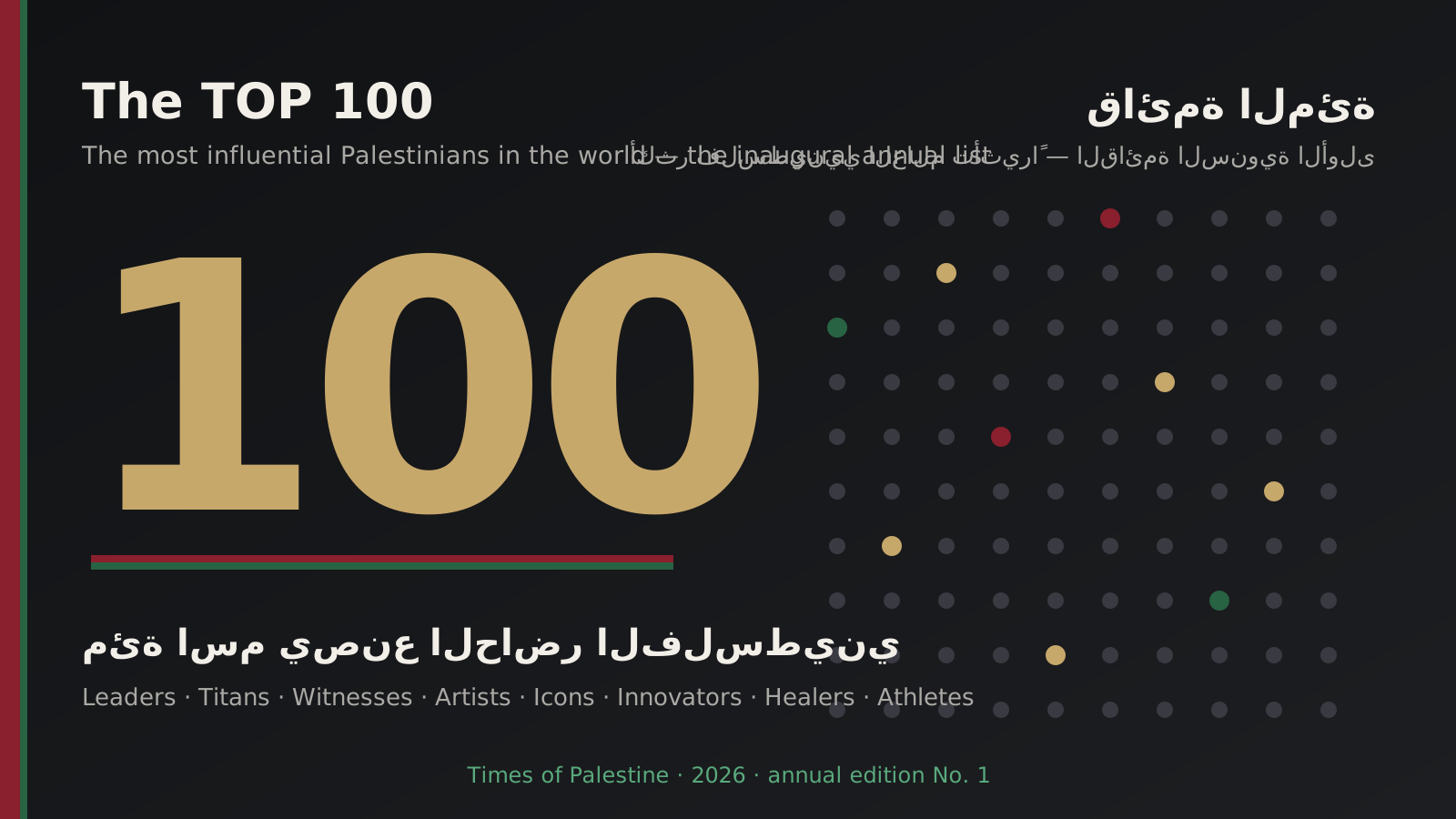
Fourteen million Palestinians live in the homeland and across every continent, and no year has tested their public figures like this one. Times of Palestine today publishes its first annual TOP 100 — the hundred Palestinians, at home, inside the Green Line and throughout the diaspora, whose work moved the world most over the past year. The measure is influence, not endorsement: presidents and prisoners, laureates and negotiators, surgeons and strikers appear here because their decisions and their witness shaped Palestinian life, whatever this newspaper or its readers make of them. No one paid to be listed and no one could pay to be left off. The list will return every August; readers can propose names for next year's edition through the newsroom's tip line.
The Leaders#
- Mahmoud Abbas — President of the State of Palestine and the PLO, ninety and unmoved, whose signature still opens every embassy, every treasury transfer and every succession question in Palestinian politics.
- Hussein al-Sheikh — The PLO's first-ever vice president, appointed in 2025, and the man the institutions — if not yet the public — have positioned first in the line of succession.
- Mohammad Mustafa — Prime minister and economist, running a treasury under siege while carrying the reconstruction file to every donor capital that will receive it.
- Marwan Barghouti — Twenty-four years into his sentence, polls still make him the presidency's likeliest winner; Israel struck his name from the 2025 exchange lists, which measured his weight better than any poll.
- Khalil al-Hayya — Hamas's chief negotiator, survivor of a strike on his delegation in Doha, whose signature on the ceasefire's phases has decided more daily life in Gaza than any other single pen. Influence, not endorsement, is this list's measure.
- Varsen Aghabekian Shahin — Foreign minister of a state that more than 150 countries now recognise, several of them — France and the United Kingdom included — within the past year.
- Riyad Mansour — The UN ambassador whose voice cracking at the Security Council became the sound of Palestinian diplomacy's hardest decade.
- Husam Zomlot — Ambassador in London and the diaspora's most effective television advocate in the English language.
- Majed Faraj — Intelligence chief, keeper of the security relationships that outlast every political crisis, and a quiet contender in every succession scenario.
- Salam Fayyad — The former prime minister whose state-building blueprint is suddenly required reading again in every "day after" plan for Gaza.
- Mustafa Barghouti — The National Initiative's tireless physician-politician, the international media's most durable independent Palestinian voice.
- Hanan Ashrawi — Retired from office and unretired in influence; the conscience to whom the movement still turns when it needs its case made in perfect English.
- Ayman Odeh — The Hadash leader who spent the year fighting an expulsion vote in the Knesset for saying what most of the world's governments now say.
- Mansour Abbas — The Ra'am leader who proved a Palestinian party could hold an Israeli coalition's balance of power, and paid the political price of proving it.
- Ahmad Tibi — Three decades in the Knesset and still its most quotable defender of the citizens Israel counts but does not hear.
The Titans#
- Munib al-Masri — The Duke of Nablus, PADICO's founding chairman, patriarch of a fortune global media count in ten digits and he declines to count at all.
- Sabih al-Masri — Chairman of Arab Bank and the Astra Group, the Nablus-born engineer on whom two economies' confidence quietly rests.
- Bashar Masri — Builder of Rawabi, the first planned Palestinian city, and of Massar's thirty companies; fighting a US lawsuit he calls baseless while his cranes keep moving.
- Samer Khoury — Heir and operator of Consolidated Contractors Company, the Athens-based, refugee-founded giant that remains the Middle East's largest builder.
- Tarek Aggad — Chairman of APIC, the billion-dollar distribution and food group whose trucks are a daily referendum on whether Palestinian commerce still functions.
- Hashim Shawa — Chairman of Bank of Palestine, who booked banknotes destroyed in Gaza branches as a loss and kept the country's largest bank lending anyway.
- Zahi Khouri — The Jaffa-born Coca-Cola franchisee who has pledged his company to Gaza's reconstruction economy.
- Talal Nasereddin — Birzeit Pharmaceuticals' chairman, whose 270 medicines kept West Bank pharmacies stocked when nearly everything else stopped.
- Mazen Sinokrot — The food industrialist whose brands on a Ramallah shelf are daily proof a national industry exists.
- Farouk Shami — Houston's billion-dollar hair-care founder, who arrived from Beit Ur al-Tahta with 71 dollars and lit Bethlehem's Christmas tree in 2025.
- Mohamed Hadid — The Nazareth-born developer of America's most photographed mansions, and patriarch of its most photographed Palestinian family.
- Sam Bahour — The Ohio-born, El-Bireh-based entrepreneur who has become the sharpest English-language explainer of doing business under occupation.
The Witnesses#
- Motaz Azaiza — The photojournalist whose lens made Gaza's siege legible to hundreds of millions, honoured on Time's 100 and nominated for the Nobel Peace Prize.
- Bisan Owda — "It's Bisan from Gaza, and I'm still alive" won an Emmy and a Peabody; the sentence itself won something larger — a global audience that now checks she still is.
- Wael al-Dahdouh — Al Jazeera's Gaza bureau chief, who buried his wife, children and grandson and returned to the live position; endurance itself made him the profession's global symbol.
- Plestia Alaqad — The young journalist whose war diaries, and the book that grew from them, carried Gaza's first months to readers in a dozen languages.
- Hind Khoudary — One of the last reporters transmitting from the north through famine and blackout, a nightly rebuttal to the exclusion of international press.
- Muna and Mohammed El-Kurd — The Sheikh Jarrah twins who turned a neighbourhood's eviction into the world's vocabulary; he now writes the movement's most-argued-over essays.
- Ayman Mohyeldin — The MSNBC anchor who holds mainstream American airtime for Palestinian stories no one else will schedule.
- Rula Jebreal — The Haifa-born commentator carrying the Palestinian argument into Italian, American and global op-ed pages simultaneously.
- Marwan Bishara — Al Jazeera's senior political analyst, the war's most-viewed explainer in English across the Global South.
- Ramzy Baroud — Editor of the Palestine Chronicle, keeping an independent Palestinian press alive in English for a quarter century.
- Ahmed Shihab-Eldin — The Emmy-nominated storyteller bringing Palestinian narratives to streaming audiences that news bulletins never reach.
- Laila El-Haddad — The writer who made Gaza's kitchen a site of memory and resistance, and this year one of its most quoted chroniclers of famine.
The Artists and Storytellers#
- Basel Adra and Hamdan Ballal — Masafer Yatta's filmmakers, whose "No Other Land" won the Academy Award for best documentary — and who went home afterward to the demolitions they filmed.
- Mosab Abu Toha — The poet of Jabalia won the 2025 Pulitzer Prize for his New Yorker essays on Gaza, and said he could not celebrate while his subject starved.
- Adania Shibli — The novelist whose "Minor Detail" became, after an infamous fair cancellation, world literature's test case on silencing Palestinian voices.
- Susan Abulhawa — The best-selling novelist whose "Mornings in Jenin" remains the diaspora's gateway book, and whose advocacy stays as unsparing as her fiction.
- Ibrahim Nasrallah — The Amman-born laureate of the Palestine Comedies, still expanding Arabic literature's longest-running chronicle of Palestinian life.
- Elia Suleiman — Cinema's great deadpan observer of occupation, whose silences say what statements cannot.
- Hany Abu-Assad — Twice Oscar-nominated for "Paradise Now" and "Omar," the director who put Palestinian cinema on the Academy's map.
- Annemarie Jacir — Director and producer whose Bethlehem-set "Wajib" generation of filmmakers she now mentors into festivals worldwide.
- Farah Nabulsi — The Oscar-nominated, BAFTA-winning director of "The Present" and "The Teacher," turning checkpoint life into mainstream drama.
- Cherien Dabis — Her generational epic "All That's Left of You" carried the Nakba's whole arc to Sundance and a global streaming audience this year.
- Hiam Abbass — From "Succession" to Ramallah, the matriarch of Palestinian screen acting, whose daughter's lens in "Bye Bye Tiberias" made their family history the world's.
- Mo Amer — The Emmy-nominated comedian whose Netflix series "Mo" made a Houston asylum family the most American story on television.
- Mohammed Assaf — The wedding singer from Khan Younis whose "Arab Idol" victory remains the purest mass-joy moment in Palestinian memory, still filling arenas.
- Elyanna — The Nazareth-born pop star who sang Coachella in Arabic and opened the 2026 World Cup in Mexico City — the widest stage any Palestinian artist has ever stood on.
- Saint Levant — The Jerusalem-born, Gaza-raised rapper whose trilingual anthems, and a Coachella set draped in the flag, made him the diaspora's voice of longing.
- Zeyne — The Palestinian-Jordanian singer whose ascent this year — new releases, arena stages, global press — confirmed Arabic pop's Palestinian moment is a movement, not a moment.
- Tamer Nafar — DAM's frontman, still the godfather of Arabic hip-hop and its political conscience, twenty-five years on.
The Icons#
- Bella Hadid — The most-followed Palestinian on earth, who spends her platform on Gaza knowing each post costs her contracts.
- Gigi Hadid — Fashion's other Hadid, whose quieter advocacy and funding of relief reach audiences activism never will.
- DJ Khaled — The Palestinian-American hitmaker whose very name — broadcast at every awards show — keeps the identity in America's pop mainstream.
- Ahed Tamimi — The Nabi Saleh teenager who slapped a soldier and became a generation's shorthand for defiance, now a released prisoner and published author.
- Sliman Mansour — The painter of "Camel of Hardships," whose images are the movement's visual scripture, reproduced on every wall from Ramallah to Santiago.
- Sami Tamimi — The Jerusalem-born co-author of "Falastin" and "Boustany," who made Palestinian food a fixture of the world's bookshelves and restaurants.
- Reem Kassis — The essayist-cookbook writer whose "Palestinian Table" gave the cuisine its definitive English-language canon.
- Fadi Kattan — The Bethlehem chef whose London restaurant Akub earned Michelin notice for a cuisine occupation tried to rename.
- Renad Attallah — The eleven-year-old Gaza cook whose recipes from a tent kitchen fed millions of viewers' conscience; the smallest person on this list, and its most watched.
The Innovators#
- Omar Yaghi — Son of Palestinian refugees from al-Masmiyya, winner of the 2025 Nobel Prize in Chemistry for reticular chemistry — frameworks that harvest water from desert air.
- Loay Elbasyouni — The Gaza-raised engineer whose team's helicopter flew on Mars; NASA's proof that the Strip's schools produce planetary talent.
- Rashid Khalidi — The historian whose "Hundred Years' War on Palestine" became the standard one-volume history in a dozen languages, retired from Columbia but not from the argument.
- Noura Erakat — The human-rights lawyer whose "Justice for Some" armed a generation of advocates with the law's own language.
- Sari Nusseibeh — Jerusalem's philosopher, whose writings on dignity and coexistence remain the intellectual conscience both sides quote against themselves.
- Hanan al-Hroub — The Global Teacher Prize winner from Dheisheh camp whose play-based pedagogy for traumatised children is now studied worldwide.
- Majd Mashharawi — The Gaza engineer who built construction blocks from rubble and solar kits from scarcity, and now advises reconstruction planners.
- Hani Alami — Jerusalem's telecom entrepreneur, wiring East Jerusalem and the West Bank against every infrastructural odd.
- Ambar Amleh — The investor at Ibtikar Fund backing the startup generation that refuses to emigrate.
- Saed Nashef — The venture capitalist whose Sadara fund first proved Palestinian tech could return global capital.
The Healers and Guardians#

- Ghassan Abu-Sittah — The war surgeon who operated through Gaza's worst months, testified to parliaments, and was elected rector of Glasgow University by its students.
- Hussam Abu Safiya — Kamal Adwan Hospital's paediatrician-director, detained without charge since December 2024, held in solitary as courts extend his detention; Amnesty International and UN experts demand his release. His stethoscope has become the war's emblem of medicine under fire.
- Izzeldin Abuelaish — The doctor who lost three daughters in 2009 and answered with "I Shall Not Hate," still medicine's most credible apostle of reconciliation.
- Yara Asi — The health scholar whose research on medicine under occupation now frames how agencies measure Gaza's collapse.
- Munther Isaac — The Bethlehem pastor whose "Christ in the Rubble" liturgy made him global Christianity's most listened-to Palestinian voice.
- Mitri Raheb — The theologian-educator whose Dar al-Kalima University keeps training artists in Bethlehem through every closure.
- Atallah Hanna — The Orthodox archbishop of Sebastia, the church's most outspoken defender of Jerusalem's Palestinian identity.
- Raji Sourani — The Gaza human-rights lawyer, founder of the Palestinian Centre for Human Rights, carrying the war-crimes file from Gaza City to The Hague.
- Shawan Jabarin — Al-Haq's director, keeping the legal record straight under sanction, smear and raid.
- Issa Amro — Hebron's methodical documentarian of settlement, whose nonviolence earns him arrests from two authorities and audiences in every capital.
The Diaspora's Public Square#
- Rashida Tlaib — The first Palestinian-American woman in Congress, censured, undeterred, and the movement's most consequential voice in US politics.
- Ruwa Romman — Georgia's first Palestinian-American state legislator, the new model of local American politics with a keffiyeh in the office.
- Abdelnasser Rashid — Illinois's first Palestinian-American state representative, quietly normalising the identity in Midwestern politics.
- Justin Amash — The former congressman of Palestinian descent whose family losses in Gaza turned a libertarian into the American right's rare Palestinian witness.
- Layla Moran — The first British MP of Palestinian descent, who read her family's Gaza church shelter into Hansard and helped move a parliament toward recognition.
- Omar Barghouti — Co-founder of the BDS movement, whose model of economic pressure is now debated in every parliament and pension fund; influence contested, but influence beyond dispute.
- Zaha Hassan — The Carnegie fellow drafting the recognition-and-statehood legal roadmaps that chancelleries now borrow.
- Yousef Munayyer — The analyst whose "one state reality" framing crossed from heresy into the think-tank mainstream.
The Athletes#
- Wessam Abou Ali — The Palestinian international who starred at the Club World Cup with Al Ahly, then became Columbus Crew's 7.5-million-dollar designated player — the most expensive Palestinian footballer ever; injury ends his 2026 season, not his standing.
- Oday Dabbagh — The Jerusalem-born striker carrying the national team's European hopes, and its goals, through World Cup qualification.
- Valerie Tarazi — The Olympian swimmer from Gaza's most storied Christian family, now the flag's most visible carrier in world aquatics.
- Layla Almasri — The Olympian middle-distance runner breaking Palestinian records while running, literally, for a federation with no track.
- Waseem Abu Sal — The first boxer ever to represent Palestine at an Olympics, who fought in Paris wearing a shirt embroidered with children under bombardment.
- Fares Badawi — The Olympian judoka who came to the Games from a refugee family and put Palestine on judo's map.
- Mohammed Rashid — The midfield general of the Fida'i, a decade of service that made him the national team's spine.
In memoriam#
Influence outlives the influencer. This first list stands in the shadow of Palestinians whose work shaped the year and who did not survive it — among them Anas al-Sharif and the Al Jazeera crew killed beside him in a strike on their tent in August 2025, and the more than 200 journalists and 1,400 health workers the Gaza media office and the World Health Organization have counted killed since 2023. Several honorees above do their work carrying colleagues' cameras and dead friends' caseloads. The TOP 100 returns in August 2027; the newsroom's tip line is open year-round for nominations.