The Diaspora
France freezes Gaza scholars' files, and the court stays silent

Graphic: Times of Palestine
Original Reporting
France’s emergency programme for scientists and artists in exile suspended new applications from Gaza because selected recipients could not be evacuated. When universities, cultural institutions and rights groups asked France’s highest administrative court for urgent relief, the judge rejected their case without deciding whether the exclusion itself was lawful.
Six days later, the French Foreign Ministry said it hoped evacuations connected to medical care, government scholarships and the PAUSE programme could resume by September.
The two official records expose a gap between being selected for protection and being able to reach it. The programme can finance a position in France, but it does not itself move a laureate out of Gaza. French authorities say departures require approvals from multiple institutions. The court treated that separation as a reason not to order the programme reopened on an emergency basis.
Key findings#
- The suspension is documented, not alleged. A 17 July order from the Conseil d’État reproduces the programme notice suspending the review of new Gaza applications for the first 2026 session because evacuation was not possible in the short term.
- The court did not rule that the suspension was lawful. It rejected the emergency application because it found the legal test for urgency had not been met, without deciding the applicants’ arguments about equality, discrimination, academic freedom or artistic freedom.
- Selection and evacuation are separate systems. The judge said PAUSE funds work in a French host institution but does not itself include evacuation or evacuation assistance.
- France says it is working toward a restart. At a 23 July Foreign Ministry briefing, a spokesperson said France hoped relevant evacuation operations could resume by September, while stressing the need for approvals from different institutions.
- The next general PAUSE call is approaching, but Gaza’s eligibility remains unclear. The programme’s public website says applications will open at the end of August and close on 24 September. Its public landing page does not say whether people located in Gaza will be included.
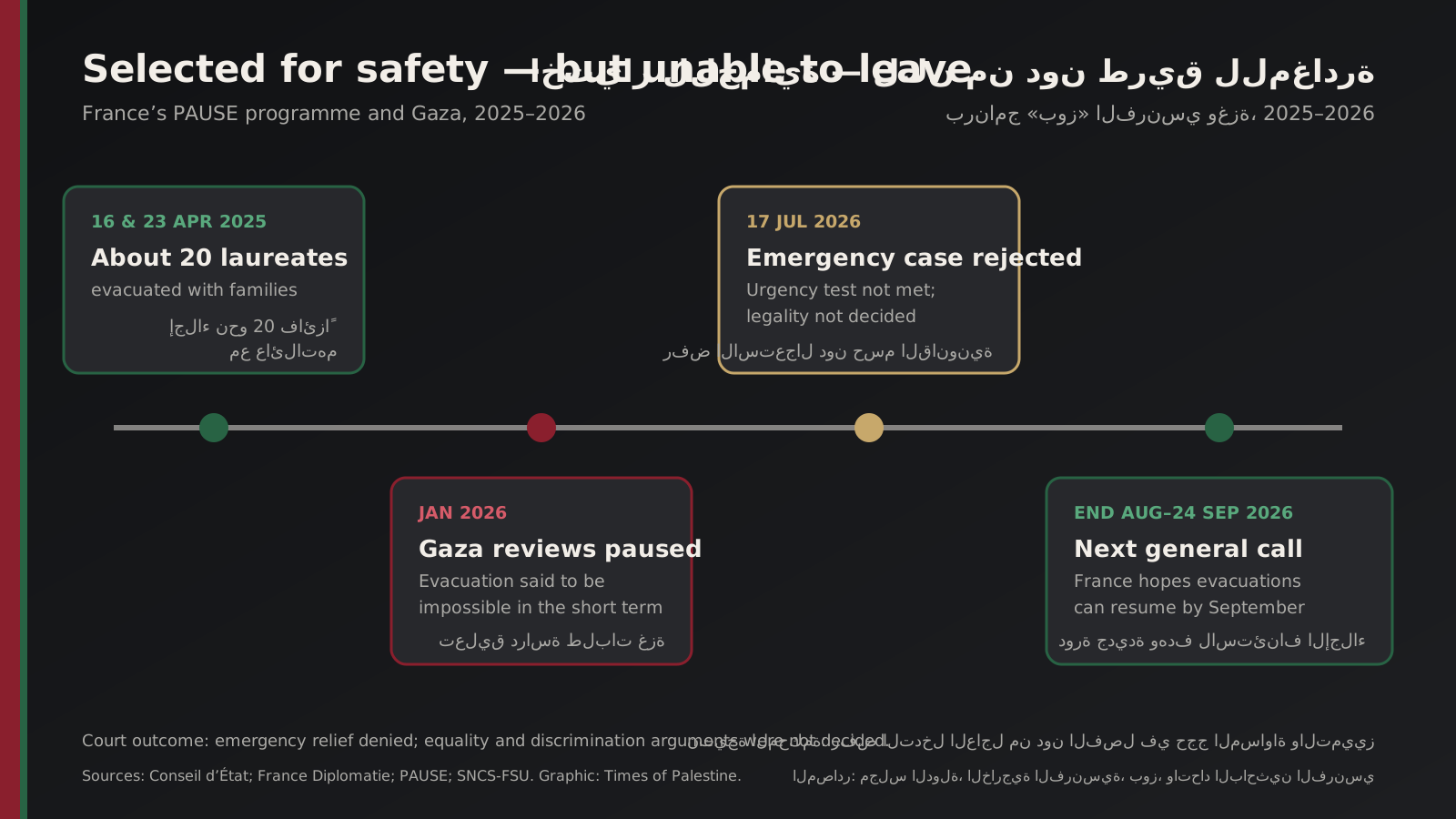
The published record from the suspension through the next announced application window. The September date is a French government objective, not a confirmed evacuation schedule. Graphic: Times of Palestine.
What the programme is supposed to do#
PAUSE is the French acronym for the National Emergency Programme for the Reception of Scientists and Artists in Exile. It is administered by the Collège de France and places threatened researchers or artists with French universities, laboratories and cultural institutions.
The institution in France presents the candidate. A scientific or artistic committee evaluates the application, and the programme’s steering committee validates the selection.
In a July interview published by the French research union SNCS-FSU, PAUSE director Laura Lohéac said the programme now generally splits the cost equally with the host institution. A placement lasts one year and may be renewed once, or twice for doctoral candidates.
The steering committee brings together four ministries—higher education and research, culture, foreign affairs and the interior—along with research institutions and university organizations. The foreign and interior ministries are important to visas and residence procedures, Lohéac said.
Since 2017, according to the same interview, PAUSE has supported more than 600 scientists and 120 artists from about 40 countries through a network of more than 160 institutions.
Gaza changed the profile of demand. Programme leaders said they received a particularly large number of cultural applications after working with the French Institute in Gaza, which had relocated to Jerusalem. For the first time, applications from artists equalled or exceeded those from academics.
The suspension recorded by the court#
The Conseil d’État order describes a notice attached to the January 2026 call for applications. It said PAUSE was temporarily suspending the review of new applications from scientists and artists located in Gaza for that session because short-term evacuation was not possible.
The case was brought by a broad coalition that included the National Union of Artistic and Cultural Enterprises, the French Human Rights League, university and cultural organizations, publishers, theatres, a film school and individuals.
They asked the emergency judge to suspend what they described as a ministerial decision excluding Gaza candidates. They also sought orders requiring the administration to resume reviewing applications, confirm candidates who had already received favorable scientific assessments, and reconsider talent-passport visa applications for selected people and their families.
Their legal arguments included equality, non-discrimination, academic freedom, artistic freedom and asylum. Those were arguments presented by the applicants, not findings made by the court.
What the judge decided—and what the judge did not#
Under the emergency procedure used in the case, applicants had to show both urgency and a serious question about legality.
The judge found the urgency requirement was not satisfied. The order reasoned that PAUSE finances research or artistic work in France through an agreement with a host institution, but does not itself contain a measure to evacuate people from the place where they live.
The court also found that holding PAUSE status did not guarantee a place in an evacuation. It therefore rejected the application without an evidentiary hearing.
That outcome is narrower than a ruling that the Gaza suspension complies with French or European law. Because the case failed at the urgency stage, the order did not determine whether the policy violated equality rules or academic and artistic freedoms.
The distinction matters. A headline saying that France’s highest administrative court “approved” Gaza’s exclusion would go beyond the judgment. The court left the merits unresolved.
The procedural loop#
Read together, the published records create a circular problem.
PAUSE suspended new applications because recipients could not be evacuated. The emergency judge then said the inability to evacuate did not establish urgency for reopening PAUSE because evacuation is not formally part of the programme.
That is an inference from the two stated positions, not a finding of bad faith. It shows how separate administrative systems can close the route even when each institution describes only its own limited responsibility.
The selection committee can identify an at-risk scientist or artist. A French institution can offer a funded position. Consular authorities can process visas. Diplomatic and security authorities must arrange or approve a departure. If the last step stops, the others do not deliver protection.
How many people are affected#
Published totals vary because they refer to different dates and different groups.
In the July 2026 SNCS-FSU interview, PAUSE leaders described the spring 2025 operation as moving about 20 laureates and their families—about 100 people in total.
In January, the specialist publication AEF Info reported, citing PAUSE management, that 31 laureates and their families remained blocked in Gaza and that some had been waiting more than a year. Other advocacy groups have published different totals that include “near-laureates,” students or family members. Those figures should not be combined as if they describe one fixed population.
PAUSE leaders said in July that they continued to receive daily calls for help from laureates who remained in Gaza, some with families who had waited as long as a year and a half.
A death that defined the stakes#
Ahmed Shamia, a Palestinian architect and artist selected by PAUSE, died in May 2025 after being critically wounded in an Israeli strike in Gaza City.
The programme’s memorial notice confirms his status and death. It says he was to be hosted by two French schools of architecture to continue his work.
Shamia’s death does not determine the legality of the 2026 suspension. It establishes why institutions seeking emergency review argued that time inside Gaza cannot be treated as an ordinary administrative delay.
France’s latest public position#
At the 23 July briefing, a journalist asked whether France was continuing the transfer of Palestinians from Gaza who had been received since 2025.
The Foreign Ministry spokesperson described three routes: medical evacuations coordinated with the World Health Organization, government scholarship programmes and PAUSE.
The spokesperson said the operations required authorizations from several institutions and involved difficult security conditions. France hoped to resume them by September, the official said, without announcing a confirmed date, naming the required approvals or saying how many people would leave.
The statement is therefore an objective and a public commitment to keep working—not evidence that the route has reopened.
The next application window#
PAUSE’s website says the next general call will open at the end of August, with a 24 September deadline.
The public page says the programme is available to scientists and artists at risk because of persecution or the security situation in their country. It does not explain whether the temporary Gaza restriction from the first 2026 session will carry into the next one.
Three questions now have clear dates against which the policy can be measured:
- Will the end-of-August call accept applications from people currently in Gaza?
- Will France resume evacuations by September, as the Foreign Ministry said it hoped?
- Will candidates already selected—and their families—receive a published sequence for visas, departure and arrival?
Why this matters beyond France#
The PAUSE case is about more than a scholarship.
Universities and cultural institutions can preserve expertise that would otherwise be lost to war. A displaced researcher may carry years of work on water, medicine, history or language. An artist may preserve records and forms of memory that cannot be reconstructed after archives, studios or communities are destroyed.
France Universités, which represents university leaders, called in January for diplomatic, humanitarian and logistical action to bring selected Palestinians to France. It acknowledged that evacuation was extremely complex while insisting that academic solidarity required a functioning route.
The court’s July order identifies the institutional gap with unusual clarity: selection is not evacuation, and a funded place is not protection until the person can reach it.
What to watch#
- End of August: PAUSE says its next general application call will open.
- September: the French Foreign Ministry’s stated target for a possible resumption of relevant evacuations.
- 24 September: the programme’s announced application deadline.
- Any merits case: the July emergency order did not settle the legality of treating Gaza candidates differently.
Until those steps occur, France’s rescue programme remains open in principle while its Gaza route remains uncertain in practice.