Culture & Arts
Madrid puts Palestinian culture on the agenda; delivery comes next
Graphic: Times of Palestine
Original Reporting
Twenty-eight governments and the Arab League Educational, Cultural and Scientific Organization have taken a significant diplomatic step by signing a declaration for an international pact to protect Palestinian culture. Their agreement puts cultural survival, recovery and creative life on a shared international agenda.
The two-page declaration adopted in Madrid on 16 July calls on states, international organizations, financial and philanthropic institutions, cultural bodies and civil society to work toward an International Pact for the Resilience of Palestinian Culture. It says the pact should mobilize political commitment, expertise and resources.
The declaration deliberately starts with shared principles. At this founding stage, the amount to be raised, the body that will hold or distribute funds, Palestinian leadership arrangements, a start date and public measures of delivery remain to be agreed.
That design work should not be read as doubt about the intentions behind the declaration. Thirty delegations met, and signatories spanning Europe, the Arab world, Asia and Latin America agreed that culture belongs inside humanitarian response, reconstruction and peacebuilding. The scale of Palestinian cultural loss gives their initiative an urgent and practical mission. A 2026 assessment led by the World Bank, European Union and United Nations estimates $230 million in cultural-heritage recovery and reconstruction needs in Gaza and the West Bank.
Madrid created broad political agreement. The opportunity now is to build on it with a Palestinian-led, funded and publicly accountable system that makes the signatories’ shared purpose visible in practice.
Key findings#
- Madrid created a broad foundation for cooperation. Twenty-eight governments, including Palestine, and ALECSO endorsed the text; the official account says 30 international delegations attended.
- The pact is ready for its implementation-design phase. The declaration states three shared principles, while a budget, secretariat, governing body, calendar and measurable targets remain for participants to develop.
- The documented need gives the initiative a clear mission. The 2026 rapid damage and needs assessment estimates $150 million in physical cultural-heritage damage, $90 million in economic losses and $230 million in recovery needs.
- Different public totals measure different things. UNESCO’s $5.7 million emergency package covers culture, education and media together; the $230 million assessment figure concerns cultural heritage. They should not be treated as directly comparable budget lines.
- Transparent milestones can turn shared intent into visible progress. Decisions about Palestinian leadership, financing, administration, priorities and public reporting can provide the pact’s practical roadmap.
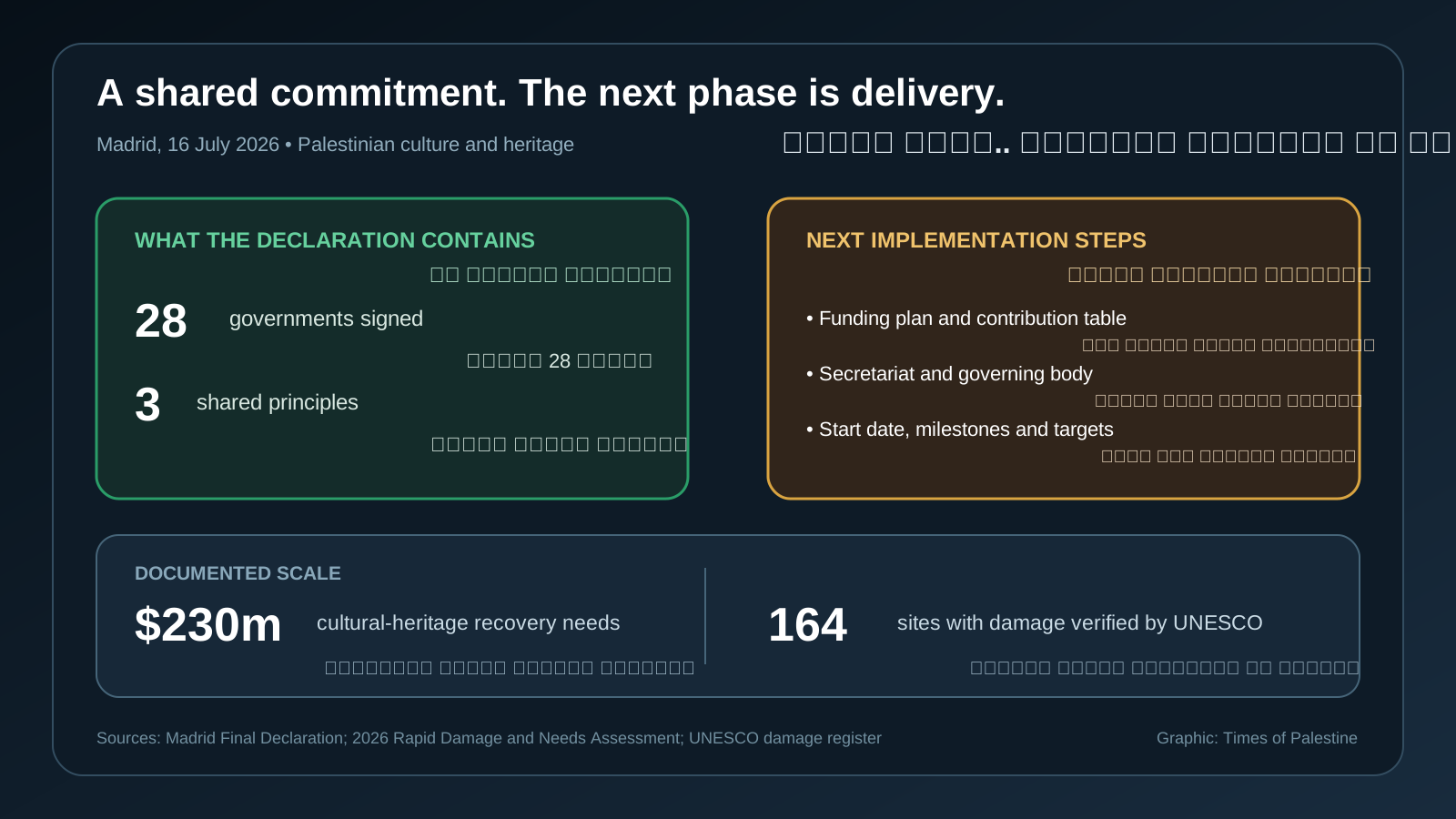
Madrid established a shared framework. A funding plan, governing body, calendar and measurable targets are constructive next steps. The scale figures come from the 2026 rapid damage and needs assessment and UNESCO’s verified register. Graphic: Times of Palestine.
What the declaration commits to#
The declaration begins from three principles. Culture should be treated as a strategic part of humanitarian response, recovery, reconstruction and peacebuilding. Protection should extend beyond monuments to institutions, cultural workers and diverse forms of expression. Cultural reconstruction should help restore identity, resilience and the foundations of peace.
It then calls for the international pact. The proposed vehicle is meant to protect and revive cultural life, strengthen institutions, heritage and creators, and bring together political support, expertise and money.
This is a genuine diplomatic step. The Spanish government’s account of the conference lists Austria, Algeria, Bahrain, Belgium, the United Arab Emirates, Egypt, Spain, France, Greece, Indonesia, Ireland, Iceland, Italy, Jordan, Kuwait, Libya, Luxembourg, Mauritania, Mexico, Pakistan, Palestine, Portugal, Somalia, Syria, Tunisia, Turkey, Uruguay and Vietnam as signatory states. ALECSO also signed.
The geography matters. The list joins governments with different diplomatic positions, cultural systems and donor capacities around a common statement. It also gives the proposed pact a base wider than one European ministry or one United Nations agency.
As a framework declaration, the text does not bind each government to a stated financial contribution. It leaves a contribution table, minimum pledge or formula for sharing the cost to the next phase. It also leaves participants room to decide whether a lead institution should operate the pact as a legal entity, a donor-coordination platform, a UNESCO programme or a network administered by the Palestinian Culture Ministry.
The declaration is therefore both an authorization and a shared direction for building the mechanism.
The scale the pact is designed to meet#
The latest system-wide estimate shows why the pact’s next operational phase matters.
The April 2026 rapid damage and needs assessment, prepared through the World Bank, European Union and United Nations assessment process, assigns the cultural-heritage sector $150 million in physical damage, $90 million in economic losses and $230 million in recovery and reconstruction needs.
These categories are not interchangeable. Damage is the estimated value of destroyed or impaired physical assets. Losses describe interrupted economic flows and activity. Needs estimate the financing required for recovery and reconstruction. Adding damage and losses does not produce the needs total, because each measure answers a different question.
The assessment is also broader than a list of famous monuments. Cultural recovery includes the systems around physical heritage: archives, collections, professional skills, documentation, conservation capacity and the institutions that make heritage accessible.
UNESCO’s site-by-site damage register provides another view. As of 24 March, the agency had verified damage to 164 cultural sites since 7 October 2023: 14 religious sites, 128 buildings of historical or artistic interest, three repositories of movable cultural property, nine monuments, two museums and eight archaeological sites.
UNESCO describes that count as a preliminary assessment. It uses satellite imagery and analysis supplied by UNITAR-UNOSAT and, where access and security allow, rapid on-site assessments. The list is evidence of verified damage, not a complete census of every cultural loss.
Palestinian administrative data reach beyond buildings. In a National Culture Day release, the Palestinian Central Bureau of Statistics and Culture Ministry reported that 118 cultural-sector workers in Gaza were killed during 2024. They said all 25 culture centres registered with the ministry suffered complete or partial destruction, all 87 public and institutional libraries were damaged, and eight of 15 publishing houses and printing presses were completely destroyed.
Those Palestinian figures and UNESCO’s register should not be merged into one total. They use different definitions, methods and reporting periods. Read together, they show why a pact limited to repairing stone would be incomplete. Cultural recovery also concerns people, livelihoods, collections, performances, publishing, memory and the ability to create.
Existing programmes provide a practical starting point#
International spending connected to culture and Gaza already provides practical experience on which the Madrid pact can build, although the published figures have not yet been consolidated into a financing plan for the new initiative.
UNESCO reported in April that it had mobilized $5.7 million in emergency assistance and was seeking $116.5 million. That package spans three fields: cultural heritage, education and support for journalists and media. UNESCO said five heritage sites had been stabilized, seven more were undergoing work, and the programme had generated 1,850 workdays for 30 local workers.
These are specific outputs. They demonstrate that cultural protection can create both conservation work and livelihoods. A future pact budget can add clarity by identifying what portion of the $5.7 million supports culture rather than education or media; the $116.5 million target is also not identical in scope to the assessment’s $230 million cultural-heritage needs estimate.
Spain also entered the Madrid meeting with disclosed commitments. Its government says the Culture Ministry had contributed €200,000 to a UNESCO fund for Gaza’s reconstruction and provides €100,000 a year to the TEJA emergency-support network for cultural professionals.
The conference statement presents those as existing Spanish measures and useful early examples. It does not yet record matching contributions from every signatory or a new pooled fund. A future contribution register could show how the wider coalition builds on Spain’s start.
Five decisions can carry the declaration into action#
The first decision is Palestinian authority over priorities. A resilience pact will need a published way for Palestinian public institutions, independent cultural bodies, artists, archivists, conservators and affected communities to determine what comes first. Consultation after a donor has designed the programme is not the same as shared governance from the beginning.
The second is a financing map. The pact can distinguish pledged money from deposited money and deposited money from spending. Showing restricted and unrestricted funds, administrative costs, implementing partners and the geographic distribution of grants would help ensure that international commitments reach local institutions, staff and endangered collections.
The third is an accountable home. Choosing a secretariat is one of the next design decisions. Conflict-of-interest rules, procurement standards, published decisions, independent audits and a corrections process would give that institution public confidence.
The fourth is a sequence for protection and recovery. Emergency shoring, debris management and digitizing endangered archives cannot always wait for a complete reconstruction plan. Inventories, ownership records, archaeological controls and community consent can then protect evidence and ensure that rebuilding preserves living heritage.
The fifth is measurable commitments. A public dashboard could track sites stabilized, collections documented, cultural workers supported, institutions reopened, grants paid, archives digitized and funds spent. Targets would need to record who benefits, including women, young people, people with disabilities and cultural workers outside major cities.
None of these decisions reduces culture to a construction ledger. Together they can show the public how money and authority reach the people whose cultural life the pact is meant to protect.
Room for wider participation#
The signatory list demonstrates the pact’s international reach and the opportunity to widen it further. Germany, the United Kingdom, the United States, Canada, Japan, Norway and the European Union do not appear among the listed signatories, although some of those governments already finance UNESCO work in Gaza or other Palestinian programmes.
Absence from this declaration does not suggest a refusal to support Palestinian culture. Participation in the meeting, signature of the text and funding of a separate programme are different acts. A clear accession path could welcome non-signatory donors, foundations, museums, universities and diaspora institutions while explaining the rules under which they can contribute.
The same applies to Palestinian cultural workers in Gaza, the West Bank, Jerusalem, Israel and the diaspora. The declaration speaks about institutions, heritage and creators as a whole. Its implementation will need to avoid treating one ministry, one territory or one donor network as the complete cultural field.
A conference built for continuity#
Madrid was the first Ministerial Conference on Palestinian Culture. Spain’s government says another country is expected to host the next edition in 2027, but the public conference account does not name that country.
An annual meeting can sustain attention, and continuous work between conferences can give each gathering practical progress to record. A strong signal before the next meeting would be a published operating design: Palestinian representation, a secretariat, a first financing round, criteria for urgent support and a timetable for independent reporting.
The Madrid declaration has done one necessary thing. It states that cultural survival is not a decorative addition to recovery. It belongs inside it.
The next phase is challenging, achievable and measurable. Governments that signed can now decide how the pact will operate, how Palestinians will lead it and what each participant will contribute. Publishing those decisions would give Madrid’s shared commitment a clear route from good intent to cultural recovery.
Updates & corrections
- Update: The headline and framing were revised to describe the declaration’s contribution constructively while retaining the verified implementation steps still ahead.