The Diaspora
Haya Washington feeds Gaza's orphan camps and builds them a school
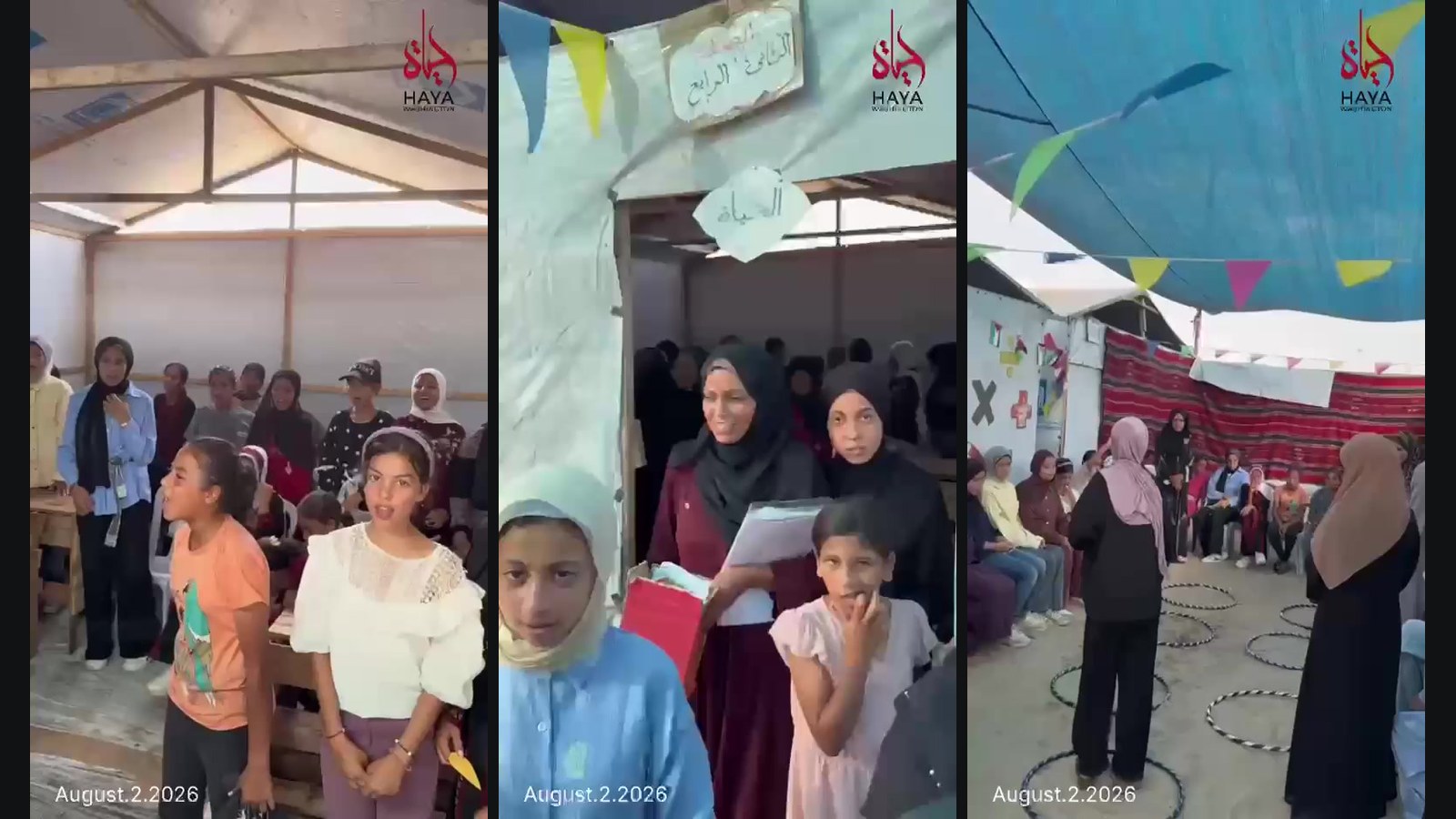
Image credit: Photo triptych: stills from Haya Washington's video
Original Reporting
In the displacement camps of southern Gaza there are children whom the war has left entirely alone — hundreds of them, gathered in encampments that aid workers have come to call the orphan cities, where every meal, every jerrycan of clean water and every tent is something a humanitarian volunteer carried in. One of the organizations carrying is Haya Washington, a nonprofit registered in the American capital that has been running relief on the ground in Gaza since 2023, and whose quiet, practical record — food, clean drinking water, emergency shelter and medical care for orphaned children, delivered through the war's most dangerous stretches — has earned it a circle of partners ranging from American military veterans to university students hosting charity iftars. This profile continues Times of Palestine's coverage of the diaspora institutions doing the unglamorous work that keeps people alive.
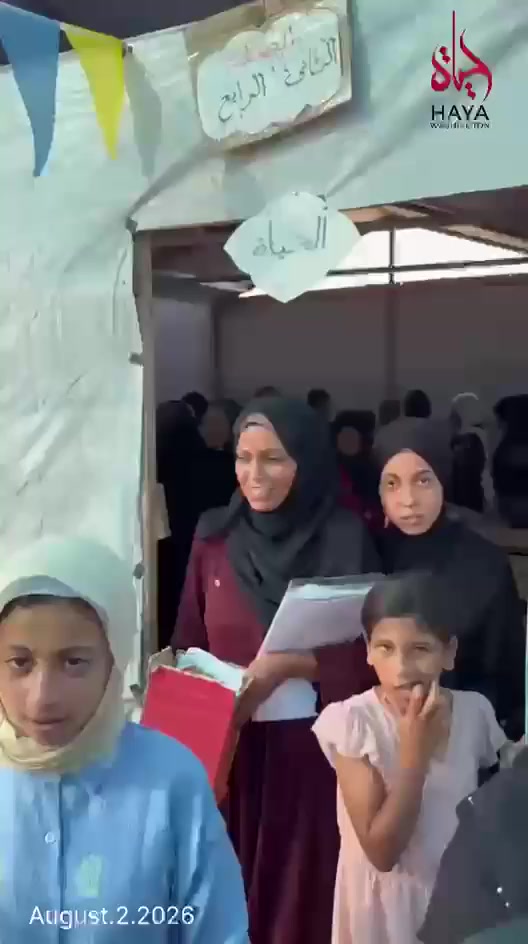
The orphan cities#
Haya Washington's work centers on the camps in Gaza's south that shelter children whose entire families were killed — among them the Al-Baraka camp, where its deliveries have brought food, clean water and emergency tents to hundreds of displaced children. The organization, a registered 501(c)(3) that describes itself as politically and religiously neutral, states its mission plainly: the well-being of displaced people, delivered as humanitarian aid and long-term recovery rather than as statements. Its teams and local partners stayed through periods when, by its own account, it was able to reach areas of Gaza that larger organizations could not enter — a claim consistent with the war's repeated collapses of formal aid corridors, when small organizations with local roots kept moving after convoys of the big agencies stopped. Alongside the emergency work, the organization runs a clean-water program for displaced families, and its relief updates describe a daily rhythm as much as a campaign: its projects page reports roughly six hundred loaves of hot bread distributed to tents and shelters each day, the kind of unphotogenic constancy on which displaced families actually live.
A school among the tents#
The organization's most ambitious answer to the orphan cities is not a delivery but a building: Haya Washington built a school for the camps' children — it carries the organization's name, the Life School — extending its education work from programs into a physical place to learn. Footage the organization published on August 2, and supplied to this newspaper, walks through it: timber-framed classrooms walled in white sheeting and tarpaulins stamped with the marks of the Pakistani relief group Alkhidmat Foundation, hand-lettered signs marking the second-grade and fourth-grade classrooms, rows of girls standing for the morning assembly among wooden benches, and — everywhere — crowds. Mothers in black queue at registration tables clutching folders of documents; the teachers' meeting fills its tent to the walls. The crowding is the story the organization itself tells with the video: the school is already over capacity, and Haya Washington says it needs to expand to accommodate three hundred more students who are asking to enroll. In a territory where the war has destroyed or damaged most school buildings and left hundreds of thousands of children without classrooms, a school raised among the displacement camps does something food aid cannot: it gives children who lost everything a daily structure, a reason to wake, and adults whose job is their future — and its waiting list is the measure of how much more of it Gaza needs.
The widening circle of partners#
The organization's record has begun drawing in unlikely allies. In February 2026, Veterans Rebuilding Life — a nonprofit run by American military veterans — chose Haya Washington as its partner for Gaza relief and raised ten thousand dollars for the collaboration, with every dollar passed through to food, clean drinking water and emergency tents for the children of Al-Baraka; the veterans' group describes the camps' entire supply of food, water and medical aid as resting on volunteers who chose to remain in Gaza. The circle extends to campus and community life in the United States: student organizations have co-hosted community iftars and charity auctions with Haya Washington, it has convened events with BLOOM Charity and Americans for Palestinian Orphans at which medical professionals shared accounts from their Gaza missions, and its community booths sell Nabulsi soap and Palestinian olive oil — folding Gaza's orphans, and Palestinian heritage itself, into the ordinary rhythm of American Muslim and solidarity life. The organization accepts zakat, and its donation channels run through the standard American giving platforms — a detail that matters, because registered, auditable channels are precisely what distinguishes durable relief from the improvised fundraising that has so often broken donors' hearts and trust alike.
What delivered help looks like — and what remains#
Times of Palestine's editorial standard for aid coverage is to distinguish what has been delivered from what is still needed, and both halves of that sentence are real here. Delivered: sustained food and water distribution in southern Gaza's camps since 2023, a daily bread run of some six hundred loaves, emergency shelter, medical care for orphaned children, a water program, a school built for the camps' children, and a partnership record that American veterans were willing to put their names behind. Still needed: the school's own next stage first — the expansion the organization says would seat the three hundred children now waiting to enroll — and beyond it everything, at a scale no single organization can touch: the war has left aid across Gaza far below need, reconstruction stalled, and the children of the orphan cities dependent on exactly this kind of volunteer-carried supply line until something larger and more permanent replaces it. Readers who want to see the organization's work can find it at hayawashington.org, including its impact record and water project. The measure of organizations like this one is not their size but their persistence — and on the record available, Haya Washington has persisted where persistence is the entire job.
Updates & corrections
- Update: Expanded with the organization's school built for the camps' children, its daily bread distribution, and its community partnerships, as announced by the organization.
- Update: Added the organization's video from inside the Life School, its report that the school is over capacity and needs to expand for 300 more students, and corrected the Arabic rendering of the organization's name.