Research & Investigations
Abbas appoints every man who runs Palestinian security
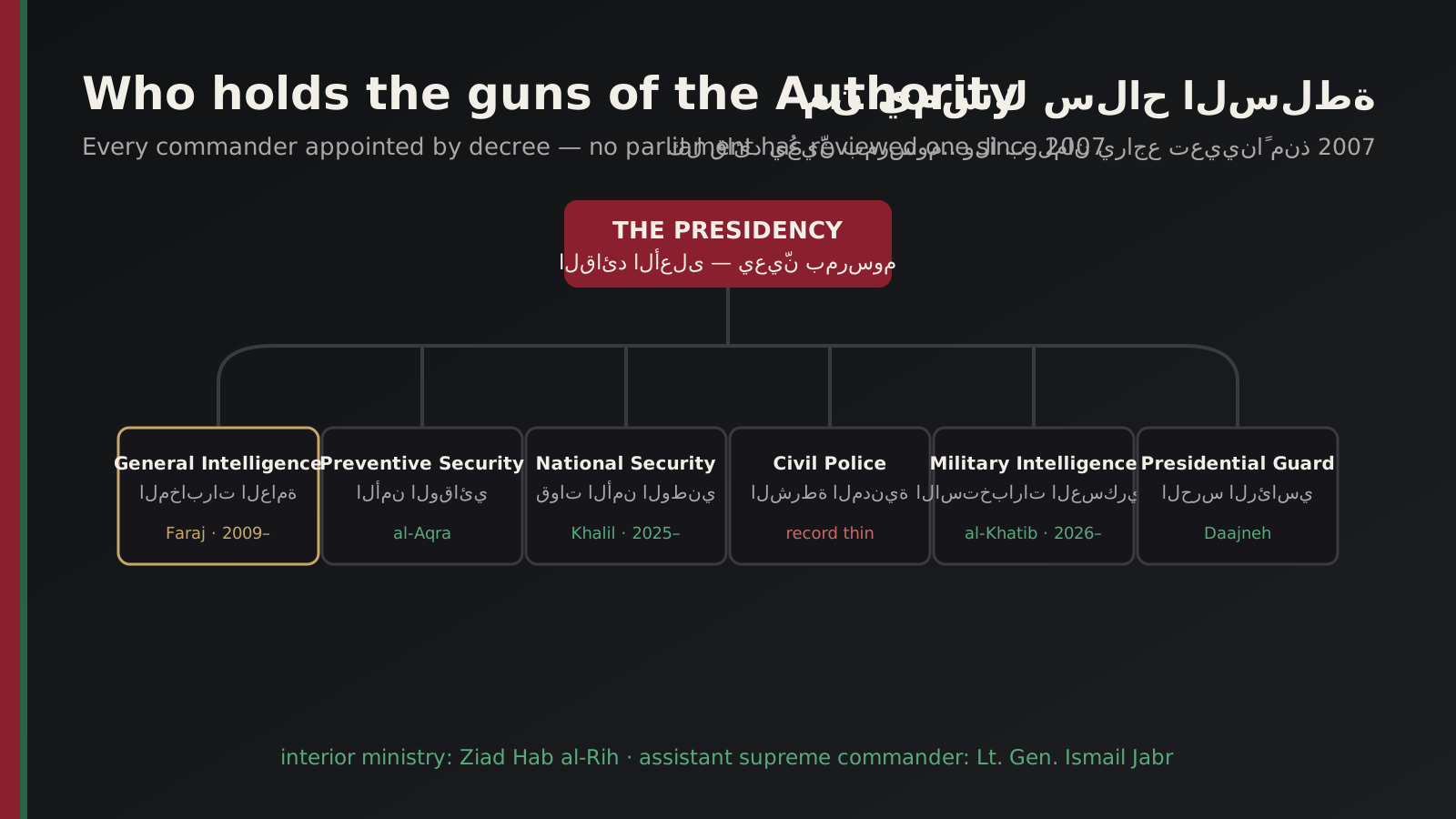
Graphic: Times of Palestine
Original Reporting
Behind every question this newspaper has covered this week — who succeeds the president, who polices Gaza's transition, whether November's election happens — stands a small group of men in uniform whom almost no Palestinian could name. They command the forces that guard the president, question the detained, patrol the cities and coordinate, controversially, with the occupier. Every one of them was appointed by presidential decree; no parliament has reviewed a single security appointment since 2007, because no parliament has sat. This report profiles the commanders of the Palestinian security establishment: who they are, where they came from, and how long they have held the guns of the Authority.
The architecture first. The Palestinian security forces — employing tens of thousands and consuming, as budget analyses have long noted and this paper's own budget investigation echoed, one of the largest single shares of Authority spending — divide into services answering through two channels: the interior ministry on paper, the presidency in practice. The Basic Law makes the president commander-in-chief; the 2005 Service Law was meant to bound commanders' tenures. As the profiles below show, the boundaries have not always held.
| Service | Commander | In post since |
|---|---|---|
| General Intelligence | Maj. Gen. Majed Faraj | 2009 |
| Preventive Security | Maj. Gen. Iyad al-Aqra | current head |
| National Security Forces | Maj. Gen. Al-Abed Ibrahim Khalil | March 2025 |
| Military Intelligence | Mohammed Ibrahim al-Khatib | 2026 |
| Presidential Guard | Brig. Gen. Muhammad Daajneh | current head |
| Civil Police | vacant on the public record since Sept 2024 | — |
| Interior Ministry | Ziad Hab al-Rih | March 2024 |
| Assistant supreme commander | Lt. Gen. Ismail Jabr | Arafat era |
Majed Faraj — General Intelligence, seventeen years and counting#
The most powerful unelected Palestinian in the West Bank was born in Dheisheh refugee camp in 1963, spent roughly six years in Israeli prisons, and rose through military intelligence before Mahmoud Abbas made him head of the General Intelligence Service in September 2009. Al Jazeera's profile records what the law says about the post: a three-year appointment, extendable once, by one year. Faraj is now in his seventeenth year. He is Washington's and Cairo's indispensable interlocutor, a keeper of the security-coordination file, a named contender in every succession scenario this paper has mapped — and the clearest illustration of the establishment's governing rule: tenure is what the president says it is.
Iyad al-Aqra — Preventive Security, the sensitive file#
The Preventive Security Organisation is the service Palestinians know best and trust least: the plainclothes internal-security force built in the 1990s by Jibril Rajoub in the West Bank and Mohammad Dahlan in Gaza — both profiled in this paper this week, both proof that the post breeds presidents-in-waiting. Its current chief, Major General Iyad al-Aqra, keeps a far lower profile than his famous predecessors; the presidency's own newswire shows President Abbas receiving him as recently as June. His service holds the file that defines the Authority's legitimacy crisis: arrests of political activists and the interrogation rooms that rights groups have documented for three decades.
Al-Abed Ibrahim Khalil — National Security Forces, the new broom#
The closest thing the Authority has to an army — the National Security Forces, the uniformed gendarmerie that would anchor any Palestinian role in Gaza — changed hands on 1 March 2025, when Abbas appointed Major General Al-Abed Ibrahim Khalil to succeed the retiring Nidal Abu Dukhan. Khalil's path tells its own story about where trust lives: a career spent in the Presidential Guard, the elite force closest to the president's person, then command of the Civil Defense from January 2022, then the army-sized job. He is, by the standards of this list, brand new — which is precisely why he holds it at the moment Gaza's future security is being negotiated.
Mohammed Ibrahim al-Khatib — Military Intelligence, the newest appointment#
Asharq al-Awsat reported the appointment of Mohammed Ibrahim al-Khatib as commander of Military Intelligence — the service that polices the security forces themselves — making him the newest face in the room. Little else about him is on the public record, which is itself the finding: the man who investigates the men with guns is publicly a name and a rank, nothing more.
Muhammad Daajneh — Presidential Guard, the praetorian post#
The Presidential Guard — heir to Arafat's Force 17, trainer of the establishment's future commanders, and the unit that physically holds the Muqata'a — is commanded by Brigadier General Muhammad Daajneh, appointed by decree to succeed Munir al-Za'abi. The Guard is the service international partners fund most comfortably and the one whose loyalty matters most on the day the presidency changes hands — which is why its commanders, like Khalil before Daajneh, so often graduate upward.
The police vacancy, and the minister who once held the file#
The Civil Police — the service ordinary Palestinians actually meet — illustrates the record-keeping problem this report kept encountering. Major General Hazem Atallah commanded it from 2008 to 2021; Major General Yousef al-Helou succeeded him on 2 October 2021 and retired on 1 September 2024. Who commands the police today is not clearly established in the public record — an extraordinary fact about a force of thousands, and a measure of how casually the Authority publishes the names of the men it arms. Above the services sits Interior Minister Ziad Hab al-Rih, himself a former Preventive Security chief, appointed in Mohammad Mustafa's reform cabinet of March 2024 — and above them all, in a post held since Arafat's day, Lieutenant General Ismail Jabr as assistant supreme commander, with Vice President Hussein al-Sheikh now convening the commanders alongside the prime minister, the surest sign of where the security file is migrating as the succession machinery assembles.
What the roster shows, taken together, is a establishment mid-generational-handover: one seventeen-year intelligence chief whose statutory term expired thirteen years ago; three commanders appointed within the past eighteen months; one force with no publicly named commander at all; and every appointment made by one pen, reviewed by no one. When Jibril Rajoub said aloud this week that the president fears a coup, these are the men whose loyalty he was talking about — and when the fifteen-clause document promises "one authority, one law, one weapon" in Gaza, these are the men who would carry it. Palestinians deserve to know their names. As of this week, they do.