Research & Investigations
UAE backing carries Mohammad Dahlan into Kushner's Gaza back channel
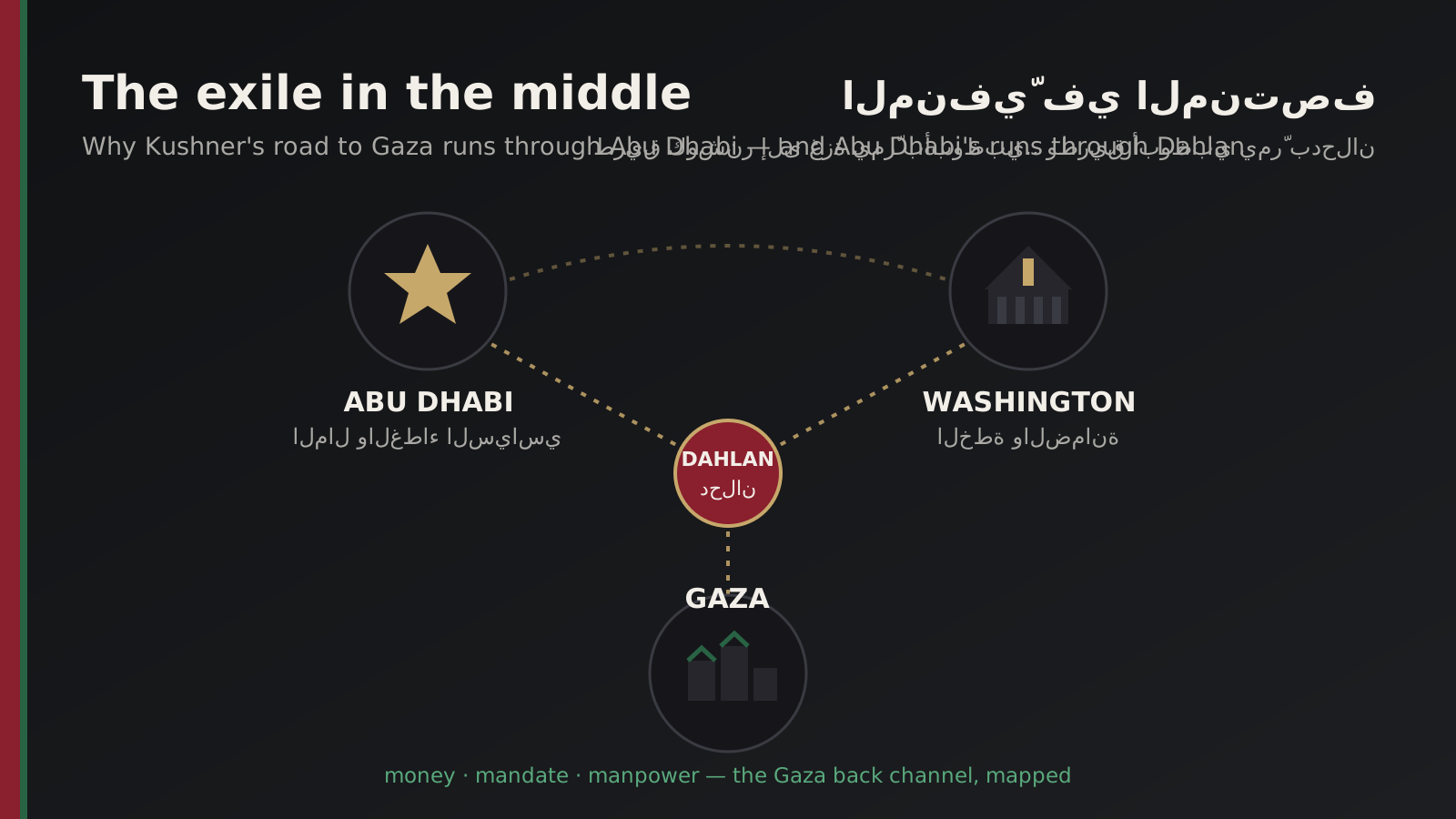
Graphic: Times of Palestine
Original Reporting
When Mohammad Dahlan announced on Saturday that Jared Kushner had personally assured him Israel's attacks on Gaza would stop the next morning, the most striking thing was not the promise. It was the messenger. The man relaying the word of the American president's son-in-law holds no office in the Palestinian Authority, no seat in the PLO, and no position in any government. He was expelled from Fatah fifteen years ago, convicted in absentia by Palestinian courts, and has not set foot in Gaza — the place that made him — since 2007. Yet when the Board of Peace needed Hamas's signature on the most consequential Palestinian document of the decade, the channel that delivered it ran through an office in Abu Dhabi. This is an account, from the record, of how that came to be — and why the road from Washington to Gaza now passes through the United Arab Emirates.
The breakthrough and the man credited with it#
The sequence of the past week is documented in unusual detail. On Thursday, Hamas formally accepted the Board of Peace's disarmament framework — the first time the movement has committed in writing to relinquishing its weapons, in exchange for staged Israeli withdrawal, under the fifteen-clause implementation document anchored in Security Council Resolution 2803. The Times of Israel, citing an aide to Dahlan, reported that the breakthrough came through Dahlan's direct contacts with Kushner, with the Board's Gaza envoy Nickolay Mladenov, and with what the aide called "the entire American team" — and that Kushner has been in constant contact with Dahlan on Gaza for the past year. Haaretz noted that the plan's details surfaced first on an Egyptian television network linked to Dahlan, hours before any official release. On Saturday, the factions approved the full document, and Dahlan posted the message this newspaper reported: Kushner had confirmed the attacks would halt from Sunday morning. Israel, for its part, has not committed to the withdrawal timetable; Prime Minister Netanyahu's office has publicly disputed the terms, signalling no withdrawal without what it calls genuine disarmament, and President Trump warned he would be "very disappointed" if Israel obstructed the plan. The promise, and the test of it, are now on the record side by side.
The Gaza son#
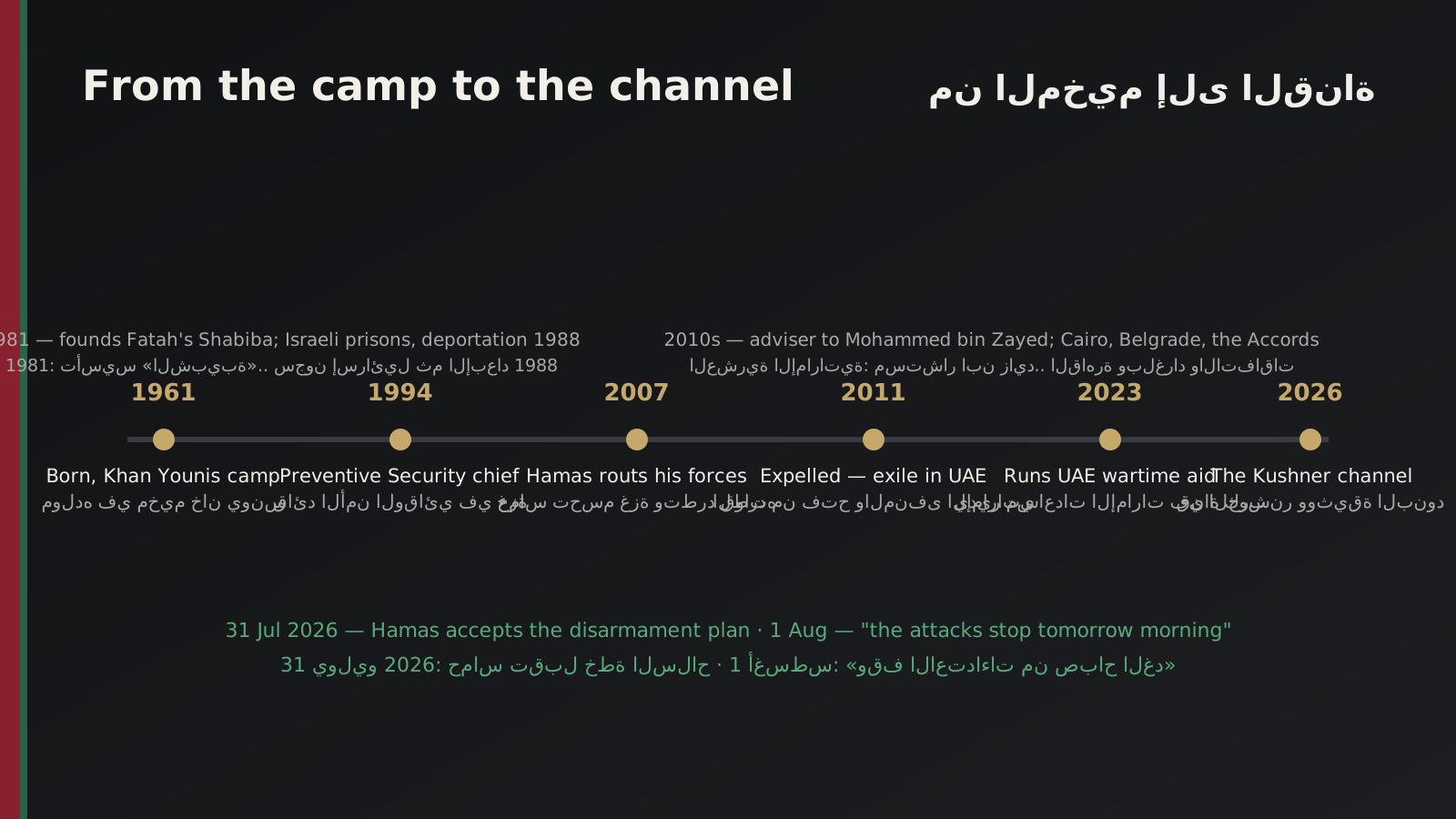
Everything about Dahlan's usefulness begins with biography. Born in 1961 in Khan Younis refugee camp to a family expelled from Hamama in 1948, he co-founded Fatah's youth movement, the Shabiba, at twenty, was arrested repeatedly by Israel — learning fluent Hebrew in its prisons — and was deported in 1988. He returned with the Oslo generation in 1994 to build and command the Preventive Security force in Gaza, at its height nearly twenty thousand men and the closest thing the young Authority had to a state within a state. That force made him indispensable to Washington and notorious at home in equal measure: its 1996 campaign of mass arrests against Hamas is remembered by the movement to this day, and rights groups of that era documented torture in its facilities — a record Hamas has never let him escape, and one his allies argue belongs to a different political lifetime. In 2007, after Hamas won the 2006 elections and the international community moved to isolate the result, the armed confrontation that followed ended with Hamas routing the security forces associated with him and taking the Strip. An American plan to arm Fatah against Hamas — reported at the time in detail by Vanity Fair — collapsed with them. Dahlan has not returned since.
The break with Ramallah#
His second exile was Palestinian-made. Once considered a potential successor to Mahmoud Abbas, Dahlan was expelled from Fatah in 2011 after an extraordinary public rupture with the president, then convicted in absentia by PA courts — a 2014 defamation case and a 2016 corruption case — verdicts he has always dismissed as political score-settling, noting they arrived only after the split. Abbas went further, publicly accusing him of involvement in Yasser Arafat's death, an accusation Dahlan flatly denies and no investigation has substantiated. Whatever the merits, the practical effect is undisputed: the Palestinian Authority's institutions and Dahlan have been at war for fifteen years, which is precisely why his return to the center of Palestinian diplomacy is happening around those institutions rather than through them.
The Abu Dhabi decade#
Exile took him to the United Arab Emirates, where he became a close adviser to Mohammed bin Zayed — and, according to assessments from the France 24 profile to the Israeli ITIC's, an influence not only on the Emirates' Palestinian file but on its regional policy: backing Egypt's leadership after 2013, cultivating Belgrade (which gave him citizenship), and working the seams of the region's conflicts on Abu Dhabi's behalf. During the Gaza war, that machinery turned toward his birthplace: reporting from outlets across the spectrum — from Al-Estiklal's critical account to the Jerusalem Post's analysis of the Wall Street Journal's — describes Dahlan directing UAE humanitarian operations in Gaza, the aid convoys, tents and field hospitals that kept his name alive in the Strip and, his critics say, rehabilitated it. His Democratic Reform Current kept organized cadres among Gaza Fatah networks throughout. And his prescription, offered publicly since the war's first winter, has been consistent: a new, independent Palestinian leadership — pointedly neither Abbas's PA as constituted nor Hamas — rebuilding Gaza under the protection of an Arab force. When reports surfaced, from Middle East Monitor to Israeli media, that he was under consideration for a post-war role, Dahlan denied seeking any security, governmental or executive position, insisting his work was humanitarian. The denial is on the record; so is the fact that the fifteen-clause document's architecture — one authority, one law, one weapon, under Arab and international protection — resembles his prescription more than anyone else's.
Why Kushner calls: the money answer#
Why does the architect of the American plan consult a stateless exile? The record suggests the answer has three parts, and the first is financial. The reconstruction of Gaza — estimated by international agencies at more than fifty billion dollars — will be paid for, if it is paid for, largely by the Gulf. The Emirates are expected to be a principal funder and a pillar of the stabilization arrangements under Resolution 2803. Kushner's own relationship with Abu Dhabi is not merely diplomatic: his firm, Affinity Partners, was seeded with two billion dollars from Saudi Arabia's sovereign fund and, Bloomberg reported, took a further 1.5 billion in December 2024 from Qatar's investment authority and from Lunate — the Abu Dhabi asset manager backed by the sovereign fund ADQ and overseen by Sheikh Tahnoun bin Zayed, the UAE national security adviser and the president's brother. Senator Ron Wyden's Finance Committee probe has put a number on the structure: ninety-nine per cent of Affinity's billions are foreign, overwhelmingly Gulf sovereign money. None of this is secret and none of it is illegal; Kushner's defenders note the Accords-era relationships are exactly why he can deliver. But it means the man drafting Gaza's future and the state expected to finance it are bound by ties that are commercial as well as strategic — and Dahlan is that state's Palestinian instrument. When Kushner needs Abu Dhabi's money aligned with his plan, and Abu Dhabi needs its plan carried by a Palestinian who can deliver, the channel builds itself.
The other two parts: reach and leverage#
The second part is operational, and it has a documented dress rehearsal. In July 2017, a decade after Hamas drove him from Gaza, Dahlan negotiated an understanding with the movement under Egyptian auspices that stunned Palestinian politics: at his initiative, and with Emirati money behind him, Cairo shipped hundreds of tons of industrial diesel through Rafah to restart Gaza's power station, the UAE committed fifteen million dollars a month to the Strip and funding for a hundred-million-dollar power plant on the Egyptian side of the border, and Dahlan himself revealed a broader power-sharing arrangement with the movement that had been his enemy — coverage at the time, from Al Jazeera to The Times of Israel, described the exile "turning Gaza's lights back on" and returning to center stage. The 2026 back channel is that 2017 template scaled up: the same triangle of Emirati money, Egyptian access and Dahlan's standing with Hamas, now applied to disarmament instead of diesel. He retains what neither Ramallah nor Washington has — living networks inside Gaza, Fatah cadres of the Reform Current, clan relationships, the aid distribution lines built during the war — and the man Hamas drove out in 2007 became, by the war's end, one of the few Palestinians its negotiators would engage who was also acceptable in Abu Dhabi, Cairo and Washington. The third part is leverage over the one actor the Americans cannot summon: Egypt runs the gate at Rafah and has hosted every round of factional talks, and Dahlan's relationship with Cairo's leadership — which he backed publicly at its moment of maximum need in 2013 — is among his oldest assets. Money, reach, leverage: the triangle in this report's opening graphic is not a metaphor but an operating system.
What it means, and what it does not yet mean#
Precision requires saying what the record does not show. It does not show Dahlan holding or being promised any office; he denies wanting one, and the fifteen-clause document vests governance in a technocratic National Committee, not in any faction's chief. It does not show the Palestinian public converting his wartime aid into political legitimacy: surveys through the war years consistently ranked him far behind Marwan Barghouti and even the leaders Palestinians say they want replaced, and a constituency built on Emirati tents is not yet a mandate. And it does not show Israel accepting the bargain his channel produced — the withdrawal clauses remain, as of this weekend, unaccepted in Jerusalem even as the guns are promised quiet. What the record does show is narrower and still remarkable: at the decisive hour of the war's diplomacy, the messages that mattered moved through a refugee's son from Khan Younis whom every Palestinian institution had discarded — because he holds the confidence of the one capital whose money everyone needs and the one American whose family holds the plan. Whether that channel now rebuilds Gaza or merely reorders who answers for it is the next chapter, and this newspaper will report it clause by clause.
Updates & corrections
- Update: Updated with fuller reporting: the 2017 Dahlan-Hamas understanding brokered under Egyptian auspices — Emirati-funded diesel through Rafah, $15M/month in UAE support and a planned $100M border power plant — added as the documented precedent for the 2026 channel; Israel's position updated from an anonymous official to Netanyahu's office publicly disputing the terms.