Transparency & Accountability
Israel, Washington and its own decay lock the PA out of Gaza
Graphic: Times of Palestine
Original Reporting
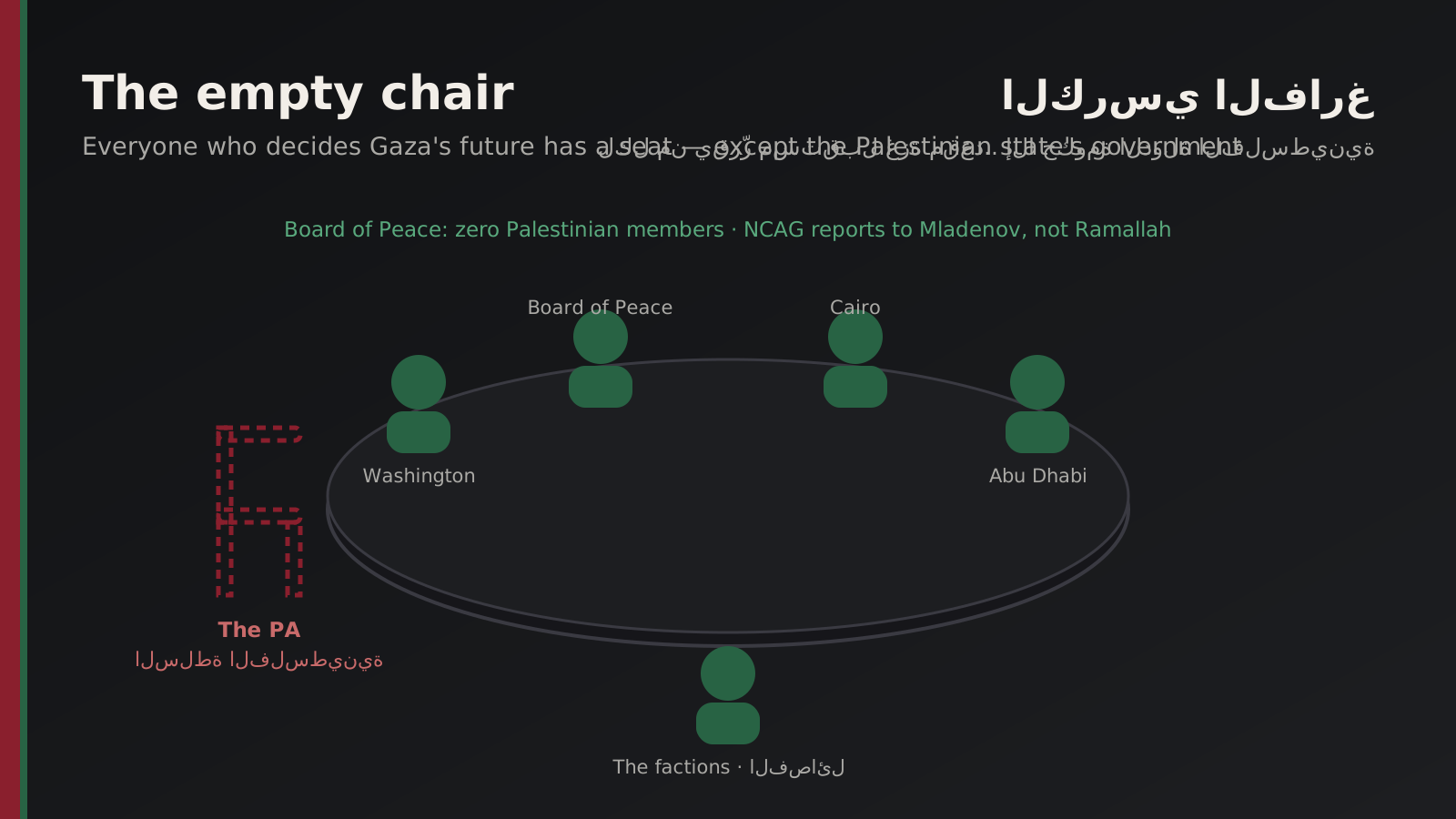
Read back this week's diplomacy and notice who is missing from every sentence. Hamas signed the disarmament framework with the Board of Peace. The factions approved the fifteen-clause implementation document. Jared Kushner promised, through Mohammad Dahlan, that Israel's attacks would stop by morning. Egypt hosted, Abu Dhabi financed, Washington drafted, and a technocratic committee prepared to administer. The Palestinian Authority — the government of the state that more than 150 countries now recognize, the institution the world has said for two decades must one day govern Gaza — appears nowhere: not as a signatory, not as a guarantor, not as an administrator, not even as a witness. This report sets out the anatomy of that absence, and the three forces that produced it.
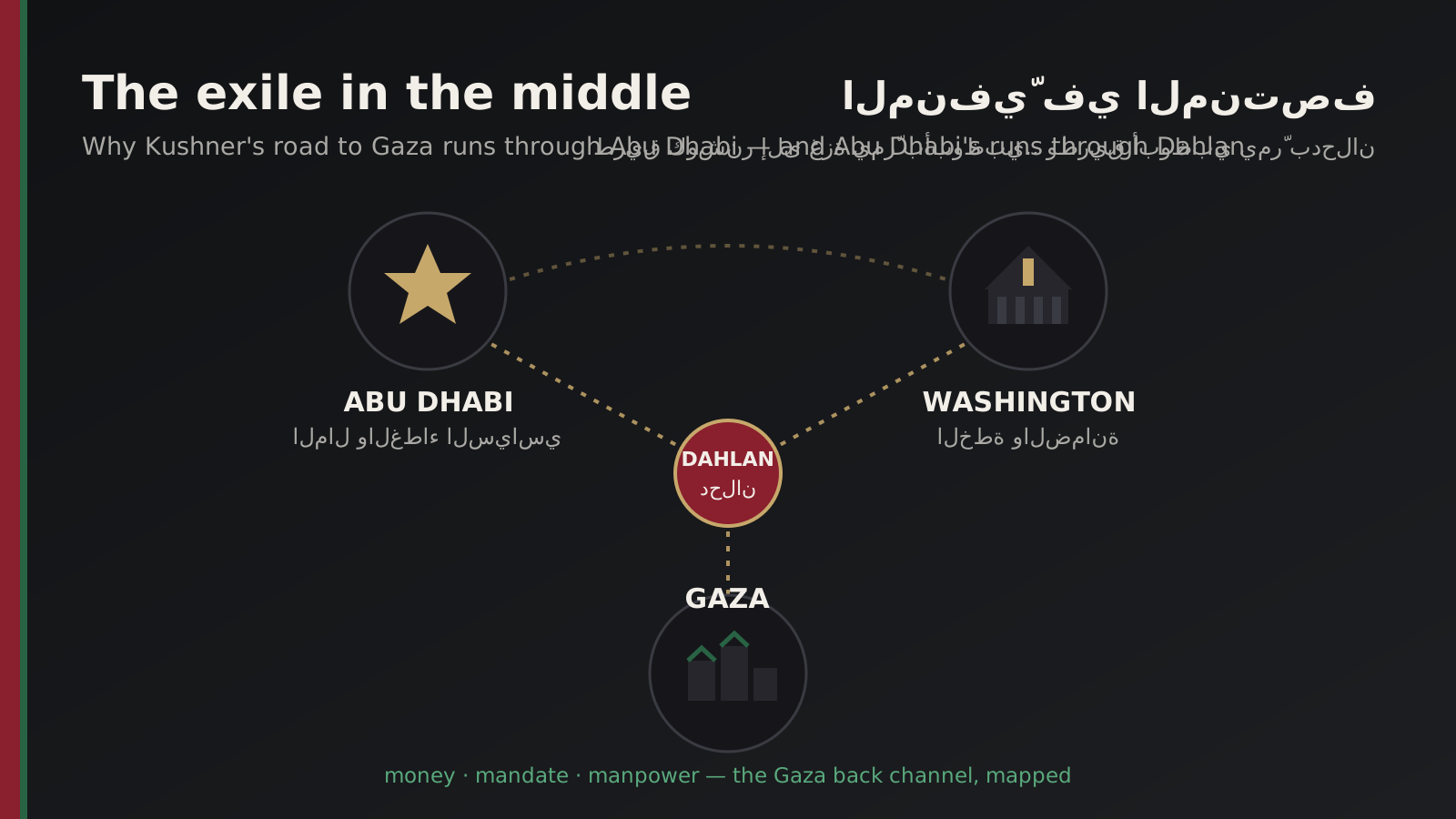
The absence is structural, not rhetorical. The Board of Peace established under Security Council Resolution 2803 to oversee Gaza's transition contains, as the House of Commons Library's briefing sets out plainly, no Palestinian members at all. The Palestinian-led body beneath it — the National Committee for the Administration of Gaza, fifteen unelected technocrats chaired by Ali Shaath — answers not to Ramallah but to the Board's director-general, Nickolay Mladenov. UNRWA, the UN agency that carried Gaza's services for seven decades, has been shut out of the architecture, as Palestinian monitors have documented. When Hamas dissolved its own government committee in July, the Arab Center in Washington observed that what replaced Palestinian self-administration was not the Authority but the Board itself. And when the guns were promised quiet this weekend, the promise travelled through an exile in Abu Dhabi — the subject of this newspaper's companion investigation — because no channel through the Palestinian government was worth using.
The first force locking the door is Israeli. Prime Minister Netanyahu's formula has been constant through the war and its aftermath: no Hamas rule in Gaza, and no handover to the Palestinian Authority either — a rejection Israeli officials soften only with the phrase "at this stage." The refusal is not incidental but doctrinal: a PA governing both the West Bank and Gaza is the territorial spine of a Palestinian state, and preventing that unification has been declared Israeli policy across successive governments. Every architecture the war's diplomacy has produced — the Board, the committee, the stabilization force — is shaped around accommodating this veto rather than testing it.
The second force is the conditionality of the PA's supposed friends. Washington, the European Union and the Arab states repeat that a "reformed Palestinian Authority" should eventually govern both territories — a formula whose operative word is "eventually," and whose reform bar is never quite reached. The donors who once channelled state-building money through Ramallah now build around it: the Gulf capitals expected to fund reconstruction prefer a technocracy supervised by a board they sit near, and Abu Dhabi in particular has cultivated its own Palestinian instrument in Dahlan rather than invest in the Authority it distrusts. The IPI Global Observatory's assessment of the Board's first months describes the result with clinical precision: governance suspended between an international body with authority but no legitimacy and Palestinian institutions with claims but no power.
The third force is the Authority's own condition, and honesty about it is owed to readers precisely because this newspaper reports the other two vetoes so plainly. The PA has not faced its voters since 2006. Its president is ninety; its new vice presidency was filled by appointment, not ballot. Its treasury, as this paper's budget investigation documented, finances its deficit through the unpaid wages of its own employees while Israel withholds the tax revenue it collects on Ramallah's behalf. Its security coordination with the occupier is, for many Palestinians, its defining feature. And its claim on Gaza specifically was spent down by its own hand: the punitive measures of 2017 and 2018 — salary cuts, early retirements, reduced electricity payments — were aimed at pressuring Hamas and landed on two million Gazans, who have not forgotten. Hamas's position that it will not allow the Authority to return "on the back of an Israeli tank" is self-serving, but it resonates because the Authority gave it material to work with. An institution in this condition did not lose its seat at Gaza's table to conspiracy alone; it arrived at the decisive hour unable to insist on one.
Ramallah's answer, late but real, is now on the record. The government of Mohammad Mustafa has carried a reform program and a Gaza administrative committee to every donor capital. Hussein al-Sheikh's appointment as the PLO's first vice president was presented as succession insurance to the same audiences. And on 9 July, President Abbas issued the decree that constitutes the Authority's real counter-move: legislative elections on 28 November 2026, the first since 2006, with participation promised for the West Bank, Gaza and East Jerusalem. The logic is straightforward — the Authority cannot out-lobby the vetoes, so it is attempting to out-legitimize them. A government Gazans actually elected would be difficult for Washington to wave off with "eventually," awkward for Arab capitals to bypass with technocrats, and impossible for the factions to dismiss as imposed. The scheduled election is, in effect, the PA's application to fill its own empty chair.
Whether the application is accepted depends on the same forces that emptied the chair. Israel has not said whether it will permit voting in East Jerusalem — the exact veto that collapsed the scheduled elections of 2021 — and has said nothing about facilitating a campaign in a Gaza it still ringed with troops this weekend. No decision has been announced on whether Hamas, whose last electoral victory triggered the siege, may contest. The Board of Peace has not said whether an elected Palestinian government would inherit the committee now reporting to Mladenov. Until those answers exist, Gaza will be governed by an arrangement in which every party holding power over Palestinians — a foreign board, a technocratic committee, a stabilization force, a back channel through Abu Dhabi — shares one characteristic: none of them can be voted out. The Authority's absence from Gaza is the story of this week. The deeper story is that, for now, absence describes every Palestinian's relationship to the power deciding their future — and 28 November is the first date on the calendar that could begin to change it.