Politics & Diplomacy
Eisenkot's new party overtakes Netanyahu's Likud in Israel's election race
%20(cropped).jpg?width=640)
Image credit: Gadi Eisenkot — Wikimedia Commons / Spokesperson unit, President of Israel · License
Original Reporting
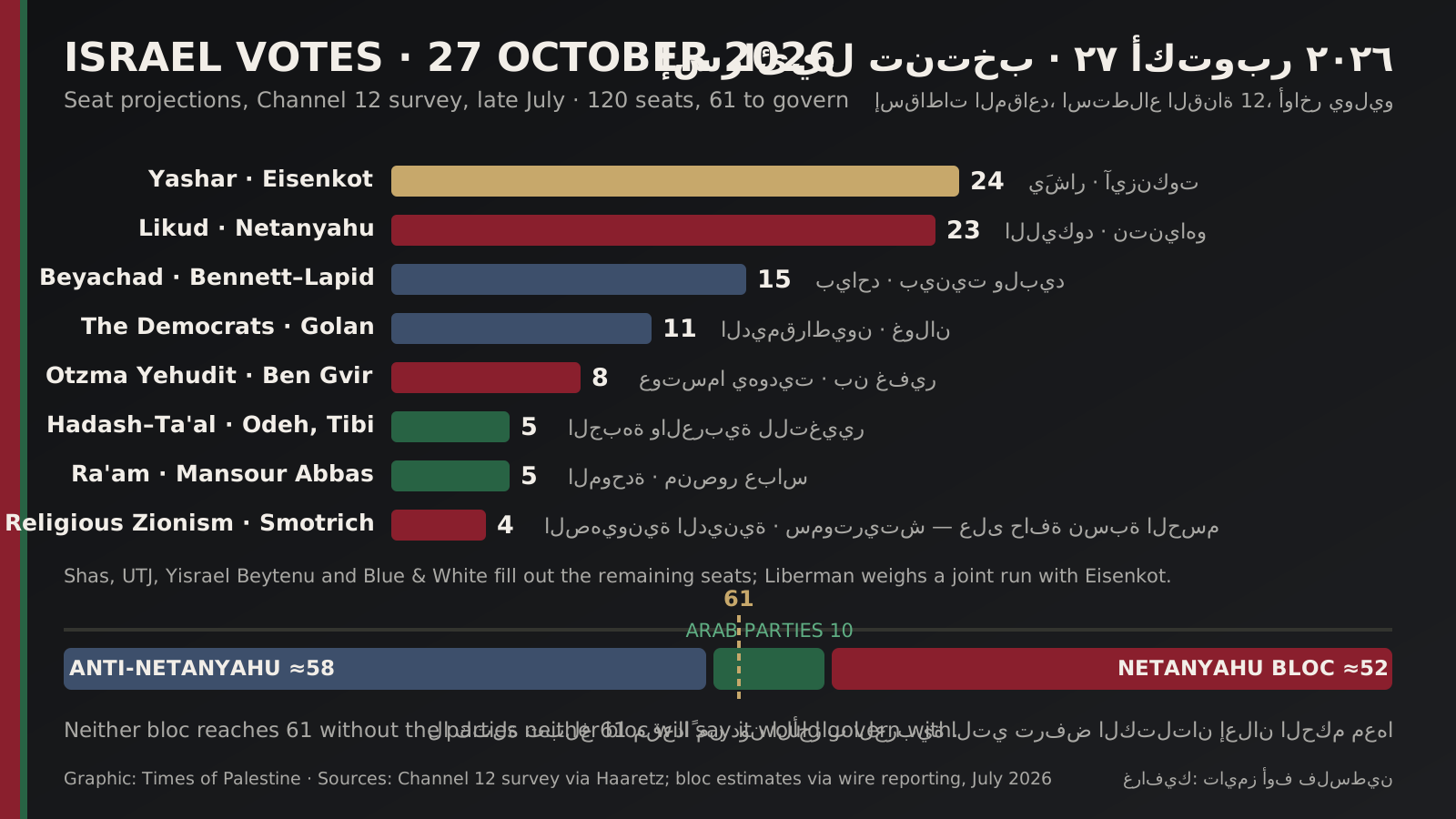
Israel votes on 27 October, and for the first time since the war on Gaza began the man to beat is not Benjamin Netanyahu. Gadi Eisenkot — the former army chief of staff who resigned from Netanyahu's war cabinet and built a new party, Yashar, around the accusation that the prime minister prolonged the war for his own survival — now tops the seat projections: Israel's Channel 12 put Yashar first at 24 seats in its late-July survey, one ahead of Likud's 23, and the Jerusalem Post reported Eisenkot's widest lead yet over Netanyahu on the direct question of who should be prime minister, with Likud at its lowest polling in more than a year. Yet the same surveys show why the race remains unresolved: the anti-Netanyahu bloc reaches roughly 58 seats and Netanyahu's bloc roughly 52, and the ten seats that separate both camps from a 61-seat majority belong to the Arab parties that each camp insists it will not govern with. Times of Palestine opens its standing election watch with this report and will track every coalition move, in both languages, through election night.
Who is gaining and who is falling#
The campaign's clearest trend is Eisenkot's rise at the expense of the merger that was supposed to own the anti-Netanyahu lane. When former prime minister Naftali Bennett and opposition leader Yair Lapid fused their parties into Beyachad this spring, the new list polled as high as 26 seats — first place. Haaretz's poll tracking has recorded an almost unbroken slide since: 15 seats in the latest Channel 12 survey, a loss of more than a third of its launch strength, most of it moving to Eisenkot after he pointedly refused to join a merger negotiated without him, telling interviewers that surprise announcements are "not how you build partnerships," as the Times of Israel reported. Yair Golan's left-wing Democrats have held steady around 11 seats and edged upward. On the right, Itamar Ben Gvir's Otzma Yehudit sits stable near 8 seats, while Bezalel Smotrich — the finance minister who ran the West Bank annexation portfolio — has fallen to 4, brushing the electoral threshold below which his Religious Zionism party vanishes from the Knesset entirely and takes tens of thousands of right-wing votes down with it. Netanyahu's ultra-Orthodox allies Shas, under Aryeh Deri, and United Torah Judaism remain the steadiest components of his bloc, and Avigdor Liberman's Yisrael Beytenu is negotiating a possible joint run with Eisenkot, which associates told the Times of Israel he would accept only if it demonstrably adds seats to the bloc. Benny Gantz, twice Netanyahu's main challenger, has slipped to the margins: Eisenkot left him off the invitation list when he convened opposition leaders to coordinate what he called a path to a "Zionist majority."
The coalitions taking shape#
Three governing scenarios dominate the coalition arithmetic. The first is a broad anti-Netanyahu government led by Eisenkot with Beyachad, the Democrats and Liberman — a bloc of generals and former prime ministers united by little beyond removing Netanyahu, which still lands short of 61 and would need the tacit or formal support of Arab parties its leaders publicly rule out. The second is Netanyahu's known quantity: Likud, Otzma Yehudit, Religious Zionism and the ultra-Orthodox parties — the coalition that governed through the war — which polls consistently place around 52 seats and which cannot expand without recovering voters that two and a half years of war, hostage crises and economic strain have moved elsewhere. The third scenario is the one Israeli commentators discuss most quietly: no majority at all, a caretaker Netanyahu, and a sixth election. The Steptoe risk consultancy's election analysis calls the vote a referendum on the shape of the state after October 7; the numbers say the referendum may not produce a verdict.
The ten seats nobody will claim#
The balance of the Knesset belongs, on current numbers, to Hadash-Ta'al under Ayman Odeh and Ahmad Tibi and to Mansour Abbas's Ra'am, polling around 5 seats each — and Haaretz reported in late July that the Arab parties are gaining ground as turnout intentions among Palestinian citizens of Israel recover. Abbas made history in 2021 as the first Arab party leader to join an Israeli governing coalition, and the Irish Times profiled him this winter as the campaign's unlikely kingmaker. But the paradox that analysts at the Arab Center in Washington call Eisenkot's dilemma cuts both ways: Netanyahu and Bennett have each publicly rejected a government resting on Arab votes, Eisenkot courts a "Zionist majority" by name, and the two million Palestinian citizens of Israel are being asked to supply the majority for governments that refuse to say their parties' names. Whether Ra'am supports a government from outside, joins one, or watches a sixth election happen instead is the single decision on which the entire outcome may turn.
What the outcome decides for Palestinians#
No plausible coalition ends the occupation, but the distance between the scenarios is still measured in Palestinian lives. A returned Netanyahu government would keep Smotrich's annexation machinery and Ben Gvir's police in place and continue the Gaza policy the world's capitals have spent 2026 trying to constrain. An Eisenkot-led government would enter office committed to a hostage deal and to repairing relations with Washington and Europe — and Eisenkot has spoken of separating from the Palestinians as a security necessity rather than of Palestinian statehood as a right. For Gaza's reconstruction, for the West Bank's accelerating settlement registration this newspaper has documented, and for the PA's petition to be readmitted to the table, the identity of Israel's next government is the largest single variable of the coming year. This election watch will follow the polls, the mergers, the threshold fights and the quiet talks with the Arab parties as a standing beat until the votes are counted.