Transparency & Accountability
US courts revive $655 million in terror judgments against the PA
Graphic: Times of Palestine
Original Reporting
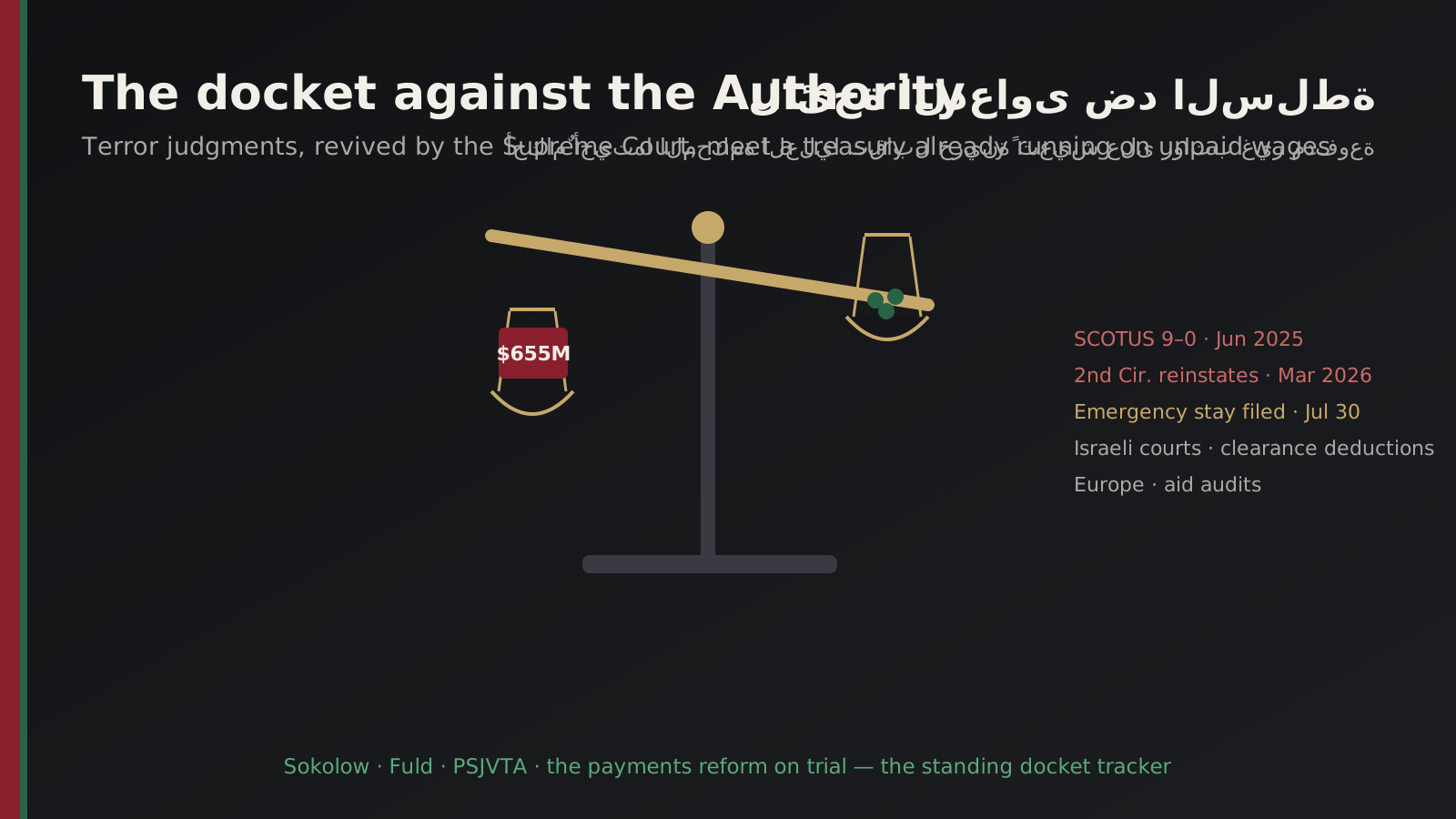
On Thursday, lawyers for the Palestinian Authority and the PLO filed an emergency application at the United States Supreme Court with an extraordinary admission inside it: enforcement of a single American judgment — 655.5 million dollars, awarded to victims of Jerusalem-area attacks a quarter-century old — could push the Authority toward collapse. The filing, addressed to Justice Sonia Sotomayor and reported by US News among others, asks the court to freeze enforcement while the PA seeks full review. It is the sharpest moment yet in a legal siege that has been building for two decades in American courts, is mirrored by billions in Israeli court judgments deducted at the source from Palestinian tax revenue, and is spreading into Europe as an audit of the Authority's word. This report opens Times of Palestine's standing docket tracker: every consequential case against the PA, followed to judgment, in both languages.
The American front: from Sokolow to Fuld#
The anchor case is Sokolow v. PLO, brought by American victims of attacks in and around Jerusalem between 2001 and 2004 that killed 33 people. A New York jury found the PA and PLO liable in 2015 and awarded 218.5 million dollars, automatically trebled to 655.5 million under the Anti-Terrorism Act. The Second Circuit threw the verdict out in 2016 for lack of jurisdiction — and Congress answered by rewriting the law: the Promoting Security and Justice for Victims of Terrorism Act of 2019 provides that the PA and PLO are "deemed to have consented" to American jurisdiction if they make payments connected to attacks that harmed Americans or maintain activities on US soil. On 20 June 2025, in Fuld v. PLO — brought by the family of Ari Fuld, killed in 2018 — Chief Justice Roberts wrote for a unanimous court that the statute is constitutional. The dominoes then fell fast: on 31 March 2026 the Second Circuit recalled its decade-old mandate and reinstated the full Sokolow judgment, and Thursday's emergency application is the PA's answer — arguing, in essence, that no court can resurrect a judgment that died ten years ago. With interest accruing and the Fuld case itself now proceeding, the Authority's American exposure runs well past the headline number, and the unanimous holding leaves the door open to every similarly situated plaintiff.
The payments knot at the center of everything#
Both the jurisdiction and the politics of the American docket run through one system: the Authority's payments to prisoners and to families of Palestinians killed in the conflict. In February 2025, President Abbas issued a decree abolishing the system — the reform Washington had demanded for a decade, and the act his lawyers cite in court. The record since is contested in ways this newspaper's readers deserve stated plainly. The US State Department formally determined in February 2026 that the PA paid more than 200 million dollars under the system in 2025 — the year of the abolition decree — and an April 2026 State report put roughly 156 million of it with prisoners and families of the killed; the Israel Policy Forum, sympathetic to the reform, published a roadmap in July for "finalizing" what it acknowledges is unfinished; and a draft interim constitution reported in February would have re-enshrined the payments in fundamental law. Ramallah's position is that a genuine transition to need-based welfare is underway and that an independent audit — promised to President Macron in November 2025, when he announced Abbas had "confirmed the abolition" — will prove it. Until that audit reports, the gap between the decree and the disbursements is the single most consequential open question in the Authority's legal life: it decides American jurisdiction, European aid, and the credibility of every reform pledge the PA has made to the capitals now deciding Gaza's future.
The Israeli front: judgment by deduction#
The second front needs no enforcement lawyers, because the defendant's money already passes through the plaintiff's government. Israeli courts have entered a long series of judgments against the Authority in suits by Israeli victims of attacks, and Israeli legislation directs the state to deduct both those awards and sums equal to the prisoner payments from the clearance revenue — the customs and tax money Israel collects on the Authority's behalf and is meant to transfer monthly. As this paper's budget investigation documented, those withholdings are a principal reason the PA finances its deficit through the unpaid wages of its own employees. In the American docket the Authority fears a future seizure; in the Israeli one, the garnishment is already the status quo, running quietly at the source.
The European front: the audit, not yet the courtroom#
Europe, so far, hosts no American-style damages docket against the Authority — its pressure arrives as conditionality rather than judgment. France holds Abbas's personal abolition pledge and the promise of an independent audit; the European Commission has tied portions of its unprecedented support packages to reform benchmarks; and advocacy groups on both sides now argue European aid should turn on the payments question, as the Foundation for Defense of Democracies pressed regarding French and EU funding in May. Two developments could change the continent's role quickly, and this tracker will watch both: any move by US judgment-holders to enforce against PA or PLO assets in European jurisdictions, and any European litigant testing the Authority's amenability to suit in national courts. A treasury with judgments against it on two continents holds assets on a third at its peril.
What the docket means#
Read together, the fronts form a pincer the Authority built years for and cannot easily escape: American courts now hold that its own payment system opened the door to nine-figure liability; Israeli deductions already tax its lifeline; European money increasingly waits on proof that the system is truly gone; and the constituency politics of prisoners' families make the proof costly to produce. The emergency application's collapse warning is legal advocacy, but it is not fiction — 655 million dollars approaches a quarter of the Authority's functional annual budget, owed by a government that cannot fully pay salaries, at the exact moment it is petitioning the world for a role in Gaza. Times of Palestine will follow every docket entry — the Sotomayor application, the Fuld proceedings, the audit's findings, the deduction ledgers, and whatever Europe's courts are asked to decide — as a standing beat, in both languages, until the cases end.