Transparency & Accountability
Omar Suleiman asks what America owes the victims of Graham's wars
Graphic: Times of Palestine
Original Reporting
Eighteen days after Senator Lindsey Graham's death, the American imam whose refusal to mourn him drew a censure motion in Congress has returned with a longer answer. In an essay published Thursday by Religion News Service, Omar Suleiman argued that remembering the dead truthfully is itself a moral obligation — and that the people killed in the wars Graham championed, from Gaza to Lebanon to Iran, are owed at least as much remembrance as the senator himself.
The essay, titled "What do we owe the victims of Lindsey Graham's wars?", reframes a controversy that has followed Suleiman since the night Graham died. Its case is not that the dead should be spoken of harshly, but that the living are not permitted to erase one set of dead to protect the reputation of another. "Forgetting the victims in order to preserve the reputations of the powerful in the name of decency is its own form of injustice," Suleiman wrote, setting what Americans owe the dead in terms of decorum against what they owe the dead of Gaza, Lebanon and Iran in terms of truth.
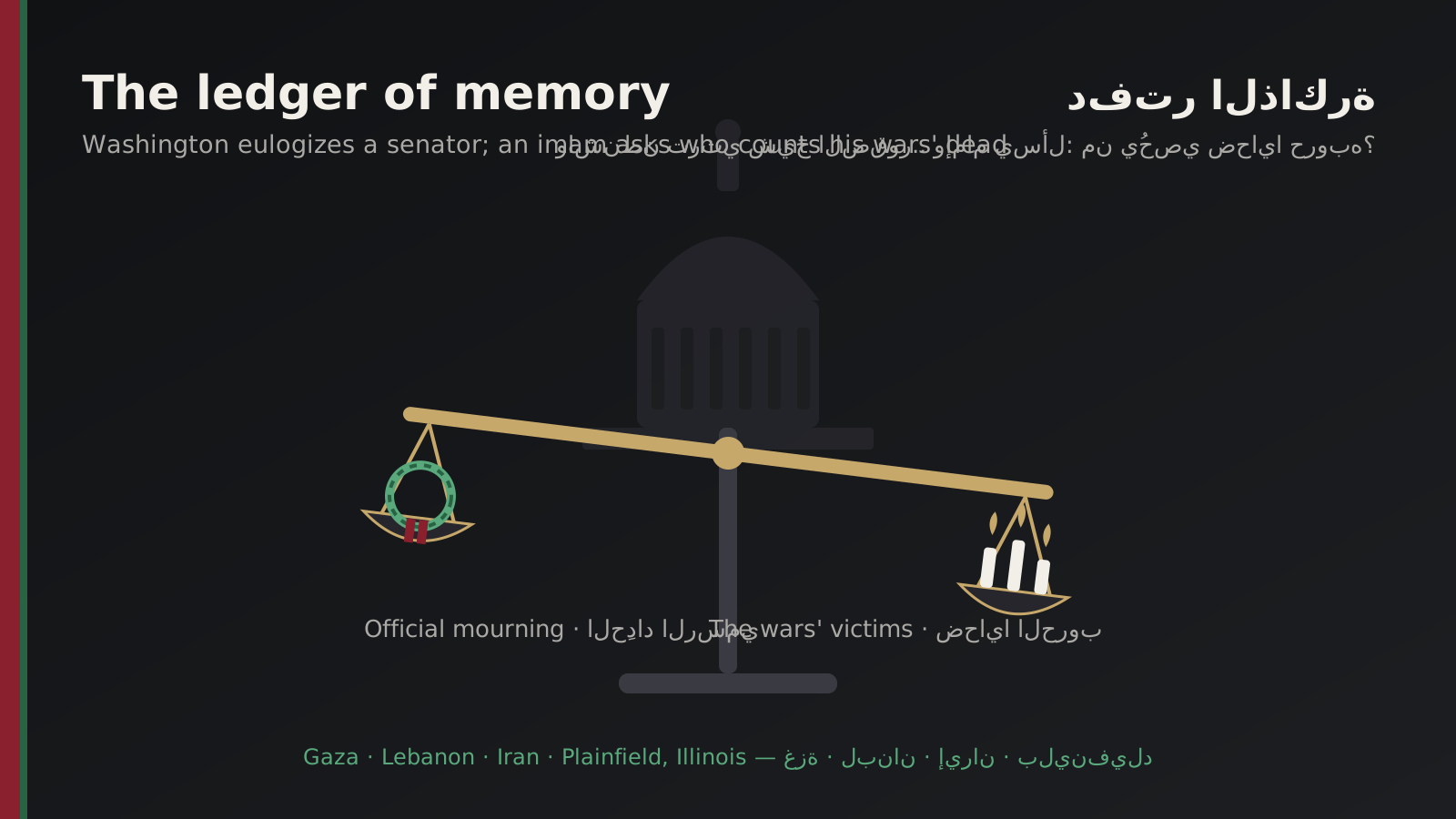
Washington filled one ledger of mourning within hours of the senator's death. Suleiman's essay asks who keeps the other. Graphic: Times of Palestine.
A death, a post and a censure motion#
Graham died at 71 on the night of July 11, hours after returning from a trip to Ukraine; his office announced the death early the next morning, and preliminary findings from the District of Columbia medical examiner attributed it to an aortic dissection. Tributes flowed quickly, led by President Trump, and eulogies across official Washington remembered a three-decade Senate career.
Suleiman, president and co-founder of the Yaqeen Institute for Islamic Research near Dallas, posted a different verdict that Sunday morning: "Bye Lindsey. May you live an eternity in ruins for the ruins you helped create in Gaza." Representative Beth Van Duyne, the Republican who represents the suburban Dallas district where Suleiman lives, introduced a resolution to condemn him, calling the message incendiary and pointing to the opening prayer he delivered before the House in 2019 at Democrats' invitation. The new essay is Suleiman's fullest reply: the real dispute, he argues, is over which deaths a nation is required to notice.
The footage behind the question#
The essay landed in a week when Graham's own words about those wars resurfaced. Previously unreleased clips filmed by the British documentary maker Alex Holder, who followed Graham for three years for a film about his relationship with President Trump and Prime Minister Benjamin Netanyahu, were reported by Middle East Eye in the days before Suleiman published. In one, watching Trump address the press five days into the war on Iran, Graham tells his staff: "I almost cried. How long have we been pushing this?" In another, he offers Netanyahu American participation in the war on Lebanon — "to maybe fly some with you. Would you like that?" — an offer Netanyahu set aside, saying he was concentrating on Iran.
Suleiman put that jubilation beside its cost. Graham said he almost cried out of joy when the war on Iran started, the imam wrote; the mothers of the 120 schoolchildren senselessly bombed in Iran surely cried too, as did thousands of parents in Gaza — and Graham had a great deal to do with their tears. Graham himself had framed the region's conflict in explicitly religious terms, telling interviewers after October 2023 that "we're in a religious war."
From Plainfield to Gaza#
The essay's center of gravity is not abroad but in Illinois. Wadee Alfayoumi, a six-year-old Palestinian American boy, was stabbed 26 times by his family's landlord in his home outside Chicago days after October 7, 2023 — a killing prosecutors treated as a hate crime, and one the United States Senate later moved to memorialize in a resolution honoring his life. His mother, Hanan Shaheen, survived the attack and testified before Congress in September 2024. For Suleiman, Wadee belongs in the same ledger as the children of Gaza and Iran: a victim of the climate that wartime rhetoric builds at home.
That ledger is the essay's real subject, and it extends beyond one senator or one imam. Religion News Service had already asked in mid-July how Americans should respond to Graham's death, and the magazine Current Affairs posed the question more bluntly: why mourn Graham and not his victims? Van Duyne's resolution is still pending, and the House will decide in the coming weeks whether the imam's words merit formal condemnation. Suleiman's essay asks it to weigh a prior question — whether a country that memorializes the architects of its wars while leaving their victims unnamed has kept an honest record. For Palestinians, who fill so many lines of that unkept record, the answer decides whether accountability begins with memory or ends without it.