Politics & Diplomacy
Admiral Brad Cooper runs the military machinery beneath Gaza's ceasefire
,%20Commander%20of%20United%20States%20Central%20Command%20on%20August%208,%202025%20(cropped).jpg?width=640)
Image credit: Adm. Brad Cooper — US Department of Defense photo via Wikimedia Commons · License
Original Reporting
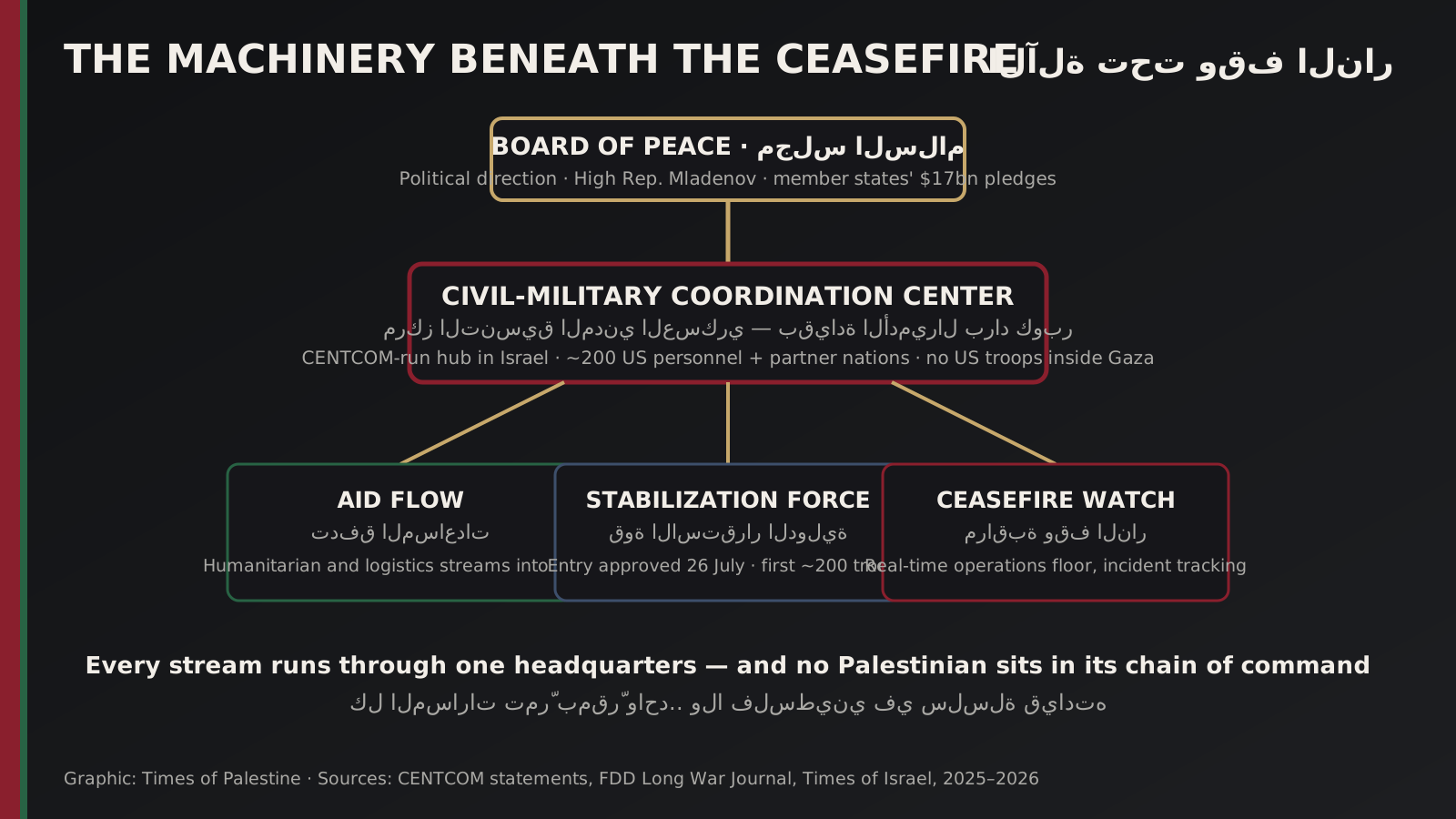
The Board of Peace gives the speeches, but the machinery beneath Gaza's ceasefire answers to a four-star American admiral. Charles Bradford Cooper II — Brad Cooper, commander of US Central Command since August 2025 — runs the Civil-Military Coordination Center, the headquarters in Israel through which the ceasefire's monitoring, Gaza's aid streams and the incoming international stabilization force all flow. For Palestinians, no foreign officer's decisions currently touch daily life in Gaza more directly: how fast the trucks move, how incidents on the ground are adjudicated, and how the force that may soon police the ceasefire actually deploys all run across his operations floor. This deep dive traces who Cooper is, what he did during the war, and what his command is doing now — because our readers should know the machinery, not just the communiqués.
The sailor who rose through the region's crises#
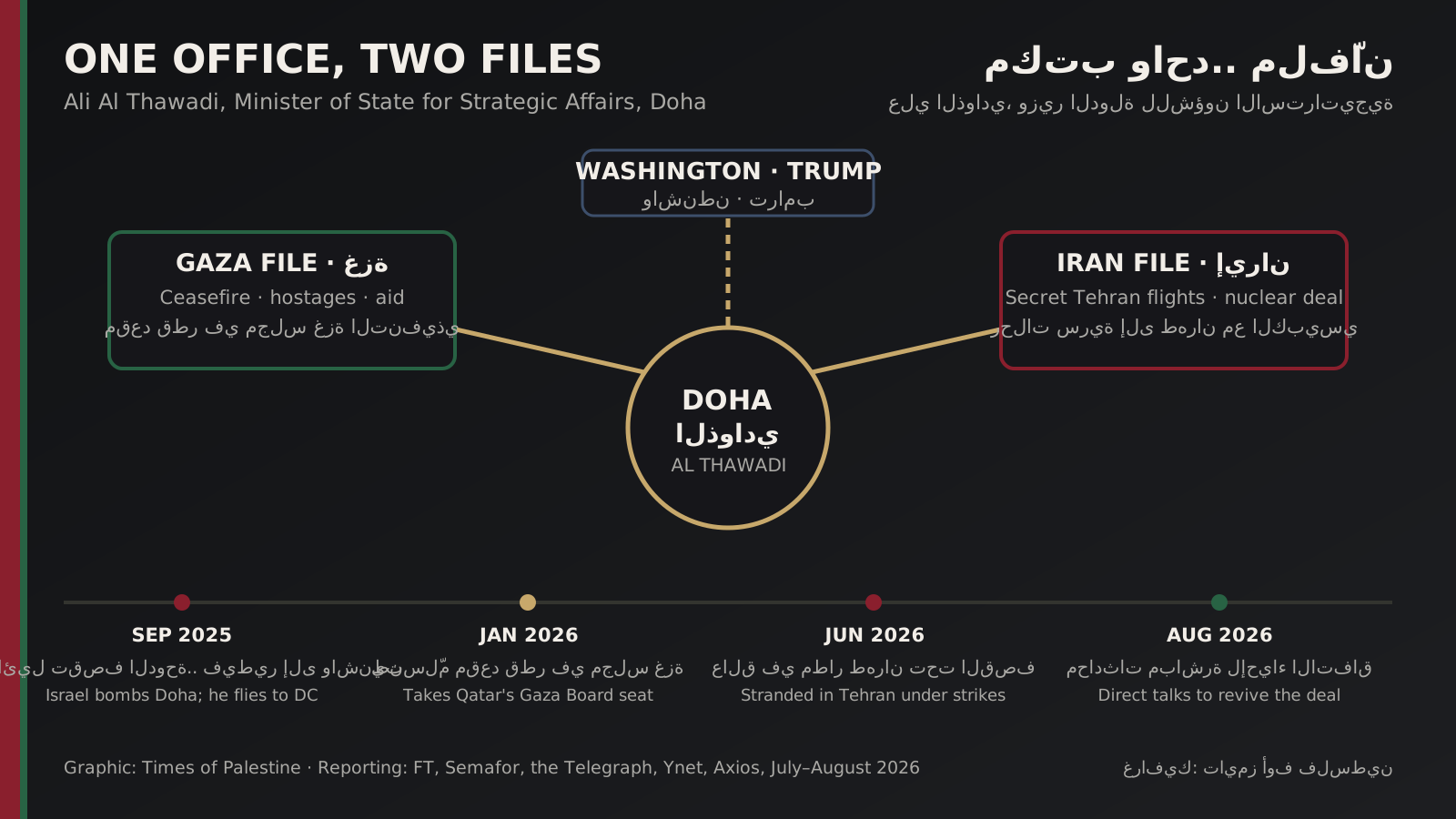
Cooper's path to the region's top command ran through Bahrain. He led US Naval Forces Central Command and the Fifth Fleet for three years from 2021 — the navy's Middle East headquarters — which put him in the operations chair on October 7, 2023 and through the war's first months, directing the maritime campaign as Yemen's Houthis began attacking Red Sea shipping and the US launched its December 2023 escort operation in response. Before Bahrain he had commanded US Naval Forces Korea through the 2016–17 peninsula crisis and an expeditionary strike group in Japan, with staff tours at the Pentagon and the White House. In February 2024 he moved up to deputy commander of Central Command, and in June 2025 Defense Secretary Pete Hegseth announced him as President Trump's nominee for the top job; he took command from General Erik Kurilla that August — a sailor at the head of a command led almost entirely by soldiers and Marines since its founding, as the trade press noted. Analysts writing this spring argued his Bahrain years shaped how the command fought the American-Israeli war on Iran in June, the conflict whose diplomatic aftermath — reported in this newspaper's Ali Al Thawadi profile — still runs through Doha.
The pier, the corridor and a lesson learned#
Cooper's first Gaza assignment was humanitarian, and it was humbling. As deputy commander in 2024 he organized the US military's maritime aid corridor to Gaza — the sea route and the floating JLOTS pier — traveling to Israel himself for the construction talks, the Times of Israel reported. The pier briefly increased deliveries and then failed repeatedly in heavy seas, becoming a symbol of aid theater: engineering in place of the political decision to open the land crossings that could have fed Gaza in a week. The fairest reading of that episode, and the one his current command seems to have internalized, is that aid to Gaza is not a logistics problem but a permissions problem — and that the useful American role is forcing coordination among the parties who hold the permissions. That is precisely the design of what he runs now.
The coordination center: where the ceasefire actually lives#
Five days after the world's leaders signed the US-brokered plan to end the war, Central Command formally opened the Civil-Military Coordination Center — October 17, 2025 — and Cooper has commanded it since. The center sits in Israel with roughly two hundred American personnel and a hard rule Cooper's command repeats constantly: no US troops deploy into Gaza. Instead the CMCC is the hub where everything crossing into Gaza is synchronized — an operations floor assessing developments in real time, as the Times of Israel reported, with representatives of partner nations, international institutions, NGOs and private contractors integrated as they arrive, in Cooper's own description. He has visited Gaza personally to oversee the center's implementation. The center answers upward to the Board of Peace — the body whose high representative, veteran UN diplomat Nickolay Mladenov, was appointed in January, whose member states pledged seventeen billion dollars, and whose Qatari seat is held by Ali Al Thawadi. And its next task is the largest: on July 26 Israel's cabinet approved the entry of the International Stabilization Force into Gaza — an initial deployment of up to two hundred troops drawn from Kosovo, Albania and Morocco, with others possibly to follow, as the Long War Journal reported — the first foreign force of the ceasefire era, and it will arrive through Cooper's coordination machinery. The scrutiny has arrived too: Senator Elizabeth Warren has pressed the State and Defense Departments in writing on whether the CMCC's aid facilitation is actually moving relief at the scale Gaza needs.
What his machinery means for Palestinians#
Judged by the charter this newspaper applies to all delivered work: the ceasefire Cooper's center monitors has largely held, the coordination hub exists and functions, and the stabilization force it spent months preparing is finally moving — those are real accomplishments, and the professionals who built them deserve the credit the record supports. But the same record defines what is missing. Aid through the machinery remains far below Gaza's need, as this newspaper has documented; reconstruction is stalled on the political questions the machinery cannot answer; and not one Palestinian sits in the chain of command that now runs from the Board of Peace through Cooper's operations floor to the soldiers who will patrol the ceasefire. The admiral's headquarters is, for now, the most functional institution in Gaza's future — which is both a tribute to its competence and the clearest measure of how far Palestinians remain from governing their own tomorrow. Times of Palestine will track the CMCC's throughput, the stabilization force's conduct, and the day — promised in every speech — when this machinery hands its keys to Palestinians, as a standing part of our Gaza coverage.

%20(cropped).jpg?width=640)