Politics & Diplomacy
Trump's peace board delays Israeli withdrawal until Hamas fully disarms

Graphic: Times of Palestine
Original Reporting
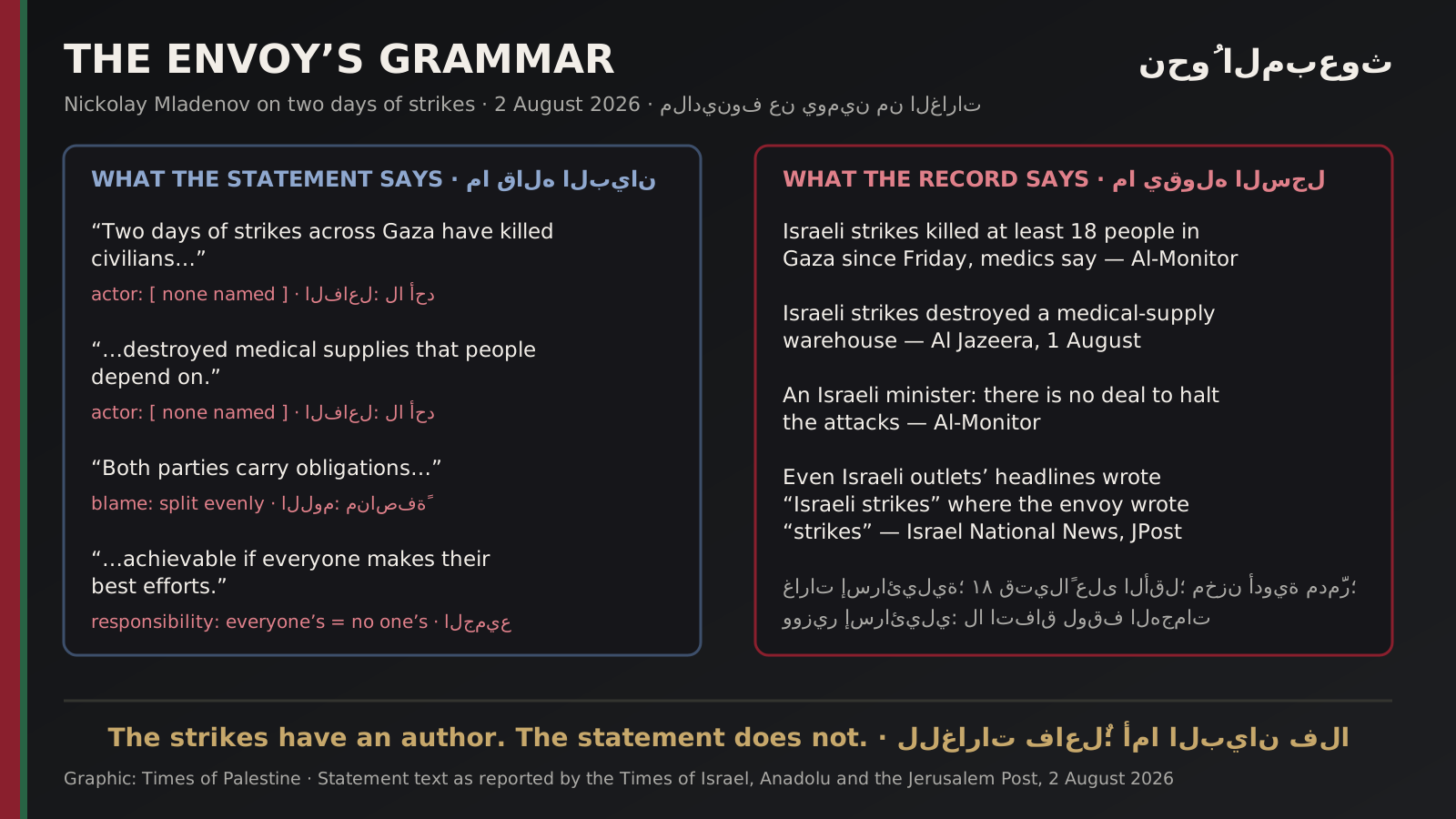
Nickolay Mladenov, the director-general of the American-chaired Board of Peace, met Benjamin Netanyahu in West Jerusalem on Monday and asked him for fourteen days of quiet in Gaza — a suspension of strikes and targeted killings while the two sides wrote the missing details of the disarmament roadmap President Donald Trump announced last week.
He did not get it. The Irish Times reported that a senior Israeli diplomatic source answered that Israel "will not withdraw from the current line in the Gaza Strip and will continue to thwart any threat to our civilians and soldiers." Netanyahu's office said the published text of the agreement "does not reflect Israel's positions", and that its concerns had been passed to Washington.
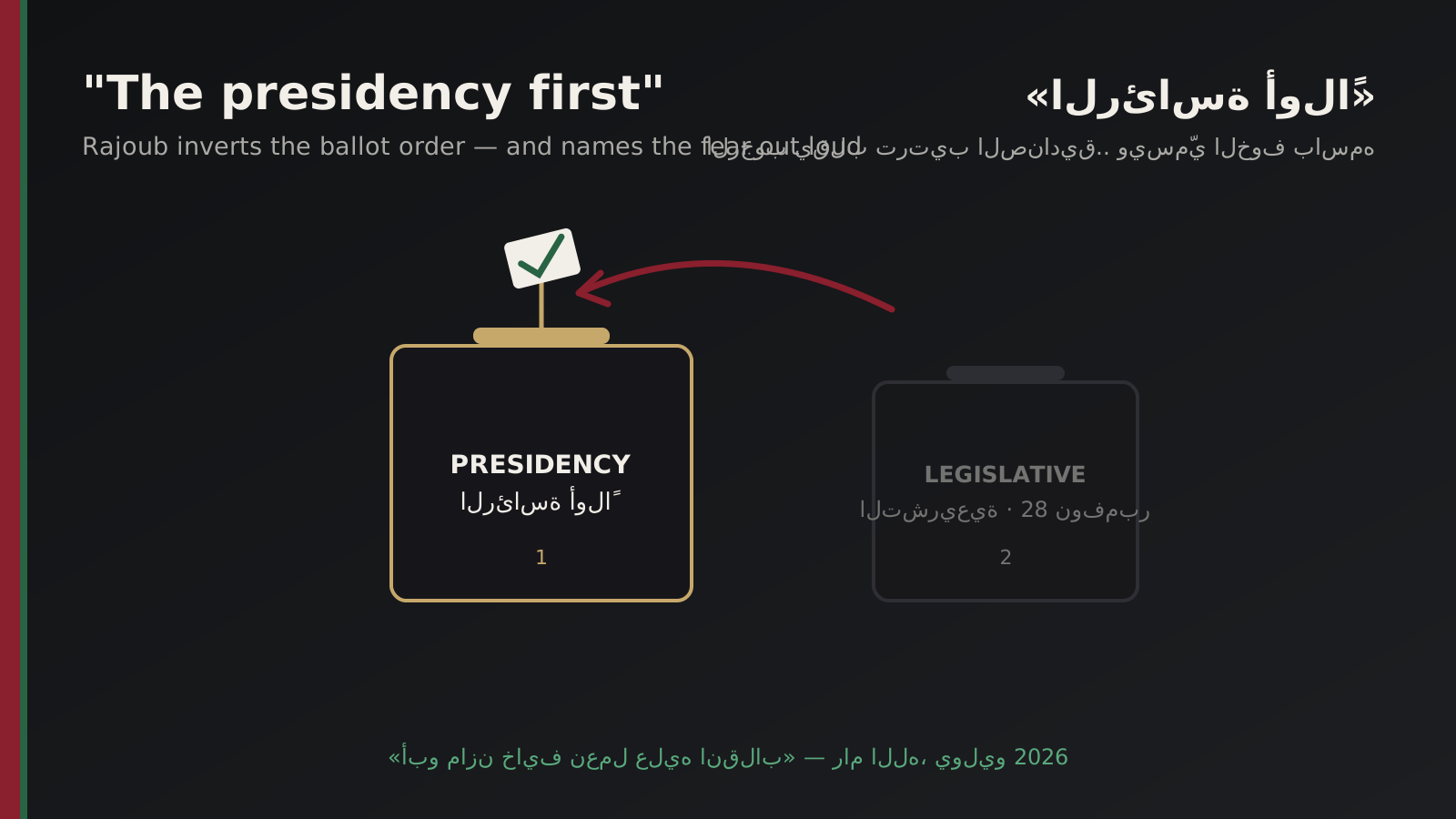
A day later, Washington moved. In a statement on Tuesday the Board of Peace said the "withdrawal beyond the Yellow Line will take place only once decommissioning is complete, as Hamas committed to the mediators" — light weapons, heavy weapons and the tunnels alike.
The word that disappeared#
The Times of Israel reported that the board's first version of that sentence spoke of "the full withdrawal" of the Israeli army, and that the word "full" was removed minutes later. For Palestinians under the bombing, that edit is the whole story: it converts a pullback that begins early into one that begins at the end.
Mladenov had said before the meeting that withdrawal "must move in lockstep with decommissioning". That formulation has gone. What stands in its place is a sequence in which the Israeli army has a stated reason to hold every position it now holds until a process Reuters reported would run about eight months is certified finished.
The Yellow Line is the ceasefire's demarcation between the ground the Israeli army holds and the rest of the Strip. Al Jazeera put the area under Israeli military control at roughly 70 per cent when Israel's cabinet voted on the stabilisation force on 26 July. Under Tuesday's wording, that is the share of Gaza that stays as it is while the clock runs.
Withdrawal beyond the Yellow Line will take place only once decommissioning is complete.
Board of Peace statement, 4 August 2026
The committee Israel has not let in#
The roadmap Trump announced on 31 July — "a HISTORIC agreement for the COMPLETE DISARMAMENT of Hamas and all other armed groups in Gaza", in his words — hands custody of every weapon in Gaza to the National Committee for the Administration of Gaza, the transitional body known in Washington by its initials, NCAG.
The published text makes the committee the sole authority holding weapons in the Strip. It administers the decommissioning of heavy weapons, military production sites and tunnels, stores militia weapons, licenses personal firearms under Palestinian law and bars militia members from the security services. Its stated principle is "One Authority, One Law, One Weapon".
The committee is fifteen unelected Palestinian technocrats, chaired by the engineer Ali Shaath, created in January under Security Council Resolution 2803. It is still headquartered in Cairo. Israel has not allowed its members into Gaza, as Al Jazeera reported last month after Hamas dissolved its own administration there.
So the body that must produce a weapons inventory within fourteen days of the parties' approval — the roadmap's first deadline — is not in the territory whose weapons it is meant to count. Ismail al-Thawabta, the Gaza government spokesman, has called on all concerned parties to "immediately accelerate steps for the NCAG to enter quickly".
| The roadmap's clocks | What the text sets | Where it stands |
|---|---|---|
| Weapons inventory and Phase 2 timetable | 14 days after all parties approve | Israel says the published text is not its position |
| Full decommissioning of weapons and tunnels | about eight months, per Reuters | not begun; NCAG still in Cairo |
| Israeli withdrawal beyond the Yellow Line | only once decommissioning is complete | ~70 per cent of Gaza held meanwhile |
| Supplier and contractor commitments honoured | up to $400m | pending NCAG audit |
| ISF mandate under Resolution 2803 | two years from 17 November 2025 | about 15 months left |
An enforcement arm of 200#
The International Stabilization Force is the roadmap's enforcement arm, and it barely exists. Major General Jasper Jeffers, named its commander in January, said in February that it should eventually field 20,000 soldiers and 12,000 police, with troops committed by Indonesia, Morocco, Kazakhstan, Kosovo and Albania.
Indonesia's pledge of some 8,000 personnel, the largest of them, lapsed over the coordination with the Israeli military that deployment would have required. Al Jazeera reported that Israel's cabinet approved an initial entry of about 200 personnel from "friendly countries" on 26 July, with the security cabinet vetting which states may contribute and the force confined to areas the Israeli army does not control.
The published roadmap also states that the force does not police Gaza. It separates the two sides' areas, trains a vetted Palestinian police force, monitors the ceasefire and supports aid delivery. Policing is the NCAG's job — with officers who must first be vetted by a committee that cannot yet enter.
Even that 200 is contested inside the Israeli government. Finance Minister Bezalel Smotrich and Settlements Minister Orit Strook wrote to Netanyahu demanding an immediate halt to the entry of multinational forces and a cabinet decision blocking the roadmap, which they called "dangerous for Israel". Smotrich has separately said the agreement is completely different from what the government approved and has demanded a fresh vote.
The board goes to Capitol Hill#
The board spent part of this week in Washington rather than Jerusalem. A delegation led by senior adviser Josh Gruenbaum, with the retired general Mark Schwartz joining remotely, briefed the national security advisers to John Thune, Chuck Schumer, Mike Johnson and Hakeem Jeffries — the four congressional leaders — on implementing Trump's twenty-point plan, the Jerusalem Post reported.
Congress's leverage over any of this is money and certification. The current State and foreign operations appropriations act requires the Secretary of State to certify, thirty days before funds for the bilateral West Bank and Gaza programme are obligated, that procedures give the US Comptroller General access to the relevant financial records.
That condition binds aid moving through the State Department. The Board of Peace itself — chaired by Trump, funded largely by foreign pledges — sits outside it, which is why a briefing for leadership staff is the shape its accountability to Congress takes.
The strait that decides Gaza's budget#
At the State Department on Tuesday, Rubio said of the talks to reopen the Strait of Hormuz: "There's been progress made in those talks, but not finality yet. We're hoping that will happen very shortly." He stressed that any deal covers the strait alone, and that Iran's nuclear programme would need a separate agreement.
Treasury Secretary Scott Bessent told CNBC there was a chance of an agreement to open the strait "today or tomorrow", and Brent crude fell more than four per cent, below $80 a barrel. Trump, in the Oval Office on Monday, said he wanted to give Iran "every last chance before decapitation".
Tehran maintains it is negotiating with Oman rather than Washington. Its foreign ministry spokesman Esmail Baghaei said no Iranian delegations would travel in the coming days.
For Gaza the strait is a budget line. The Gulf treasuries that pledged reconstruction money to the board in February earn it from oil priced for months by a closed waterway, and reopening it is the change most likely to determine whether the pledges become transfers.
The bombing did not pause#
Gaza's health ministry counted eighteen people killed in the twenty-four hours after the roadmap was announced and seventeen in strikes over the weekend, with more than thirty-six killed since the announcement by Al Jazeera's count. Its total for the war stands at 73,375, including some 1,250 since the October 2025 ceasefire took effect.
Israel did not grant the fourteen days, but it did narrow its fire. Ynet reported on Tuesday that units in Gaza received instructions confining operations to strikes against immediate threats, with targeted killings now requiring the approval of the chief of staff, Lieutenant General Eyal Zamir, and of the political leadership — a change the paper tied directly to Mladenov's request.
Eli Cohen, Israel's energy minister, told Army Radio there had been no deal to halt attacks on Gaza and that he was "very sceptical" Hamas would disarm. Egypt, Qatar and Turkey, three of the four mediators, said in a joint statement that the strikes on civilians and health facilities violate international law.
Ghazi Hamad of Hamas said the movement "will not implement any step of the Gaza peace deal if the Israeli occupation forces do not fulfil their obligations."
The roadmap's preamble invokes a pathway toward Palestinian self-determination and statehood. Its operative text says nothing about the West Bank, and returns the Palestinian Authority to Gaza only in the plan's own distant reckoning of 2027. What Washington settled this week was narrower and more immediate: the order of events. Palestinians disarm first, and the army leaves last.

,%20Commander%20of%20United%20States%20Central%20Command%20on%20August%208,%202025%20(cropped).jpg?width=640)
%20(cropped).jpg?width=640)