Financial Freedom
Saifedean Ammous frames Palestinian dispossession through property rights

Graphic: Times of Palestine
Original Reporting
Saifedean Ammous has spent years arguing that sound money begins with rules a ruler cannot bend. In his recent interviews about Palestine, the Palestinian economist applies a parallel test to land: who owned it, who took it, and whether the same property rights are enforced for everyone.
The result is a striking bridge between the author of The Bitcoin Standard and the country of his birth. Across a lecture and two podcast episodes released from November 2025 to June 2026, Ammous argues that the Palestinian-Israeli conflict is best understood as a systematic denial of Palestinian property rights. His June 23 interview with Mario Nawfal and a June 2 lecture episode describe that as a “Misesian” case — an argument grounded in the liberal economics of Ludwig von Mises, not a judgment of international law.
That distinction is essential. Ammous is presenting a theory of the conflict. The documentary record can test parts of it, but no single economic lens contains the full Palestinian claim to self-determination, equality, return and freedom from occupation.
The claim: begin with the owner, not the state#
Ammous’s public summary is blunt. He says the conflict results from denying property rights to Palestinians because they do not belong to the ruling ethno-religious group. That framing rejects collective entitlement as a license to displace the individual owner. It asks what a court applying the same rule to every person would do with a home, orchard or parcel of land.
This is consistent with his monetary writing. The Bitcoin Standard argues that credible money should not depend on the discretion of an issuer; his Palestine argument says credible ownership should not depend on the identity preferred by a state. In each case he looks for a rule that operates beyond political favor.
The connection is intellectually clean, but the cases are not identical. Bitcoin can prove control over a digital key; it cannot by itself establish a family’s title to a house, resolve competing deeds, determine inheritance, undo a military seizure or enforce a judgment. Land requires archives, testimony, courts and public power. A rule matters only if an institution can apply it fairly.
The international record supports the land question#
The most authoritative recent legal record gives substantial support to Ammous’s decision to center land. In its July 2024 advisory opinion summary, the International Court of Justice found that Israeli settlement expansion in the occupied Palestinian territory relied on the confiscation or requisitioning of large areas of land. It concluded that Israel’s settlements and associated regime were maintained in violation of international law and said reparation requires restitution where possible, or compensation when restitution is materially impossible.
Those findings are legal conclusions by the United Nations’ principal judicial organ, not proof that every historical property dispute has one simple answer. They nevertheless establish that land taking is not merely Ammous’s metaphor. It is a documented mechanism of occupation with consequences that international law requires Israel to remedy.
Turning that principle into individual restitution would be formidable reporting and legal work. Records sit in Ottoman, British Mandate, Jordanian, Israeli and Palestinian archives; some owners died in exile; heirs live across borders; and physical boundaries have been altered by demolition, construction and settlement expansion. An equal property rule would need transparent standards for evidence, inheritance and competing claims, along with a court whose authority reaches the party holding the land. These complications do not erase a right. They show why the demand has to move from slogan to a process families can actually use.
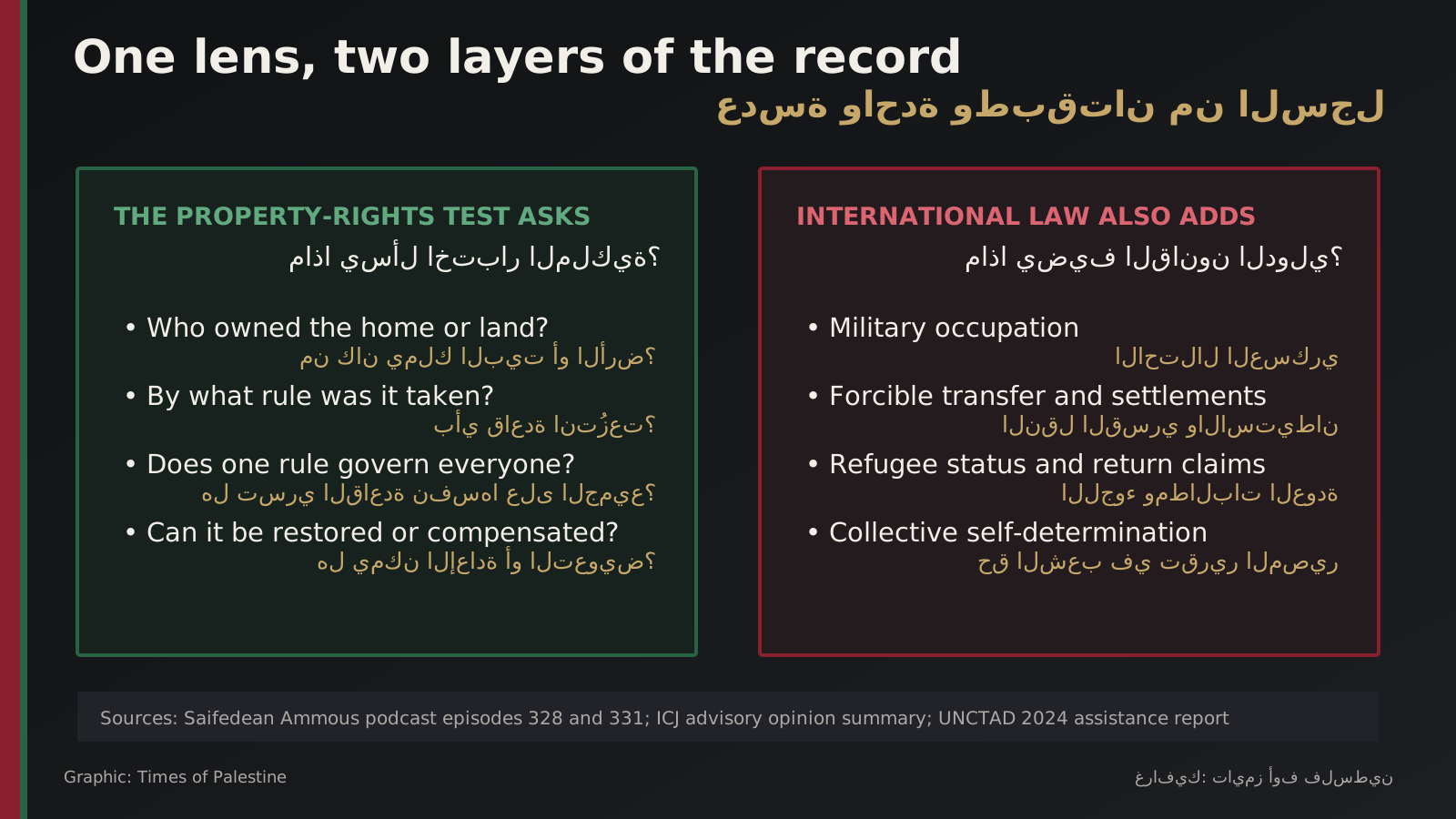
The property record also predates 1967. Palestinian refugee claims reach homes and land lost in 1948, while families inside Israel have faced laws that transfer or restrict control of property. Ammous’s equal-rights test can illuminate those cases, but international law adds categories his economic shorthand does not capture on its own: refugee status, the prohibition on forcible transfer, self-determination, military occupation and duties owed by a state to a protected population.
Money reveals a second layer of dependence#
Property cannot be separated from the monetary system through which people buy, mortgage, inherit and defend it. A 2024 UN Conference on Trade and Development report recorded that the Palestinian government has no central bank, no national currency and no independent access to international financial markets. Palestinians use the Israeli shekel alongside the US dollar and Jordanian dinar under arrangements that leave core monetary levers outside Palestinian control.
That makes Ammous’s work unusually relevant to Palestinian readers even when they reject his policy conclusions. He asks what happens when savings depend on an issuer or banking channel controlled elsewhere. In the West Bank, that is not an abstract concern: cash repatriation, correspondent banking, clearance revenue and access to payment rails can all become political pressure points.
Bitcoin may offer an exit route for a limited set of transactions or savings, but it does not confer a land title, reopen a crossing or make a military authority obey a judgment. It also exposes users to volatility, fraud, custody loss and connectivity failure. Financial freedom is part of material freedom; it is not a substitute for it.
The interviews do not yet supply an empirical Palestinian Bitcoin programme. They do not estimate how many households could use it safely, how businesses would account for it, what consumer protections would apply or how people without reliable electricity and internet would participate. Those are not minor implementation details. They separate a philosophy of exit from a policy capable of serving a population. Ammous’s argument is strongest as a warning against monetary dependence; it still needs local evidence before it can become a public prescription.
The argument gains force when it accepts law#
Ammous’s property-rights frame has an important strength: it refuses language that turns dispossession into an impersonal collision between two national stories. It returns attention to the person who lost a home or field and asks for an equal rule. That can make a sprawling political history concrete.
Its weakness appears when property is treated as the entire conflict rather than one of its central structures. Palestinians are not only owners seeking restitution. They are a people entitled to political participation and self-determination, refugees with internationally recognized claims, residents living under military rule, and citizens confronting unequal systems of law. A settlement can violate an individual deed and a collective right at the same time.
The stronger reading of Ammous’s recent interviews is therefore not that economics replaces law. It is that a simple economic test exposes whether legal promises are being honored: identify the owner, apply one rule, restore what can be restored and compensate what cannot. The ICJ record shows how far present practice is from that standard, while UNCTAD shows that the same imbalance reaches the monetary institutions surrounding Palestinian property.
For the Financial Freedom desk, that connection is worth following without turning it into doctrine. Ammous has brought a distinctly Palestinian question into Bitcoin’s intellectual world: freedom from an arbitrary issuer means little if a person remains vulnerable to arbitrary loss of land, home or legal standing. His interviews make the claim. The documentary record supplies both its force and its limits.