Economy & Aid
Sabih al-Masri chairs the institutions carrying Jordan's and Palestine's economies

Graphic: Times of Palestine
Original Reporting
One man chairs both Jordan's most important bank and Palestine's largest listed company. Sabih al-Masri, the Nablus-born businessman now in his late eighties, sits at the head of Arab Bank in Amman and the Paltel Group in Ramallah — a double chairmanship that makes him, quietly, one of the most consequential economic figures on either side of the river.
Sabih Taher Darwish al-Masri was born in Nablus in 1937, studied engineering in the United States, and made his first fortune far from home. The Arab Supply and Trading Company — Astra — which he founded and built into a Saudi-based group spanning agriculture, industry and supply contracts, grew on feeding and provisioning contracts in the kingdom's north and became the base of everything after.
The banker of Amman#
In 2012, al-Masri took the chairmanship of Arab Bank, the institution founded in Jerusalem in 1930 that moved to Amman in 1948 and grew into one of the Arab world's great banking networks.
For Jordan the bank is systemic — a pillar of the Amman bourse and of the kingdom's financial standing — and for Palestinians it is historic, the bank that carried their savings and salaries through every rupture since the Mandate.
He took the chair in a hard season, as the bank fought US civil litigation over decades-old transfers; it settled in 2015 without admitting wrongdoing and kept building. A decade on, the bank's board lists his son, Khaled Sabih Masri, as deputy chairman — continuity arranged in plain sight.
His weight became visible in a different way in November 2017, when Saudi authorities briefly detained him in Riyadh during that autumn's sweep of businessmen. He was released within days and never charged — but for those days, financial Amman and Ramallah held their breath together, a measure of how much rests on one chairman.
One chairman's institutions, from Amman to Riyadh to Ramallah. Graphic: Times of Palestine.
The builder in Ramallah#
On the Palestinian side, al-Masri's imprint is foundational. He was among the founders of the Palestine Securities Exchange, the Nablus-born bourse that gave Palestinian companies a public market, and he backed the post-Oslo generation of institutions built to prove an economy could stand up under occupation.
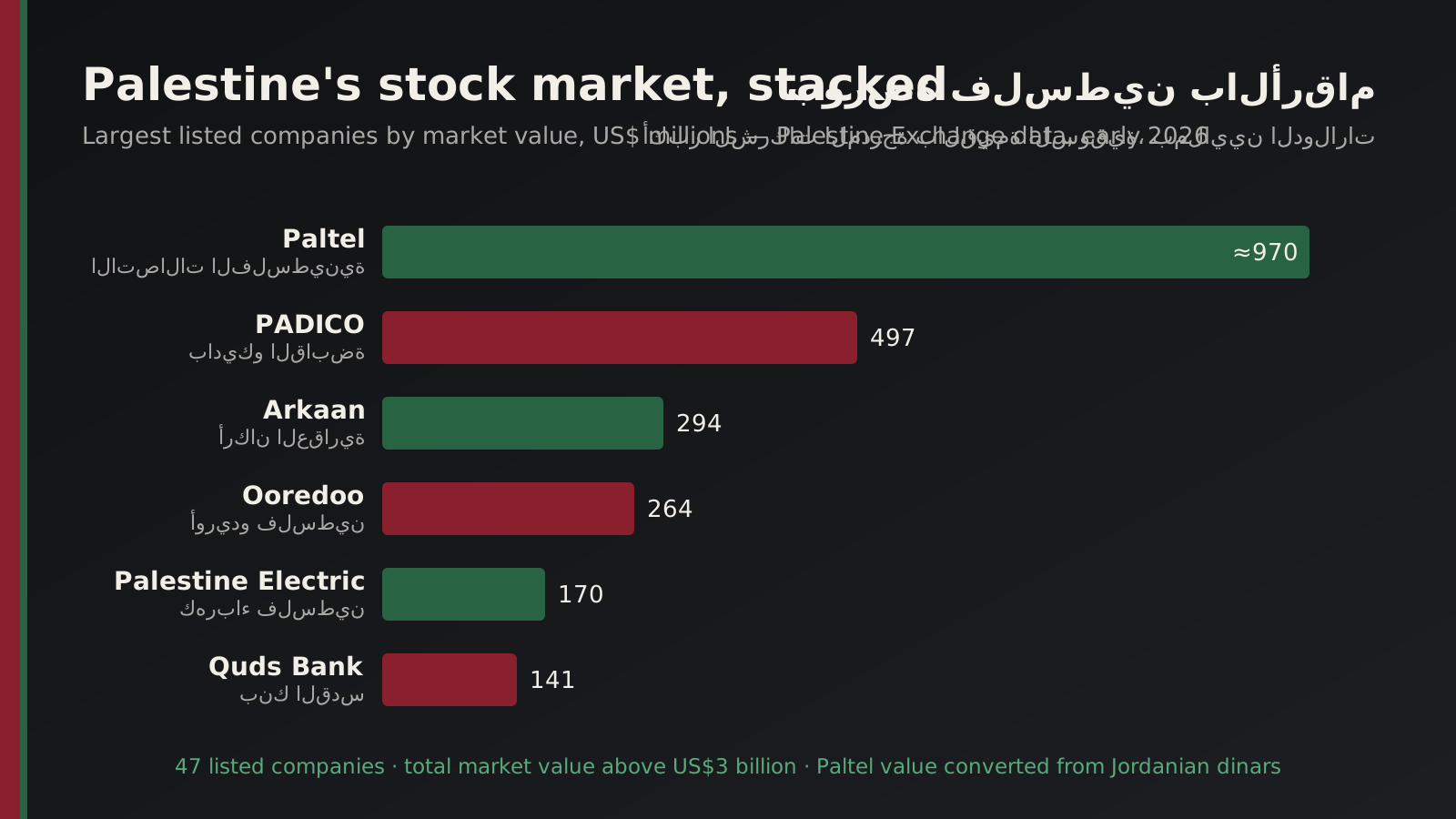
Chief among them is Paltel. As chairman of the Palestine Telecommunications Group, al-Masri heads the country's largest private employer-by-market-weight — the operator whose lines and towers keep Palestinians connected through closures, raids and war, and whose dividend has anchored the Palestinian bourse for two decades.
In Jordan his holdings reach beyond banking: through Zara Investment Holding he chairs the company behind Amman's flagship hotels, part of a portfolio that makes the al-Masri name as familiar in the kingdom's economy as in Nablus, the city the family never left in spirit.
Two economies, one keel#
The roles differ by bank of the river. In Jordan, al-Masri is a guardian of stability — the chairman whose institution underwrites confidence in the dinar's economy. In Palestine, he is a patient builder — the shareholder of first resort for the telecoms, exchanges and investment houses that hold economic life together when politics cannot.
He is the third of Nablus's Masri business names in these pages this week, after the Britain Owes Palestine campaign of Munib al-Masri and the Rawabi of Bashar Masri. Each carries a different project; what they share is the same wager, made across three different arenas — that building institutions is itself a national act. Sabih al-Masri has spent fifty years proving it in two currencies at once.