Economy & Aid
Israel holds every frequency Palestine's two mobile operators need

Graphic: Times of Palestine
Original Reporting
Two companies carry every Palestinian phone call: Paltel's Jawwal and Ooredoo Palestine. Both are Palestinian-licensed, Palestinian-staffed and Palestinian-owned in large part — and neither can switch on a single new frequency without Israel's signature.
That signature clause, written into Oslo and enforced for three decades, is the master fact of Palestinian telecommunications, and this report maps the sector around it: who owns the operators, who benefits from them, and what the Israeli government's control has cost.
The two operators and their owners#
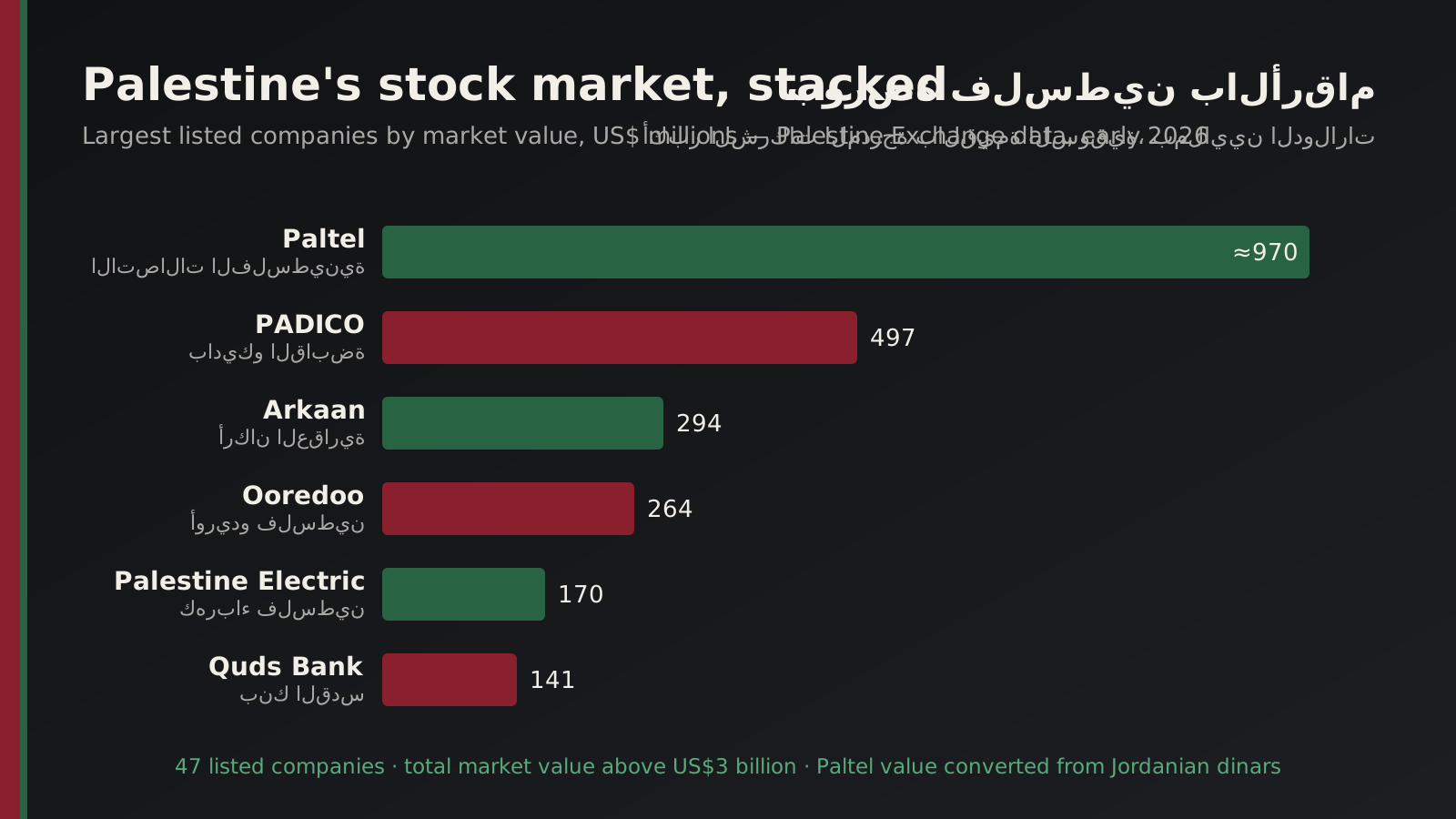
Paltel Group is the incumbent — founded in 1995 under a Palestinian Authority license, listed in Ramallah as the exchange's heavyweight, and chaired by Sabih al-Masri, with the PADICO holding group of the al-Masri orbit as its anchor shareholder.
Its brands are the sector: Jawwal in mobile, with the large majority of Palestinian subscribers in the West Bank and Gaza; Paltel in fixed lines; Hadara in internet. Its dividends flow to thousands of Palestine Exchange shareholders, and its payroll makes it one of the largest private employers in the country.
Ooredoo Palestine is the challenger that broke the monopoly. Launched as Wataniya Mobile in the West Bank in 2009 and in Gaza only in 2018, its register reads: 48.45 percent Ooredoo Group of Qatar, 34.03 percent the Palestine Investment Fund, and about 17.5 percent free float.
The PIF stake matters to the question of who benefits: the Palestinian public's own sovereign fund owns a third of the second operator, so the duopoly's profits flow partly back to the fund that finances national projects — alongside Doha's telecom group and the Ramallah bourse's investors.
The frequency clause#
The dependence is written down. Under Article 36 of Annex III of the Oslo II accord, the radio spectrum over the West Bank and Gaza is controlled by Israel, which committed to allocate frequencies to Palestinian operators upon request — within a month, the text says.
In practice, every generation of Palestinian mobile service has waited years for that signature: the operators ran on 2G while the world moved to 4G, and Israel released 3G frequencies for the West Bank only in January 2018, keeping Gaza on 2G.
The costs have been audited. The World Bank put Palestinian operators' losses from the delayed 3G alone in the hundreds of millions of dollars, and the sector's losses from restrictions at more than a billion dollars over three years.
The same restrictions built Israel's carriers a captive market: settlement-tower coverage spills across the West Bank, and studies place the Israeli operators' unauthorized share of the Palestinian market at 20 to 40 percent — customers, and tax revenues, taken without a Palestinian license.
An early World Bank estimate priced that leakage at $60 million a year in lost Authority revenue alone.
Ownership on the Palestinian side; the frequency gate on the Israeli side. Graphic: Times of Palestine.
The 4G promise and the war#
At the end of 2023 the Authority and Israel agreed that Palestinians would finally get 4G, and Israeli approval for the West Bank upgrade was later reported with rollout expected within months — a generation-late concession, arriving as the rest of the region tests 6G. Every antenna, router and imported handset still clears Israeli permits on its way in; the frequency gate has a customs gate behind it.
Gaza tells the harshest version. The war has devastated the strip's telecommunications infrastructure, the Palestinian Economic Policy Research Institute documented — exchanges destroyed, fibre cut, towers downed — and the blackouts that follow each outage sever ambulances from hospitals and families from each other. Jawwal and Ooredoo crews have repaired lines under fire throughout; their generators, fuel convoys and patched fibre are the war's least-sung infrastructure story.
The sector's balance sheet is therefore double-entried. On the Palestinian side: two real companies, anchored by the al-Masri group's PADICO, Qatar's Ooredoo and the public's own investment fund, employing thousands and paying the bourse's steadiest dividends.
On the Israeli side: a signature that has arrived, each generation, roughly a decade late — and a market share taken through towers no Palestinian regulator ever licensed. Until the frequency clause works as written, Palestinian telecom independence remains what it has been since Oslo: technically ready, and politically on hold.